Product Core Brief
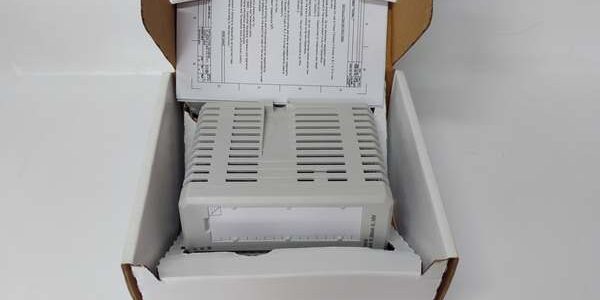
- Model: AI810, OEM Article Code 3BSE008516R1
- Brand: ABB
- Series: S800 Distributed I/O System for AC800M / Freelance DCS
- Core Function: Collects 8 unipolar analog field signals from pressure, flow and level transmitters, converts analog readings to digital backplane data for process controllersABB.
- Product Type: Rack slide-in analog input I/O module
- Key Specs: 8 single-ended channels | 12-bit A/D resolution | Group ground isolation + PTC short-circuit protectionNote: Active OEM spare, new original surplus stock available; supports HART signal pass-through without built-in HART modemABB.
Key Technical Specifications
- Operating supply: 24 V DC ±10 %, max power draw 2.8 W
- Supported unipolar signal ranges: 4–20 mA, 0–20 mA, 2–10 V, 0–10 V DCABB
- A/D resolution: 12-bit unsigned conversion
- Full 8-channel scan cycle: 8 ms total refresh rate
- Input impedance: 290 kΩ (voltage); 250 Ω shunt (current, integrated PTC fuse)ABB
- Measurement accuracy: Max 0.1% full scale at 25 °C ambient
- Galvanic isolation: Single group (all 8 channels) isolated from backplane logic
- Overvoltage withstand: 30 V DC continuous short-circuit protection via self-resetting PTC resistorsABB
- Input filter rise time: 140 ms fixed analog filter to suppress high-frequency switching noise
- Diagnostic functions: Wire-break detection for current loop transmitters, over-range / under-range flagging
- PCB coating: G3 industrial conformal coating per ISA-S71.04 for mild corrosive cabinet environmentsABB
- Status indicators: Individual LED per channel, global POWER and BUS COMM fault lamps
- Mechanical form: S800 standard slide-in card, hot-swap certified per IEC 61131-2
- Operating ambient: 0 °C to +55 °C; compact MTU rack limited to 0–40 °C continuous dutyABB
- Storage range: -40 °C to +70 °C, non-condensing 5–95 % relative humidity
- Dimensions: 254 mm L × 58 mm W × 27 mm D
- Net weight: 0.41 kg
Product Introduction
This I/O card is a standard single-group analog acquisition component built exclusively for S800 I/O racks paired with AC800M and Freelance DCS controllers. It interfaces with standard 2-wire industrial transmitters for continuous process variable monitoring.Group isolation eliminates common-mode voltage drift from nearby medium voltage drives, holding steady-state measurement deviation below 0.1% full scale during large motor load transients. Integrated PTC fuses remove need for external field-side fuse terminals to protect against wiring shorts.
QA & Testing SOP (Transparency Building)
- Incoming Inspection: Cross-reference serial numbers and 3BSE part code against ABB S800 spare part databases. Inspect conformal coating for cracking, terminal block spring tension and full 8-channel LED functionality. Reject units with torn factory anti-static packaging to filter counterfeit inventory.
- Live Testing: Seat the module in an S800 MTU test rack paired with an AC800M PM865 controller simulator. Run continuous 24-hour cyclic scan testing across all channels while logging stable 24VDC supply with a Fluke 115 multimeter. Simulate open-loop transmitter wiring and +30V accidental overvoltage to validate PTC current limiting and wire-break alarm timing.
- Electrical Testing: Use a 500V Megger to measure insulation resistance between field channel group and backplane logic; pass threshold set at ≥10 MΩ. Inject 50Hz differential ground-loop noise to confirm no false wire-break fault triggers.
- Firmware/Config Backup: Record factory default signal range preset values via Control Builder M engineering software. Capture high-resolution photos of terminal pin labels for field commissioning reference.
- Final QC & Packaging: Fit plastic dust caps over the front terminal header. Place the card inside foam-lined anti-static shielding bag, affix a dated QC pass label before sealing in original factory carton.
Installation Pitfalls & Guide (Engineer to Engineer)
❗Firmware Rev Mismatch Risk: AC800M controller firmware older than v5.1.1 lacks register mapping for wire-break diagnostic flag logic. Post-replacement, the DCS will ignore broken transmitter loop signals and throw intermittent AI COMM LOSS alarms. Remediation: Flash matching firmware revision to the main controller before rack insertion.❗Hot-Swap Misuse Warning: While rated hot-swap, removing the unit during active heavy motor load transients can create backplane voltage spikes that corrupt adjacent I/O scan data. Always pause fieldbus communication before card exchange for high EMI cabinet environments.❗Wiring Incompatibilities: Unshielded field wiring introduces mains interference into current inputs, creating ±0.3% full scale reading drift. Use OEM shielded twisted pair cable with single-point chassis ground at the rack terminal bar, follow 0.8 N·m torque specs for terminal screws.❗Backplane Power Draw Changes: A degraded rack 24VDC supply with less than 20% current headroom cannot support the unit plus multiple AO810 analog output cards during controller cold startup, triggering repeated backplane resets and total analog data loss. Recalculate total rack load before swapping the card.❗ESD Dangers: Ungrounded handling exposes analog A/D traces to static discharge from dry control room air. Field records show unprotected handling burns input signal circuits; full boiler/turbine unit downtime labor cost exceeds $1,520. Remediation: Place anti-static mat under the rack, wear grounded wrist strap, touch bare rack chassis ground for 3 seconds before handling the PCB.
4-step replacement guide
- Pre-install: Lock out and tag rack 24VDC auxiliary power for low-EMI sites; pause Profibus fieldbus communication if performing live hot-swap. Photograph terminal wiring layout and existing channel range assignments from the old unit.
- Removal: Release the rack slide latch, pull the old card free and disconnect terminal wiring one channel at a time to avoid cross-channel miswiring.
- Install: Transfer wiring harness to the new unit’s terminal header, slide the card fully into the MTU rack slot and lock the slide latch.
- Power-on Test: Restore 24VDC auxiliary power first; verify all channel LEDs activate correctly, connect a precision mA signal calibrator to confirm accurate process readings before resuming full DCS fieldbus communication.
FAQ (Frequently Asked Questions)
Q: Can this module be hot-swapped while the rack remains powered?A: Yes, the hardware carries official ABB hot-swap certification for standard low-EMI control rooms. For cabinets housing medium voltage drives or high-frequency VFDs, lock out auxiliary power first to avoid backplane data corruption from voltage transients.Q: Does this card carry original OEM factory warranty when purchased as new surplus?A: ABB factory warranty coverage follows component lifecycle timelines. All surplus inventory passes full in-house QA testing and carries a 12-month internal stock replacement warranty, limited to manufacturing defects detected during bench validation.Q: Can AI620 serve as a direct drop-in replacement for the module?A: Mechanical rack fit only. AI620 is a 16-channel mixed RTD/current input board with different backplane register mapping and no built-in PTC short-circuit protection. Swapping without reworking field wiring and DCS tag logic will halve available analog input capacity.Q: What minimum controller firmware version enables full wire-break diagnostic support?A: AC800M controller firmware v5.1.1 or newer. Older builds lack register addresses for open-loop current detection, only returning raw unflagged analog values with no broken transmitter alarms.Q: Will the unit retain channel signal range settings after power loss?A: No configuration data stores on-board. All channel mA/V range parameters reside in the controller’s non-volatile memory. No re-calibration of the device itself is needed post-swap.Q: Is the unit compatible with Symphony Plus SD Series DCS racks?A: No. The module uses the proprietary Profibus backplane bus, which is electrically incompatible with Symphony HN800 I/O rack architecture and cannot be cross-mounted.Q: What is the maximum allowable field wiring distance for 4–20mA transmitters?A: Up to 600 meters when using fully shielded twisted pair control cable with proper single-point chassis grounding at the I/O rack side only. Longer runs introduce measurable signal attenuation and noise drift.