Product Core Brief
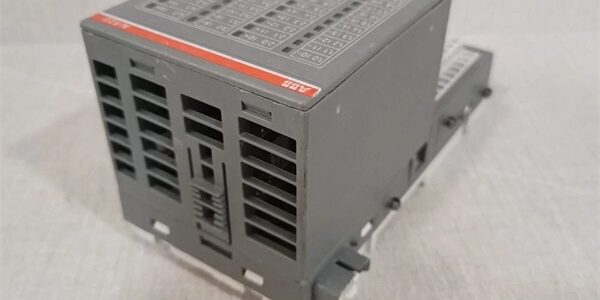
- Model: AI523, Order Code 1SAP250300R0001
- Brand: ABB
- Series: S500 I/O expansion for AC500 PLC family
- Core Function: Captures 16 software-configurable analog field signals (voltage, current, RTD, digital input) and transmits processed data to AC500 CPU via internal I/O bus.
- Product Type: DIN rail mounted analog input expansion module
- Key Specs: 16 independent channels | 12-bit + sign resolution | Module-wide galvanic isolationNote: Active production OEM spare, new original surplus inventory readily available; no native HART support.
Key Technical Specifications
- Process supply voltage: 24 V DC ±10 %, max power draw 110 mA
- Channel grouping: Two isolated groups (Channels 0–7, Channels 8–15)
- Software-selectable signal types per channel:Voltage: 0–10 V, -10–+10 V | Current: 0–20 mA, 4–20 mA | RTD: Pt100/Pt1000/Ni1000 (2/3-wire) | Digital dry contact DI
- A/D resolution: 12-bit with sign bit for bipolar voltage ranges
- Scan cycle speed: 2 ms full refresh for voltage/current channels; 1 s full refresh for RTD channels
- Measurement accuracy: Typical ±0.5 % full scale at 25 °C; maximum ±1 % full scale 0–60 °C
- Galvanic isolation: Full module isolation between field circuits and PLC internal logic
- Input filter time constant: 100 µs for voltage and current signals
- Overvoltage protection: Survives up to 35 V accidental miswiring without permanent channel damage
- Status indicators: 16 yellow channel LEDs, green power OK LED, two red fault diagnostic LEDs
- Mechanical mounting: Standard 35 mm DIN rail snap-in mount, no hot-swap capability
- Operating ambient: 0 °C to +60 °C rated; storage range -40 °C to +85 °C, non-condensing 5–95 % RH
- Physical dimensions: 120 mm H × 75 mm W × 110 mm D
- Net weight: 0.125 kg
Product Introduction
This I/O expansion card is a multi-purpose signal acquisition unit built exclusively for ABB AC500 PLC systems, usable as local CPU rack expansion or remote bus I/O over CS31 / FBP fieldbus. It consolidates voltage, current and temperature sensor inputs into a single compact DIN rail module to reduce cabinet rack space usage.Module-wide galvanic isolation blocks common-mode noise from nearby variable frequency drives, holding steady-state measurement error below 0.5% full scale during large motor load transients. Software-only channel configuration eliminates physical jumper rework for mixed signal plant layouts.
QA & Testing SOP (Transparency Building)
- Incoming Inspection: Cross-reference serial and order codes against ABB S500 I/O spare databases. Inspect terminal block spring tension, all channel LED functionality and intact factory anti-static packaging to filter counterfeit stock.
- Live Testing: Mount the device on DIN rail inside an AC500 test rack paired with PM591 CPU simulator. Run a continuous 24-hour cyclic scan test across all 16 channels while logging stable 24VDC supply via Fluke 115 multimeter. Simulate open-circuit RTD and 4–20mA wiring faults to validate diagnostic flag timing.
- Electrical Testing: Use a 500V Megger to measure insulation resistance between field channel groups and PLC backplane logic; pass threshold set at ≥10 MΩ. Inject 50Hz differential ground-loop noise to confirm no false wire-break fault triggers.
- Firmware/Config Backup: Record factory default channel range preset values via Automation Builder engineering software. Capture high-resolution photos of terminal pin labeling for field commissioning reference.
- Final QC & Packaging: Fit plastic dust caps over front terminal headers. Place the module inside foam-lined anti-static shielding bag, affix a dated QC pass label before sealing in original factory carton.
Installation Pitfalls & Guide (Engineer to Engineer)
❗Firmware Rev Mismatch Risk: AC500 CPU firmware older than v2.3.0 lacks register mapping for multi-type RTD lead compensation logic. Post-replacement, the PLC will return skewed temperature readings and intermittent I/O BUS FAULT alarms. Remediation: Flash matching firmware revision to the main CPU before DIN rail mounting.❗Channel Allocation Wiring Errors: 3-wire RTD sensors consume two adjacent module channels. Unaccounted channel consumption leads to missing process values in the PLC tag table. Always document sensor wiring layout before removing the old unit.❗Wiring Incompatibilities: Unshielded field wiring introduces mains interference into low-level RTD and bipolar voltage inputs, creating ±0.3% full scale reading drift. Use OEM shielded twisted pair cable with single-point chassis ground at the PLC cabinet terminal bar, follow 0.6 N·m torque specs for terminal screws.❗Backplane Power Draw Changes: A degraded rack 24VDC supply with less than 20% current headroom cannot support the unit plus multiple digital expansion modules during PLC cold startup, triggering repeated I/O bus resets and total analog data loss. Recalculate total rack load before swapping the module.❗ESD Dangers: Ungrounded handling exposes A/D analog traces to static discharge from dry workshop air. Field records show unprotected handling burns input signal circuits; full production line downtime labor cost exceeds $1,380. Remediation: Place anti-static mat under the PLC cabinet, wear grounded wrist strap, touch bare DIN rail chassis ground for 3 seconds before handling the module.
4-step replacement guide
- Pre-install: Lock out and tag all rack 24VDC auxiliary power. Photograph terminal wiring layout and existing channel configuration tag assignments from the old unit.
- Removal: Depress DIN rail latch, slide the old module upward off the rail and disconnect terminal wiring one channel at a time to avoid cross-channel miswiring.
- Install: Transfer wiring harness to the new unit’s terminal header, snap the module fully onto the DIN rail and lock the mounting latch.
- Power-on Test: Restore 24VDC auxiliary power first; verify all channel LEDs activate correctly, connect precision signal simulator to confirm accurate analog readings before downloading full PLC project logic.
FAQ (Frequently Asked Questions)
Q: Can this unit be hot-swapped while the PLC rack remains powered?A: No. It shares a high-speed internal I/O bus with critical control expansion hardware. Removing it live creates voltage transients that corrupt PLC process image tables and can permanently damage adjacent S500 I/O modules. Full lockout of rack auxiliary power is mandatory for replacement.Q: Does this module carry original OEM factory warranty when purchased as new surplus?A: Factory warranty terms follow ABB standard lifecycle coverage for active parts. All surplus inventory passes full in-house QA testing and carries a 12-month internal stock replacement warranty, limited to manufacturing defects detected during bench validation.Q: Can AI531 serve as a direct drop-in replacement for the module?A: DIN rail mechanical fit only. AI531 is an 8-channel high-resolution thermocouple/RTD board with half the channel count and different bus register mapping. Swapping without reworking field sensor wiring and PLC tag logic will cut available analog input capacity in half.Q: What minimum CPU firmware version enables full 3-wire RTD lead compensation support?A: CPU firmware v2.3.0 or newer. Older builds lack register addresses for dual-channel RTD lead resistance correction, only supporting uncompensated 2-wire temperature measurements with large offset error.Q: Will the unit retain channel signal type and range settings after power loss?A: No configuration data stores on-board. All channel range, RTD wiring mode and filter parameters reside in the CPU’s non-volatile memory. No re-calibration of the device itself is needed post-swap.Q: Is the unit compatible with Symphony Plus SD Series DCS racks?A: No. The module uses the proprietary S500 internal I/O bus, which is electrically incompatible with Symphony HN800 backplane architecture and cannot be cross-mounted in DCS racks.Q: What environmental constraints apply to long-term cabinet installation?A: Continuous operation above +60 °C ambient triggers linear measurement drift and shortens internal component service life. Annual visual inspection of terminal block contact tension is recommended for cabinets with heavy vibration from nearby production machinery.