Product Core Brief
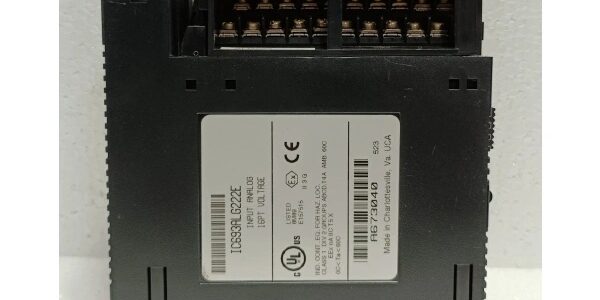
- Model:
- Brand: GE Fanuc / GE
- Series: Series 90-30 PLC
- Core Function: High-density analog voltage input module for voltage signal acquisition; supports 16 single-ended or 8 differential channels to convert analog voltage signals into digital %AI register values for the PLC CPU.
- Product Type: 16-Channel Analog Voltage Input Module
- Key Specs: 12-bit resolution | 0–10V / ±10V configurable per channel | Single-ended / differential topology Note: Discontinued legacy hardware; factory new stock exhausted, surplus and refurbished units widely traded. The -E suffix denotes specific PCB hardware revision. Hot swapping is not supported for Series 90-30 backplanes. Voltage-only module (no 4–20mA current input).
Key Technical Specifications
- Channel Configuration: 16 single-ended inputs OR 8 differential inputs (software selected)
- Supported Voltage Ranges (per-channel configuration): Unipolar: 0 ~ +10 VDC Bipolar: −10 ~ +10 VDC
- Resolution: 0–10V: 2.5 mV per count ±10V: 5 mV per count
- Absolute Accuracy: ±0.25% full scale at 25°C
- Module Update Time: 6 ms (16 single-ended channels); 3 ms (8 differential channels)
- Input Impedance: >500 kΩ (single-ended); >1 MΩ (differential)
- Isolation Rating: 1500 VAC 1-minute withstand between field circuits and PLC backplane
- Backplane Power Draw: 112 mA @5 VDC; 41 mA from isolated +24 VDC
- Status LEDs: MODULE OK, POWER SUPPLY OK
- Operating Temperature: 0°C ~ +60°C horizontal cabinet mounting
- Storage Temperature: -40°C ~ +85°C
- Form Factor: Single-width Series 90-30 rack slot
- Compatible Chassis: IC693CHS391, IC693CHS392, IC693CHS397, IC693CHS398
- Supported Programming Software: Logicmaster 90, Proficy Machine Edition
- Module Quantity Limits: Dependent on CPU model; higher-end CPUs support larger quantity of analog modules
Product Introduction
This unit is a high-density voltage input module for Series 90-30 control systems. It acquires analog voltage signals from positioners, transducers and analog instruments. Users select wiring topology (single-ended or differential) and signal range via programming software.
Differential wiring provides superior noise rejection for long cable runs in electrically noisy industrial environments. All converted data is transferred to the CPU over the backplane. Widely deployed on machine and process retrofit projects that use voltage-type analog transmitters.
Important: This module only accepts voltage signals. For 4–20mA current loops, use IC693ALG223 series.
QA & Testing SOP (Transparency Building)
- Incoming Inspection: Verify part marking and -E revision suffix. Inspect backplane edge pins for bending or corrosion; check terminal block housing for cracks.
- Live Testing: Mount into validated Series 90-30 rack, apply nominal rack power. Inject precision voltage signals to each channel, verify conversion accuracy and run continuous 24-hour signal acquisition testing.
- Electrical Testing: Use Fluke 115 to monitor backplane 5VDC rail stability. Insulation resistance testing must exceed 10MΩ between field terminals and chassis protective ground.
- Firmware/Config Backup: Record module hardware revision. Photograph terminal wiring layout before disassembly.
- Final QC & Packaging: Place unit inside anti-static shielding. Attach dated QC test tag confirming channel accuracy validation prior to shipment.
Installation Pitfalls & Guide (Engineer to Engineer)
❗ No Hot Swap Support: Series 90-30 backplanes lack hot-swap bus logic. Live removal disrupts rack communications and risks permanent backplane trace damage. Full rack power shutdown mandatory. ❗ Voltage / Current Module Mix-Up: Cannot directly substitute with IC693ALG223 (16-channel current input). This module does not support passive 4–20mA transmitters without external precision resistors. ❗ Topology Configuration: Select single-ended or differential mode in software to match physical wiring; mismatched topology leads to noisy or incorrect readings. ❗ Differential Wiring Noise Control: Route analog wiring separately from high-power AC/DC cables to reduce induced interference. ❗ ESD Dangers: Un-grounded handling damages input receiver circuits. Static faults frequently manifest as unstable analog readings after commissioning. ❗ Revision Awareness: IC693ALG222 and are mechanically interchangeable; always execute full channel calibration after cross-revision replacement.
Replacement Guide:
- Pre-install: Activate lockout-tagout on rack power; back up hardware configuration and photograph all analog field wiring connections.
- Removal: Disconnect terminal block wiring, unlatch module and slide straight out without twisting backplane connectors.
- Install: Seat new unit fully into vacant slot, lock latches, re-establish all field wiring connections.
- Power-on Test: Restore rack power, confirm MODULE OK LED illuminates; download saved configuration, verify all analog channel readings and check for noise anomalies.
FAQ (Frequently Asked Questions)
Q: Does this module support hot swapping? A: No. Series 90-30 architecture does not implement hot-swap functionality. Complete rack power shutdown is required before removing or installing the unit.
Q: What is the difference between IC693ALG222 and ? A: Base catalog number defines identical core voltage input functionality. The -E suffix represents a specific PCB hardware revision. Mechanically plug-compatible, always perform full channel validation after cross-revision replacement.
Q: Can this module accept 4–20mA current transmitters directly? A: No. It is voltage-input only. To read 4–20mA signals, install precision load resistors or use IC693ALG223 current input module.
Q: Can this module be installed inside PACSystem RX3i racks? A: No. Form factor and backplane signaling are exclusive to Series 90-30 chassis. It cannot operate within RX3i systems.
Q: Can channels mix single-ended and differential wiring on the same module? A: No. The entire module operates in either all single-ended or all differential mode. Mixed wiring will produce invalid measurements.
Q: Will saved configuration load directly onto a replacement module? A: I/O configuration imports without modification. After replacement, verify channel range settings and perform full-scale signal calibration for all analog inputs.
Q: What is the difference between IC693ALG222 and IC693ALG223? A: IC693ALG222 = voltage input (0–10V / ±10V). IC693ALG223 = current input (4–20mA / 0–20mA). They are not interchangeable without field transmitter modification.