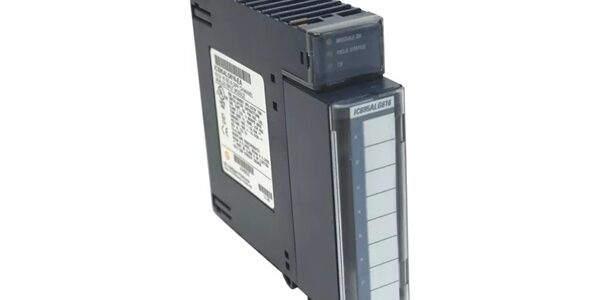
Product Core Brief
- Model:
- Brand: GE
- Series: PACSystem RX3i
- Core Function: Acquires analog voltage and current signals; configurable for 16 single-ended or 8 differential input channels.
- Product Type: Non-Isolated Analog Input Module
- Key Specs: 24-bit ADC | Software-selectable signal ranges | Configurable low-pass filtering Note: Active hardware series; -EA suffix denotes specific factory hardware revision. New original and tested surplus units circulate in global supply chains. Backplane-powered, no external field power required.
Key Technical Specifications
- Channel Modes: 16 single-ended inputs or 8 differential input pairs
- Supported Signal Ranges Voltage: ±10V, 0–10V, ±5V, 0–5V, 1–5V Current: 0–20mA, 4–20mA, ±20mA
- ADC Resolution: 24-bit
- Input Impedance: >1 MΩ (voltage); 100 Ω (current)
- Accuracy: ±0.1% full scale at 25°C
- Configurable Filter Cutoff: 8 Hz, 12 Hz, 16 Hz, 40 Hz, 200 Hz, 500 Hz
- Backplane Power Draw: 450 mA @3.3 VDC, 95 mA @5 VDC
- Operating Temperature: 0°C to 60°C horizontal cabinet mounting
- Storage Temperature: -40°C to 85°C
- Supported Terminal Blocks: IC694TBB032, IC694TBS032, extended shroud variants
- Hot Swap Support: Yes, dependent on minimum CPU firmware revision
- Diagnostics: Open-circuit detection, high/low process alarm reporting
Product Introduction
This unit performs high-resolution analog signal acquisition for continuous process monitoring. Engineers select single-ended wiring for dense transmitter layouts or differential wiring to suppress common-mode electrical noise.
All channel configuration is completed within Proficy Machine Edition; no hardware jumpers are needed. Built-in digital filtering reduces signal jitter from variable frequency drives and heavy industrial machinery.
QA & Testing SOP (Transparency Building)
- Incoming Inspection: Verify part marking and revision suffix. Inspect edge connector pins for bending or corrosion; validate housing for cracks or physical deformation.
- Live Testing: Install into a validated RX3i rack, apply backplane power. Inject calibrated voltage and current signals to all channels, run continuous 24-hour acquisition cycling.
- Electrical Testing: Use Fluke 115 to monitor backplane rail stability. Insulation resistance testing must exceed 10MΩ between signal terminals and chassis ground.
- Firmware/Config Backup: Log module firmware revision. Capture photos of terminal wiring layout before disassembly.
- Final QC & Packaging: Seal unit inside anti-static shielding. Attach dated QC test tag including channel calibration results before shipment.
Installation Pitfalls & Guide (Engineer to Engineer)
❗ Wiring Mode Mix-Up: Never mix single-ended and differential wiring on the same module. Miswiring causes erratic readings and persistent channel diagnostic faults. Document wiring topology before power-up. ❗ Firmware Minimum Threshold: Hot swap functionality fails if host CPU runs firmware older than v3.0. Attempting module removal triggers rack-wide I/O dropouts. ❗ Noise Without Filter Tuning: Default filter settings may not suppress VFD interference. Adjust cutoff frequency in software for field sites with high electromagnetic noise. ❗ ESD Dangers: Un-grounded handling can degrade ADC performance. Static damage often creates slow channel drift that only appears after weeks of runtime. ❗ Terminal Block Compatibility: Extended shielded wiring requires longer shroud terminal blocks. Standard blocks cannot accommodate large shield cable glands.
Replacement Guide:
- Pre-install: Back up hardware configuration, photograph field wiring, confirm CPU firmware supports hot swap.
- Removal: If hot swap qualified, unlatch and extract module; if unsupported, execute lockout-tagout on rack power.
- Install: Seat new unit fully into backplane, lock latches, reattach terminal block and replicate all wiring connections.
- Power-on Test: Restore power, download saved configuration, run full-scale signal injection test and clear all diagnostic alarms.
FAQ (Frequently Asked Questions)
Q: Does this unit support hot swapping? A: Yes, hot swap works when the RX3i CPU runs firmware revision 3.0 or newer. Older firmware cannot reinitialize the bus and will register module missing faults.
Q: What is the differencend ? A: The base catalog number defines core hardware. The -EA suffix indicates a specific factory revision with minor PCB component updates. Always match suffix revision when performing direct drop-in replacement.
Q: Does this module include channel-to-channel galvanic isolation? A: No. This is a non-isolated module. Ground loops between multiple transmitters will create measurement offset; use isolated analog modules if ground potential differences exist.
Q: Can this hardware read HART transmitters? A: No. There is no onboard HART modem. Select IC695ALG626 if bidirectional HART communications with field instruments are required.
Q: What software version is required for configuration? A: Proficy Machine Edition v5.0 SP3 or later. Older software builds lack parameter menus for filter selection and alarm thresholds.
Q: Will saved hardware configuration transfer directly to a replacement unit? A: Configuration imports without modification. Always perform a full calibration check after replacement to confirm consistent measurement accuracy.
Q: Can the module operate in remote expansion racks? A: No. This module is only supported inside the local main RX3i rack; remote expansion baseplates do not support this analog I/O hardware.