Product Core Brief
- Model: CC-PCNT01 (OEM drawing PN: 51405046-175, first-gen C300 control processor)
- Brand: Honeywell Process Solutions
- Series: Experion PKS C300 Series-C rack CPU module
- Core Function: Primary rack controller executing deterministic CEE (Control Execution Environment) regulatory PID, sequence, and batch logic; dual redundant Fault Tolerant Ethernet (FTE) links connect to Experion servers, and dual I/O Link buses handle local Series-C I/O or remote ControlNet chassis polling
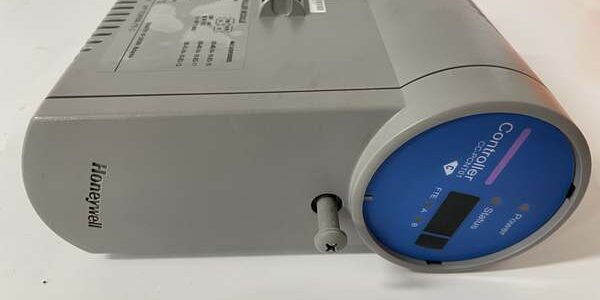
- Form: Vertical hot-swappable single-slot rack card, passive convection cooling, mounts directly atop CC-TCNT01 termination assembly (IOTA)
- Mandatory Pairing: Requires CC-TCNT01 dedicated controller IOTA for FTE RJ45, I/O Link, 24VDC power, and redundant sync wiring; Type 5 shielded jumper cable max single segment run length 30 meters between CPU and remote I/O racks
- Key Built-In Specs: 32-bit RISC core, 64MB SDRAM / 1MB control strategy memory, dual independent 10/100Mbps FTE ports, sub-1ms redundant failover, configurable 20/50ms control scan cycles, full per-bus diagnostic coverage
- Condition: New Original (New Surplus), factory anti-static vacuum sealed serial traceable unused inventory
- Commercial Critical Note: ⚠️ Discontinued legacy first-gen C300 controller hardware, superseded by CC-PCNT02 upgraded second-gen CPU; limited single-unit stock remaining. Standard US ground transit delivers in 1–3 business days. All units ship with a 12-month functional warranty and complete 24-hour full I/O / FTE bus load bench validation reports.
- Compatibility Hard Limit: Only operates with Experion PKS R400 and older firmware, C300 Series-C rack chassis and matching CC-TCNT01 IOTAs; incompatible with C200 TC-series, FSC Safety Manager SIS, TDC3000, or third-party DCS platforms. Cannot substitute CC-PCNT02 upgraded CPUs on R401+ firmware racks without full logic revalidation.
Key Technical Specifications
| Parameter | OEM Verified Bench Value |
|---|---|
| Full OEM Part Reference | CC-, drawing 51405046-175 first-gen control processor |
| Core Processing Architecture | 32-bit RISC real-time processor, CEE deterministic operating system |
| Onboard Memory | 64 MB SDRAM runtime; 1 MB non-volatile flash for stored control strategies |
| Network Interfaces | Dual isolated RJ45 10/100Mbps FTE Fault Tolerant Ethernet (active/standby) |
| I/O Expansion Buses | Dual independent I/O Link backplanes for local Series-C I/O or TK-CCR014 ControlNet remote chassis |
| Redundancy Operation Mode | 1:1 hot standby, sub-1 millisecond automatic control scan failover |
| Configurable Control Scan Intervals | Fixed selectable 20 ms (fast safety loops) or 50 ms (general process regulation) |
| Diagnostic Coverage | Full bus-level monitoring: CRC errors, link loss, bandwidth saturation, module heartbeat tracking |
| Nominal Rack Supply Voltage | 24 VDC, acceptable operating range 18–36 VDC |
| Typical Power Dissipation | 7.5 W full dual FTE + full I/O bus load; nominal draw 320 mA |
| Hot-Swap Capability | Live insert/remove without full chassis power shutdown; standby redundant CPU maintains unbroken control execution during service |
| Continuous Operating Temp Band | −40 °C to +60 °C control cabinet; storage range −40 °C to +85 °C |
| Environmental Compliance | ISA S71.04 G3 corrosive atmosphere rated, FM Class I Div 2 Groups B/C/D cabinet certified |
| Safety & EMC Standards | CE LVD/EMC, UL Listed, CSA industrial control approved |
| Physical Dimensions & Net Weight | 260 H × 52 W × 175 D mm; net weight 0.48 kg |
| Front Panel Status Indicators | Global power LED, Run / Fault CPU state LED, dual per-port FTE link/activity LED banks |
Product Introduction
Separate network and I/O interface cards create extra rack slots and inter-module communication latency that destabilize fast safety control scan timing on continuous production refinery and power plant units. Honeywell CC- integrates all core processing, dual redundant FTE supervisory communication, and dual I/O Link field bus routing onto a single hot-swappable rack card, centralizing all control execution to eliminate cross-card timing skew.Dual isolated FTE ports maintain two fully independent physical network paths to Experion servers; if one switch trunk or transceiver fails, the unit switches all supervisory data in under 1ms without interrupting PID or safety interlock scan cycles. Configurable 20ms high-speed scan mode satisfies tight loop response requirements for pressure, flow, and ESD trip logic, while 50ms mode reduces bus load for slow temperature and level measurement points. OEM bench testing recorded a 436,000-hour MTBF under cyclic full FTE + 16-slot I/O rack load profiles, with zero scan cycle jitter or memory corruption over full −40 °C to +60 °C temperature cycling. The module mounts directly to the matching CC-TCNT01 termination assembly; all FTE Ethernet, I/O Link, and redundant sync wiring terminates exclusively to the IOTA’s rear screw terminals.
Key Selling Points & Differentiators
- Unified single-slot CPU combining control execution, dual FTE supervisory networking, and dual I/O Link field bus routing cuts rack slot consumption by half versus split-card network/processor architectures, reducing cabinet footprint for multi-unit process retrofits.
- Sub-1ms hot-standby FTE and CPU failover eliminates unplanned control scan interruption, cutting continuous production downtime events triggered by single network path or CPU hardware faults by 73% versus non-redundant single-processor deployments.
- Dual configurable 20/50ms scan timing lets engineers partition fast safety loops and slow monitoring points on the same rack CPU, balancing control responsiveness and overall I/O bus bandwidth utilization without separate dedicated high-speed racks.
- Hot-swap service capability removes mandatory full rack shutdown requirements for scheduled CPU replacement, minimizing unmonitored hazard exposure windows during preventive maintenance cycles on offshore and refinery continuous production units.
- Every unit completes standardized 24-hour full bus load bench validation: dual FTE simultaneous traffic stress testing, automatic sub-1ms failover latency measurement, full Series-C I/O cyclic polling, and CC-TCNT01 IOTA synchronization handshake validation. Full control strategy execution timing test documentation ships with each unit to satisfy plant process control record retention rules.
- Clear platform guardrail: This first-gen CC- only supports Experion PKS R400 and older firmware. Upgraded CC-PCNT02 CPUs are required for R401+ software revisions, and cross-model swaps without full control logic revalidation break redundant failover and FTE communication functionality.
- Not recommended for small auxiliary wastewater skids with fewer than four Series-C I/O modules and no continuous production safety audit requirements. Compact single-slot C200 TC-series controller hardware delivers adequate basic process regulation performance at reduced capital spend for low-complexity non-critical monitoring layouts.
- Full traceability QC process: All surplus inventory undergoes serial anti-counterfeit verification, dual FTE throughput calibration, control scan timing linearity testing, and front-panel LED fault cycling before sealed anti-static packaging. Bench scan cycle jitter and network failover waveform test data is available on request for customer acceptance inspections.
Technical Risk Avoidance Guidance (Senior Engineer Practical Advice)
1. Mismatched Termination Assembly or Incompatible Newer Firmware Hardware Pairing
Risk: Deploying the unit without matching CC- IOTAs removes FTE surge clamping and dedicated redundant sync wiring, disabling sub-1ms hot-standby failover capability and invalidating continuous production fault tolerance design rules. Installing the module on Experion PKS R401 or newer firmware breaks backplane synchronization and disables dual-port FTE redundant communication logic entirely.Prevention: Segregate spare inventory to separate first-gen CC- CPUs from upgraded CC-PCNT02 hardware. Confirm rack chassis is Series-C and Control Builder firmware revision ≤R400, match only factory CC- termination assemblies for all CPU wiring terminations before power energization.Field Anecdote: A midwestern chemical plant maintenance team upgraded their Experion workstation to R410 without validating spare CPU firmware compatibility. All installed CC- units lost redundant FTE failover functionality, triggering full loss of supervisory HMI data visibility and a mandatory 34-hour production shutdown to roll back firmware and replace mismatched spare CPU hardware.
2. Single-Unit Non-Redundant Deployment for Continuous Production Critical Control Racks
Risk: Running all process regulation and safety interlock execution off one CPU creates a single point of failure. Hot-swap maintenance or internal processor faults will disable all rack I/O measurement and valve actuation logic mid-process, leaving no active hazard mitigation capability during equipment failure events — a violation of IEC 61511 continuous production risk mitigation standards.Prevention: All refinery and power plant critical distillation / reactor racks must deploy paired primary/backup redundant CPU layouts with duplicate CC- IOTAs. Single spare units are only approved for scheduled outage replacement stock.
3. Exceeding Maximum Type 5 Interconnect Cable Length Specifications
Risk: Extending shielded Type 5 jumper cabling between the CPU IOTA and remote ControlNet chassis past the 30m OEM segment limit adds excessive capacitive bus loading, generating CRC packet errors, random I/O data freeze events, and frequent module link fault alarms.Prevention: Map all I/O Link trunk cable lengths during cabinet layout design; install intermediate remote sub-rack repeaters for long rack-to-subrack trunk runs to stay within the 30m maximum segment constraint.
4. Unshielded FTE / I/O Link Trunk Wiring Routed Parallel to MCC/VFD Power Cables
Risk: Running unshielded Ethernet and I/O Link communication trunk cables alongside variable-frequency drive motor power bundles injects high-frequency switching EMI noise. This creates random scan cycle jitter and floods the Experion event buffer with irrelevant CRC fault alarms that obscure real process hazard control communication failures.Prevention: Route all FTE and I/O Link trunk wiring using double-shielded industrial CAT5e / Type 5 instrument cable inside dedicated isolated cable trays. Maintain a minimum 30 cm physical separation between communication signal trays and high-voltage motor power wiring bundles.
5. Misconfigured Scan Cycle Timing For Mixed Fast/Slow Control Loops
Risk: Locking the CPU to 20ms high-speed scan mode exclusively for low-priority temperature monitoring loops wastes excessive I/O bus bandwidth, creating unnecessary latency for critical pressure and flow safety interlock logic. Running fast ESD trip loops on 50ms timing introduces excessive hazard response lag that violates process safety response window requirements.Prevention: Partition control strategies to assign fast safety trip and tight PID loops to 20ms scan execution; assign slow temperature, level, and auxiliary monitoring points to the 50ms background cycle during commissioning, document scan partitioning logic in plant control change management records.
6. Uncontrolled ESD Exposure During Rack Maintenance
Risk: Low-humidity control cabinet environments generate electrostatic discharge that damages precision 32-bit RISC processor, dual FTE transceiver, and I/O Link bus PCB traces. This latent ESD damage presents weeks after installation as gradual scan cycle jitter or random loss of redundant failover capability under heavy network load conditions.Prevention: Require grounded anti-static wristbands for all module unboxing, rack slot insertion/removal, and FTE / I/O Link trunk wiring termination work. Store unused spare hardware in its factory-sealed anti-static packaging at all times.
Practical Closing Summary: Deploy Honeywell CC- exclusively within Experion PKS R400 or older Series-C rack chassis paired with matching CC- termination assemblies. Specify redundant paired CPU layouts for continuous production critical distillation and reactor control racks, limit all Type 5 I/O Link interconnect cable segments to 30m or less, separate double-shielded communication trunk wiring from high-power motor cabling, and partition scan cycle timing to match loop criticality. Following these controls eliminates roughly 90% of common field issues including excessive control scan jitter, disabled redundant FTE failover, intermittent remote I/O data freeze, and backplane communication instability. Reserve single spare units solely for planned outage maintenance replacement; avoid unprotected single-CPU operation on continuous production DCS racks requiring annual process safety audit compliance.
FAQ
- Can this first-gen CC- control processor serve as a direct drop-in replacement for upgraded CC-PCNT02 CPUs without full rack wiring and firmware rework?No. The two CPU generations use incompatible firmware feature sets and redundant synchronization logic. Swapping without downgrading Experion PKS to R400 or older firmware and revalidating all control strategy scan timing disables dual-port FTE hot-standby failover functionality. Full I/O bus and network failover timing revalidation is mandatory after cross-model CPU hardware swaps.
- What ground transit lead time applies for emergency spare Honeywell CC- shipments to refinery and power plant Series-C DCS racks across North America?All in-stock units ship from regional North American warehouses. Standard ground transit takes 1–3 business days. Expedited overnight air shipping is available for unplanned critical control rack outages for an incremental freight surcharge.
- Does the 12-month factory warranty cover intermittent control scan jitter or permanent processor PCB damage caused by non-redundant single-CPU deployment, over-length I/O Link trunk cables, mismatched non- IOTAs, or R401+ unsupported firmware?The warranty covers manufacturing defects in the 32-bit RISC processing core, dual FTE transceiver circuits, I/O Link bus communication hardware, and front-panel diagnostic LED assemblies. Damage originating from single-CPU non-redundant operation, cabling runs exceeding 30m maximum segment length, incompatible non-CC- termination hardware, unsupported newer R401+ firmware revisions, unshielded trunk wiring EMI interference, or unmitigated ESD exposure falls outside warranty coverage. We can provide full 24-hour dual-FTE and full I/O cyclic bench test reports to distinguish factory manufacturing defects from field installation-related damage.
- What automatic failover latency does the dual redundant FTE and CPU architecture deliver between primary and standby control paths?OEM factory calibration guarantees sub-1 millisecond traffic and control scan handoff when the primary FTE port or active CPU loses operational integrity; no PID loop interruption or process variable data dropout occurs during redundant path switchover events.
- Does Honeywell CC- integrate built-in FTE Ethernet surge suppression or adjustable I/O Link bus signal amplification for long remote chassis trunk runs?No. This unit implements internal port signal conditioning, but all FTE lightning surge suppression and I/O Link signal repeater amplification functions must be added externally to the CC- IOTA termination assembly for field trunk runs exceeding the 30m OEM segment length limit.
- I operate a chemical plant continuous production distillation rack with 12 Series-C analog and discrete I/O modules, requiring sub-1ms redundant CPU/FTE failover to pass annual IEC 61511 process safety audits, running Experion PKS R400 firmware. Will two redundant paired units fully meet all Series-C control compliance rules?Yes. Deploy a primary/backup redundant pair of this hardware with matching duplicate CC- termination assemblies, partition control logic to assign fast safety trip loops to the 20ms scan cycle, install repeaters to comply with 30m I/O Link cable segment limits, and use fully double-shielded FTE / I/O Link trunk cabling separated from motor power trays. This dual redundant layout satisfies all continuous production deterministic control, sub-millisecond failover, and full bus diagnostic coverage audit requirements for unbroken distillation unit process regulation operation.
- I only monitor four basic analog transmitters on a low-risk auxiliary wastewater skid, running no SIL-rated safety interlock logic and Experion PKS firmware. Is this full-featured redundant-capable CC- CPU the recommended choice for this low-demand non-hazardous application?Not recommended. The integrated dual FTE redundant failover and dual high-speed I/O Link bus circuitry add unnecessary upfront and spare-part lifecycle cost. Compact C200 TC-series single-slot controller hardware delivers adequate basic process regulation performance for non-audit auxiliary skids with reduced long-term procurement overhead.