Product Core Brief
- Model: T8310
- Brand: ICS Triplex (Rockwell Automation)
- Series: Trusted TMR Safety Control Series ⚠️ EOL — limited new surplus stock remaining
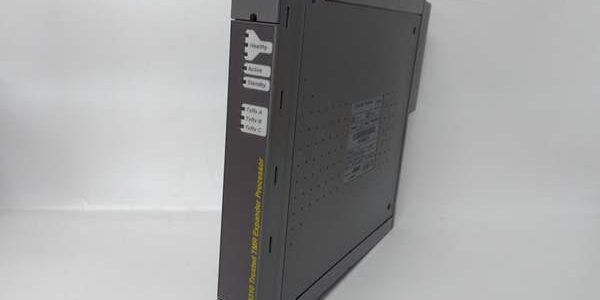
- Core Function: Act as slave TMR expander processor inside T8300 remote I/O racks, translate triplicated expander bus traffic to local chassis IMB backplane for distributed safety signal processing
- Product Type: Expander chassis-mounted TMR slave communication processor module
- Key Specs: HIFT 3-2-0 fault tolerant architecture | 250 Mbps triplicated bus throughput | Hot-swap capable slave processor | Condition: New Original Surplus
Product Introduction
The ICS Triplex is the dedicated slave expander processor installed exclusively within T8300 remote expansion racks, pairing with main rack T8311 master interface cards to route triplicated analog and discrete I/O data across copper or fiber cabling. It maintains full 2oo3 hardware voting integrity for all field signals across distributed SIS hardware.This unit differs from main-chassis T8311 master hardware via slave-only bus operation and lower 45 W steady-state power draw, versus the master’s 54 W full-load rating. OEM environmental testing confirms stable 250 Mbps bus operation across the full 0 °C to +60 °C cabinet operating window.
Key Technical Specifications
| Parameter | Value |
|---|---|
| Fault Tolerant Architecture | HIFT TMR, 3‑2‑0 hardware signal voting across three parallel lanes |
| Expander Bus Data Rate | 250 Mbps full duplex triplicated IMB communication |
| Mount Location | Two left dedicated processor slots inside T8300 remote expansion chassis |
| Supported Cabling | TC‑301 copper (max 30 m); T8314 fiber transceivers (max 10 km) |
| Chassis Backplane Supply | 20 VDC to 32 VDC nominal dual redundant 24 VDC rack power |
| Maximum Power Dissipation | 45 W full mixed I/O load steady state |
| Hot‑Swap Behavior | Live rack replacement without remote I/O safe‑state shutdown |
| Front Panel Diagnostics | Per‑slice health LEDs, active/standby status, Tx/Rx bus activity indicators |
| Operating Ambient Temp | 0 °C to +60 °C; storage -25 °C to +70 °C |
| Humidity Tolerance | 10%–95% RH non‑condensing cabinet atmosphere |
| Safety Certification | IEC 61508 SIL 3, TÜV AK6, UL/cUL, CE, IP20 cabinet‑only |
| Physical Dimensions | 266 mm H × 31 mm W × 303 mm D; net weight 1.33 kg |
| Fault Containment Logic | Isolates single lane, module, or chassis bus faults to prevent full system outage |
Quality Control Process (Engineer’s Perspective)
- Incoming Verification: Cross serial numbers against Rockwell OEM batch manifests to reject counterfeit aftermarket copies. Visually inspect rear backplane gold edge pins for bending, front panel diagnostic LED lenses for scratches, and expander bus port contacts for oxidation.
- Live Functional Test: Insert module into a populated T8300 remote test rack paired with a Fluke 115 regulated 24 VDC supply and main chassis T8311 master card. Run a 24‑hour soak cycle with full mixed analog/digital I/O load, log bus throughput and single‑lane fault isolation response hourly.
- Electrical Parameter Test: Use a 500 V Megger to measure insulation resistance between each triplicated bus lane and chassis ground; pass threshold is >10 MΩ. Verify automatic standby lane takeover after simulated primary bus lane failure.
- Firmware Verification: Read and record slave expander firmware build number via TRISTATION 1131 configuration software; photograph front‑panel bus termination DIP switch positions for site wiring reference records.
- Final QC & Packaging: Place module inside static‑dissipative poly bag. Affix dated QC Pass sticker listing measured insulation resistance and total soak test runtime before palletized warehouse storage.
Replacement Pitfall Guide
❗ Firmware Mismatch Risk: The slave firmware v5.0+ cannot hot‑swap with main chassis T8311 master cards running v4.6 or older without full SIS application re‑download. Unmatched firmware triggers persistent triplicated bus lane vote mismatch critical safety faults.❗ Master/Slave Hardware Reversal Risk: This slave module cannot install into main control chassis I/O slots reserved for T8311 master expander hardware; reverse placement creates unrecognizable bus protocol errors and total remote I/O offline state.❗ Bus Termination Jumper Misconfiguration Risk: Factory default DIP switches disable far‑end remote rack bus termination. Leaving jumpers unmodified on long copper cable runs generates signal reflection noise that corrupts 250 Mbps data packets.❗ Power Supply Headroom Miscalculation Risk: A fully loaded ICS Triplex draws 45 W steady‑state at 24 VDC. Size remote rack power supplies with 20% overhead; underrated racks drop voltage below 20 VDC and lock all distributed I/O into safe‑state offline logic.❗ ESD Damage Risk: Exposed backplane gold contacts remain unprotected during hot‑swap removal. Use a grounded anti‑static mat in low‑humidity cabinet spaces; static discharge scratches plating and generates intermittent single‑lane bus dropout faults.Keep these in mind and you’ll cut 90% of rework time.
Compatibility Matrix & Benchmarks
Compatibility Matrix
- (Main Chassis Master Expander Interface) → : Direct Compatibility — Native triplicated bus pinout matching, zero inter‑chassis wiring rework
- T8300 (Remote I/O Expansion Chassis) → : Direct Replacement — Dedicated left processor slot mechanical lock, native IMB backplane communication
- T8110B (Trusted Main TMR CPU) → : Indirect Compatible — CPU communicates via master only; cannot slot directly into CPU main rack
Benchmarks
- Full remote rack mixed I/O bus scan latency: 125 µs (fully populated rack, 24 VDC nominal supply)
- Single lane fault automatic switchover delay: <1 ms before redundant lanes carry full remote I/O data load
- Continuous power consumption: 41 W average under fully loaded remote rack traffic