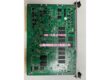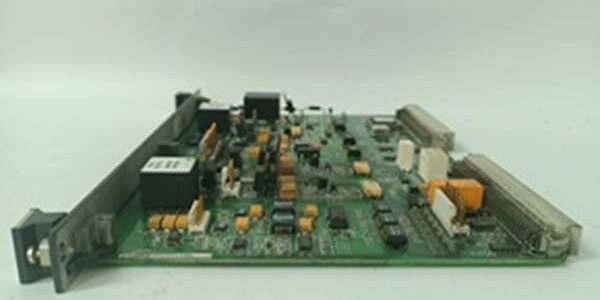
Quick Sizing & Sourcing Snapshot
- Manufacturer: GE (General Electric)
- Part Number: IS200EPCTG1A
- System Platform: EX2100 / EX2100e Excitation Control
- Hardware Type: Exciter PT/CT Terminal Board (EPCT – Simplex)
- Architectural Role: Provides passive field termination for Generator PT (Voltage) and CT (Current) signals, performing signal scaling/isolation before sending to the EMIO board.
- Key Specifications: 2x 3-Phase PT (115V AC), 2x CT (1A/5A), Open Delta Isolation, 28V DC Powered.
System Architecture & Operational Principle
The is a passive signal conditioning and termination board mounted in the EX2100 Exciter Control Cabinet (typically in the M1, M2, or C core). It serves as the field-facing interface for primary generator measurements.
Upstream (Field Side):
- It receives Two 3-Phase PT (Potential Transformer) inputs (typically 115V AC secondary) via Terminal Block TB1. These represent Generator Terminal Voltage.
- It receives Two CT (Current Transformer) inputs (1A or 5A secondary) via TB1. These represent Generator Stator Current.
- It also accepts 1 Analog Input (0-10V DC or 4-20mA) via TB1/JP1 jumper, often used for auxiliary metering.
Internal Processing:
- The board uses Isolation Transformers (T1-T6) to create a “Open Delta” configuration for voltage measurement, producing a scaled 3-wire output (approx 1.533V AC for 115V in).
- It isolates CT inputs to prevent ground loops.
- It supports CT Shorting Blocks (TB2, TB3) which are fixed (non-removable) to prevent accidental CT open circuits during maintenance.
Downstream (Controller Side):
- Conditioned signals are cabled via D-Sub Connectors (J305, J308, J315) to the EMIO (IS200EMIOH1A) board in the same controller rack.
- The “G1A” suffix indicates Simplex Operation (designed for a single controller path, e.g., M1 only), contrasting with redundant configurations.
Core Technical Specifications
- Function: Exciter PT/CT Terminal Board (EPCT)
- Operation Mode: Simplex (G1 Suffix typically denotes Simplex; Redundant uses G2/G3 variants)
- PT Inputs: 2 sets of 3-Phase, 115V AC RMS (50/60Hz), Burden <1 VA
- CT Inputs: 2 sets, 1A or 5A AC, Burden <1 VA
- Analog Input: 1 Channel (0-10V DC or 4-20mA), Select via Jumper JP1
- Isolation Method: Transformers (Open Delta for PTs), 1500V – 2500V RMS isolation
- Output to EMIO: Via J305 (Primary), J308, J315 (Fan-out in redundant setups)
- Terminals: TB1 (Removable, Field Wiring), TB2/TB3 (Fixed, CT Shorting)
- Test Points: TP1-TP8 (Monitors transformer secondaries)
- Power: Indirect (Signal conditioning passive; interfaces to powered EMIO)
- Wiring: Supports up to #10 AWG, Cable length up to 1000 ft (300m)
- Environmental: -30°C to +65°C, Conformal Coated
Customer Value & Operational Benefits
Signal Integrity & Isolation
The primary value is Galvanic Isolation via onboard transformers. By converting PT/CT signals to isolated secondaries (Open Delta), it eliminates ground loops between the high-power generator step-up transformer and the exciter control electronics. This prevents erroneous voltage readings that cause AVR (Auto Voltage Regulator) instability (VAR hunting).
CT Safety (Fixed Shorting Blocks)
The TB2 and TB3 terminal blocks for CT inputs are permanently fixed (cannot be unplugged). This is a critical safety feature: it ensures the CT secondary is always shorted or connected, preventing the development of dangerous high voltages (potentially kilovolts) if the EMIO cable is disconnected while the generator is running.
Simplex Cost Efficiency
As a G1 (Simplex) board, this is the cost-effective choice for single-unit exciters (e.g., Hydro plants, Gas Turbine Gen-Sets) where TMR (Triple Modular Redundancy) is unnecessary. It provides full PT/CT conditioning at roughly 60% of the hardware cost of a redundant (G2/G3) setup.