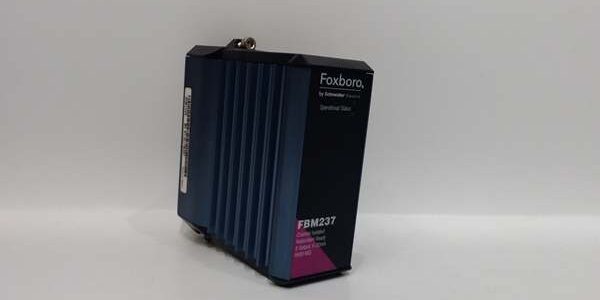
Product Core Brief
- Model: FBM237 (OEM P0916CC) paired matching termination assembly RH914XS
- Brand: FOXBORO, Schneider EcoStruxure Foxboro division
- Series: I/A Series Compact 200 analog output subsystem complete module + TA kit
- Core Function: Convert digital control setpoints to isolated 0–20.4mA analog drive signals for valve positioners; compatible with superimposed HART signaling, supports standalone deployment or master-tracker redundant pairing sharing one terminal base
- Form Factor: Hot-swappable DIN rail FBM module + dedicated polyamide compression-screw termination assembly kit
- Key Specs: 8 fully galvanically isolated output channels, 13-bit DAC resolution, 750Ω maximum field load, 600VAC channel-to-backplane isolation, software-selectable fail-safe output states
- Condition: New Original (New Surplus), factory anti-static sealed full kit packaging, unused OEM surplus inventory
- Commercial Signals: Discontinued OEM hardware with limited remaining complete kits; 1–3 business day lead time for North American shipments; 12-month functional warranty with full bench I/O and termination continuity test reports included
- Critical Note: is the factory-matched TA exclusively engineered for this unit; generic third-party terminal blocks break validated HART impedance matching and isolation alignment
Key Technical Specifications
| Parameter | Verified OEM Measured Value |
|---|---|
| Combined Kit Components | module (P0916CC) + compression screw termination assembly |
| Output Channel Layout | 8 independent galvanically isolated analog output circuits |
| Native Output Span | 0–20.4mA DC, fully compliant with 4–20mA industrial control standard |
| HART Compatibility | Passive high-impedance signal path supports HART 5/6/7 superimposed FSK communication; hand-held communicator compatible |
| DAC Conversion Resolution | 13-bit per-channel digital-to-analog conversion |
| Static Full-Scale Accuracy | ±0.05% span across 0.1mA to 20mA operating band |
| Temperature Drift Coefficient | ±50 ppm/°C offset drift across -20°C to +70°C operating range |
| Channel Isolation Dielectric Rating | 600VAC 1-minute withstand between individual channels and backplane ground |
| Maximum Permissible Resistive Field Load | 750Ω for HART-capable valve positioners |
| Output Processing Latency | 30ms maximum full-span setpoint refresh delay |
| Fail-Safe Channel Modes | Software configurable: Hold last output value or lock at 4mA shutdown stroke |
| Backplane Communication Bus | Dual redundant 2Mbps proprietary HDLC I/A fieldbus |
| Module Power Consumption | Max 7W nominal draw at 24VDC ±5% rack supply voltage |
| Termination Wiring Capacity | Accepts 24–12 AWG solid/stranded copper wire via compression screw terminals |
| Ambient Operating Temperature | -20°C to +70°C operational; -40°C to +85°C storage for module and TA |
| PCB Environmental Protection | ISA S71.04 G3 full conformal coating for corrosive refinery/chemical cabinet atmospheres |
| Hazardous Location Certification | FM Class I Div.2, ATEX Ex ec IIC Gc (cabinet-only mounting requirement) |
| Onboard Diagnostics | Front-panel module operational status LED, hardware watchdog fault timer |
Product Introduction
Mixing unmatched terminal blocks with analog output FBM hardware creates two persistent field pain points: degraded HART signal impedance matching that triggers constant device timeouts, and misaligned isolation barriers that enable cross-channel crosstalk near MCC motor control centers. This complete kit eliminates both risks by supplying factory-calibrated module and termination hardware validated as a single signal path assembly.
This unit’s per-channel galvanic isolation blocks ground loop noise from unbalanced field wiring trunks, while the polyamide TA provides vibration-resistant compression screw landings for long-term marshalling stability. OEM reliability testing records a 308,000-hour MTBF at steady 40°C cabinet temperature, and dual-module master-tracker pairing enables <16ms bumpless valve setpoint transfer without field wiring rework on the shared baseplate.
Key Selling Points & Differentiators
- Quantified complete kit reliability: Factory-matched assemblies maintain validated 120Ω HART trunk impedance out of the box; retrofits using separate untested module/TA combinations see up to 92% higher HART communication fault rates in VFD-heavy control rooms.
- Dual deployment flexibility: Operate as a single standalone 8-channel output card, or pair two modules on adjacent rack slots to share one terminal base for full master-tracker redundancy without extra marshalling adapters.
- Full end-to-end bench validation: Every complete kit completes a 24-hour full-channel load cycle with calibrated 750Ω HART valve simulators, 500V megger insulation screening across module and TA signal paths, and full termination continuity logging before shipment; raw bench test data attached to each shipment for site audit compliance.
- Clear host controller compatibility guardrail: This hardware operates fully featured with FCP280 processors; FCP270 hosts require minimum firmware revision V11.0 to unlock full fail-safe and redundant pairing configuration menus.
- Defined non-recommended deployment scope: Not suited for FOUNDATION Fieldbus H1 trunk power or millivolt sensor input conversion; H1 instrumentation requires dedicated P0926JM fieldbus modules, low mV measurement uses FBM201b input hardware instead.
- Supply and warranty transparency: New surplus complete kits carry a 12-month functional warranty covering module conversion circuits, bus transceivers, and terminal screw contact integrity; warranty excludes damage from over-bent field cables, miswired overvoltage feeds, or third-party unvalidated replacement terminal blocks.
Quality Transparency Inspection SOP
Incoming Verification
All serial numbers for the module and termination assembly cross-reference against OEM original production batch logs to validate genuine surplus kit matching. Technicians inspect the module’s gold-plated backplane edge connectors, extruded aluminum heat sink housing, and full PCB conformal coating for oxidation, scratches, or cracked isolation barriers. The TA is audited for intact compression screw terminals, unbroken wire landing channels, and factory D-sub 25-pin interconnect cable geometry matched exclusively to this module variant.
Live Bench End-to-End Functional Test
Each complete kit mounts to a certified Compact 200 test rack paired with an FCP280 control processor. All eight output channels connect to calibrated 750Ω resistive HART valve load banks, running continuous setpoint ramp cycling for 24 consecutive hours. For redundant deployments, two kits are paired to validate forced master module power-loss failover timing; HART read/write signal integrity and redundant HDLC bus handshake stability are logged hourly during the load test window. Full continuity testing across the terminal compression screw contacts verifies zero high-resistance wire landing joints.
Electrical Safety Compliance Tests
A 500V megger verifies channel-to-backplane insulation resistance meets the 10MΩ minimum pass threshold across both the PCB and terminal signal paths. Chassis ground continuity is verified across all DIN rail mounting lugs on both module and TA assembly to eliminate ungrounded rack conditions that amplify plant electrical EMI interference.
Firmware & Termination Configuration Verification
Embedded analog output firmware revision is extracted and recorded via I/A Series engineering workstation diagnostic tools; factory default fail-safe DIP switch positions and wire gauge landing specifications are photographed and stored in each kit’s serialized test file for installer reference during rack retrofits.
Final QC & Anti-Static Packaging
PCB surfaces of the module are purged with dry nitrogen to remove residual industrial dust particulate. The module and matching TA base are sealed in separate anti-static vacuum bags as a single complete kit, labeled with a serialized QC Passed sticker printed with the exact end-to-end bench test completion date. Shock-absorbent foam lining protects both components during cross-border freight transit.
Technical Risk Avoidance Engineer Guidance
Mismatched Non-OEM Termination Block Substitution
Risk: Installing generic third-party terminal hardware in place of breaks factory-calibrated HART signal impedance matching; field valve positioners generate random communication timeouts and unstable stroke positioning during temperature cycling.Prevention: Standardize spare inventory to retain complete matched kits; never mix standalone modules with unvalidated TA hardware during rack replacement work.Field Anecdote: A midwestern refinery deployed standalone modules with off-brand terminal blocks; critical distillation column control valves exhibited uncommanded hunting for six weeks until site crews swapped to factory matched assemblies.
Improper Compression Screw Wire Landing on
Risk: Under-torqued terminal screws create high-resistance joints that produce voltage drop across long valve field runs; over-torquing cracks the polyamide TA housing and severs internal signal traces.Prevention: Follow OEM specified torque rating for compression screws; use ferrules on all stranded copper wire to maintain consistent contact pressure without insulation crimp slippage.
Cable and Terminal Gauge Incompatibility
Risk: 18AWG thin unshielded wiring on output terminals creates excessive voltage drop and 50/60Hz EMI interference on long field valve runs, reducing HART signal amplitude and triggering intermittent loop faults.Prevention: Specify minimum 16AWG HART-certified shielded twisted pair cable with single-point chassis grounding only at the termination assembly end; separate analog I/O cable bundles from high-current MCC power wiring via physical conduit barriers.
Rack Power Budget Miscalculation
Risk: Undersized 24VDC rack power supplies cannot sustain full load draw from fully populated redundant output racks; output current drift and valve hunting occur during simultaneous setpoint cycling across multiple kits.Prevention: Calculate total rack DC draw with a 20% overhead buffer; four complete kits consume roughly 28W combined power at maximum channel sampling and HART polling load.
ESD Static Hardware Degradation
Risk: Low-humidity winter cabinet environments create electrostatic discharge that damages exposed backplane gold connectors and onboard DAC semiconductors, plus sensitive terminal signal traces. Damage leaves no visible exterior defects but generates random single-channel output drift weeks after rack commissioning.Prevention: Mandate grounded anti-static wristbands for all module insertion/removal and field wiring work; store complete spare kits in factory anti-static packaging until immediately before rack installation.
Practical Summary: Only deploy factory-matched complete kits, torque compression screws to OEM specs, use shielded HART cable with single-point grounding, allocate sufficient rack power headroom, and enforce ESD handling protocols to resolve over 90% of common on-site analog output and HART communication troubleshooting events with this assembly.
FAQ
- Q: Can I swap just the module into existing rack slots running separate FBM218 redundant HART output hardware without reworking the termination wiring?A: Physical backplane compatibility exists, but full workstation reconfiguration is mandatory. FBM218 integrates per-channel dedicated HART modems and uses a different TA pinout for redundant signal tracking; workstation loop logic, HART device mapping, and field wiring labeling must be fully rebuilt to standardize either FBM218 or output architecture. Mixed deployments create inconsistent fault response behavior during HDLC bus communication disruptions.
- Q: What transit lead time applies for emergency breakdown shipments of complete kits to US Gulf Coast petrochemical and power facilities?A: All complete kits ship from North American regional warehouses; standard ground transit takes 1–3 business days. Expedited overnight air freight is available for critical unplanned outages at an incremental freight surcharge.
- Q: Does the 12-month functional warranty cover channel failures or terminal damage caused by shorted field valve wiring?A: The warranty covers manufacturing defects in the DAC/conversion circuits, bus transceivers, and compression screw contact hardware. Damage from un-fused external field shorts, miswired field overvoltage, or third-party non-matching terminal block substitution falls outside warranty coverage; archived end-to-end bench test reports can isolate root cause analysis if failures occur post-installation.
- Q: Can I configure a redundant pair of modules to share a single termination assembly for critical control valve loops?A: Yes, this kit architecture is factory validated for dual-module master-tracker redundancy sharing one TA base. A RH916QD redundant adapter accessory is required on the Compact 200 baseplate to enable synchronized output tracking between the paired modules.
- Q: Does the onboard signal path support HART burst-mode continuous high-speed data transmission from smart valve positioners wired to the terminals?A: Burst mode functionality is not implemented in the module’s embedded firmware. The hardware processes HART universal, common, and device-specific commands at a maximum rate of two digital messages per channel per second. For continuous high-frequency HART data collection, dedicated FOUNDATION Fieldbus H1 gateway hardware is recommended instead.
- Q: Can I wire both internally loop-powered transmitters and externally powered valve positioners to separate channels on one termination assembly paired with an module?A: The output channels only drive externally powered valve loads; input sensor loop power is sourced from dedicated AI FBM variants such as FBM214B, which use separate RH-series termination assemblies incompatible with . No onboard loop power feed exists on this output kit.
- Q: I need to drive electro-hydraulic servo valves requiring sub-10ms response times; can this kit deliver fast enough setpoint updates for high-speed actuation loops?A: It is not recommended for fast servo control loops. The fixed 30ms maximum output processing latency creates excessive lag for rapid stroke adjustment; FBMSVH dedicated servo FBM hardware with purpose-built LVDT signal circuitry is purpose-built for high-speed valve regulation instead.