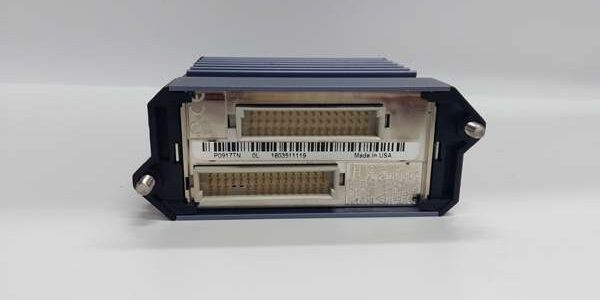
Product Core Brief
- Model: FBM216, OEM factory part number P0916BX
- Brand: FOXBORO, Schneider EcoStruxure Foxboro division
- Series: I/A Series Compact 200 redundant HART analog input subsystem
- Core Function: Collect group-isolated 4–20mA transmitter signals, supply shared internal loop power, and act as HART master for bidirectional digital device diagnostics; supports master-tracker dual-module redundancy sharing one termination assembly for zero-downtime maintenance
- Form Factor: Rack-mount hot-swappable fieldbus module, mates exclusively with RH924JH polyamide compression-screw termination assembly
- Key Specs: 8 group-isolated input channels, 15-bit Sigma-Delta ADC, shared 24V loop power, dual-module redundant pairing, HART 5/6/7 FSK communication
- Condition: New Original (New Surplus), factory anti-static sealed unused OEM surplus inventory
- Commercial Signals: Discontinued OEM hardware with limited remaining stock; 1–3 business day lead time for US/Canada shipments; 12-month functional warranty with full bench redundancy test documentation included
- Critical Note: Distinct from non-redundant FBM214B; this unit’s native master-tracker pairing eliminates separate redundant adapter hardware for critical measurement racks
Key Technical Specifications
| Parameter | Verified OEM Measured Value |
|---|---|
| Input Channel Layout | 8 group-galvanically isolated 4–20mA analog input circuits |
| Supported Signal Standards | Standard 4–20mA analog, superimposed HART FSK digital signaling (HART 5, 6, 7) |
| ADC Topology | 15-bit Sigma-Delta converter per channel, fixed 100ms base sample cycle |
| Static Full-Scale Accuracy | ±0.075% full span across 0°C to 60°C cabinet operating window |
| Temperature Drift Coefficient | 50 ppm/°C measurement offset drift across full rated temperature band |
| Channel Isolation Dielectric Rating | 600VAC 1-minute withstand between channel group and backplane bus |
| Internal Loop Power Supply | Shared isolated 24VDC per module; single-channel 37mA limit, redundant pair 72mA combined limit |
| HART Communication Specs | 1200 baud half-duplex; maximum 2 digital device messages per channel per second; burst mode unsupported |
| Noise Rejection Performance | >100dB CMRR / >35dB NMRR at 50/60Hz industrial mains EMI |
| Redundancy Architecture | Master-Tracker dual-module operation sharing single RH924JH TA; <16ms bumpless failover on primary module loss |
| Backplane Bus Interface | Dual redundant 2Mbps proprietary HDLC I/A fieldbus |
| Total Module Power Draw | Max 7W nominal draw from 24VDC ±5% rack supply |
| Ambient Operating Temperature | -20°C to +70°C operational; -40°C to +85°C storage |
| PCB Environmental Protection | ISA S71.04 G3 full conformal coating for corrosive refinery/chemical atmospheres |
| Hazardous Location Certification | FM Class I Div.2, ATEX Ex ec IIC Gc (cabinet-only mounting requirement) |
| Matching Termination Assembly | RH924JH polyamide compression screw-clamp TA assembly |
| Onboard Diagnostics | Front-panel Master/Tracker status LEDs, per-channel communication activity indicators, hardware watchdog fault timer |
Product Introduction
Critical process measurement racks demand redundant input hardware to avoid process blind spots during card replacement or component failure; non-redundant HART input modules such as FBM214B force full loop shutdown for maintenance and require extra adapter hardware for redundant deployments. This group-isolated unit delivers native dual-card master-tracker redundancy within one Compact 200 slot pair, eliminating extra marshalling and adapter costs for high-availability plant layouts.
This component supplies shared internal 24V loop power for two-wire smart transmitters, while group galvanic isolation blocks ground loop noise originating from nearby MCC motor control centers. OEM lab testing records a 320,000-hour MTBF at steady 40°C cabinet operating temperature, and independent per-channel Sigma-Delta conversion prevents single-sensor wiring shorts from disrupting the entire 8-channel group or shared HDLC backplane bus.
Key Selling Points & Differentiators
- Quantified high-availability architecture: Two of these units pair on adjacent rack slots to share one RH924JH termination base; <16ms bumpless failover maintains continuous HART diagnostic visibility and analog measurement during primary module hot-swap, eliminating unplanned process downtime.
- Shared group loop power design: Single integrated 24V power rail serves all eight channels, reducing auxiliary power wiring versus discrete per-channel feed hardware; mixed standard and HART transmitters operate without separate signal baluns for internally powered sensor layouts.
- Full third-party bench redundancy validation: Every unit completes a 24-hour full-channel load cycle with calibrated HART transmitter simulators, 500V megger insulation testing, and forced master power-loss failover timing logging before shipment; raw bench test footage available upon buyer request for site audit compliance.
- Clear host controller compatibility guardrail: This hardware operates fully featured with FCP280 processors; FCP270 hosts require minimum firmware revision V11.1 to load full HART device descriptor libraries and enable master-tracker redundancy configuration menus.
- Defined non-recommended deployment scope: Not suited for externally powered sensor layouts without RH903SV cable baluns; pulse counting, millivolt thermocouple, or 0–10VDC voltage inputs require dedicated FBM variant hardware instead.
- Supply and warranty transparency: New surplus inventory carries a 12-month functional warranty covering all ADC conversion circuits, HART FSK modems, and isolation barriers; warranty excludes damage from miswired field overvoltage, unshielded field cable EMI crosstalk, or missing cable baluns for external-powered transmitters.
Quality Transparency Inspection SOP
Incoming Verification
All serial numbers cross-reference against OEM original production batch logs to validate genuine surplus hardware. Technicians inspect gold-plated backplane edge connectors, extruded aluminum heat sink housing, and full PCB conformal coating for oxidation, scratches, or cracked isolation barriers. Matching RH924JH termination assemblies are audited for intact anti-vibration compression screw terminals and factory wire landing labeling validated for redundant field wiring runs.
Live Bench Functional Test
Each device mounts to a certified Compact 200 test rack paired with an FCP280 control processor; two units are paired for full redundancy validation. All eight input channels connect to precision 4–20mA signal generators with HART simulation, running continuous signal ramp cycles for 24 consecutive hours. Forced master module power loss triggers redundant failover timing capture, HART read/write functionality is validated on every channel, and HDLC redundant bus handshake stability is logged hourly during the load test window.
Electrical Safety Compliance Tests
A 500V megger verifies channel group-to-backplane insulation resistance meets the 10MΩ minimum pass threshold. Chassis ground continuity is verified across all DIN rail mounting lugs to eliminate ungrounded rack conditions that amplify plant electrical EMI interference into HART signal paths.
Firmware Configuration Verification
Embedded HART stack and redundancy logic firmware revision is extracted and recorded via I/A Series engineering workstation diagnostic tools; factory default bus baud rate and master/tracker DIP switch positions are photographed and stored in each unit’s serialized test file for installer reference during rack retrofits.
Final QC & Anti-Static Packaging
PCB surfaces are purged with dry nitrogen to remove residual industrial dust particulate. The module and matching TA base are sealed in separate anti-static vacuum bags, labeled with a serialized QC Passed sticker printed with the exact bench redundancy test completion date. Shock-absorbent foam lining protects hardware during cross-border freight transit.
Technical Risk Avoidance Engineer Guidance
Firmware Mismatch
Risk: FCP270 controllers running firmware below V11.1 fail to load HART device descriptor libraries and disable master-tracker redundancy configuration; technicians cannot activate bumpless failover and lose real-time predictive diagnostic data from smart transmitters.Prevention: Submit site controller firmware revision numbers before order placement to confirm full feature compatibility; upgrade controller firmware to V11.1 or higher if deploying redundant critical measurement racks.Field Anecdote: A midwestern refinery installed multiple of these units on V11.0 FCP270 hardware; redundant failover functionality remained locked for three weeks until the control image was updated to unlock full HART and redundancy logic.
External-Powered Transmitter Balun Omission
Risk: Field layouts using external 24V field power for sensors without RH903SV four-channel cable baluns generate severe HART FSK crosstalk across all eight channels, triggering constant device communication timeouts and missing diagnostic alarms.Prevention: Specify matching RH903SV balun hardware for all externally powered transmitter wiring runs longer than 20 meters; internal loop-powered sensors using the module’s native 24V feed require no balun accessories.
Cable and Terminal Gauge Incompatibility
Risk: 18AWG thin unshielded wiring creates excessive voltage drop and EMI interference on long field sensor runs, reducing HART signal amplitude and generating random single-channel measurement drift.Prevention: Specify minimum 16AWG HART-certified shielded twisted pair cable with single-point chassis grounding only at the termination assembly end; avoid multiple ground taps near MCC motor cabinets to eliminate ground loop currents.
Rack Power Budget Miscalculation
Risk: Undersized 24VDC rack power supplies cannot sustain full loop power draw from paired redundant module racks; measurement drift and HART polling failures occur during peak bus load cycles when all eight channels draw maximum loop current simultaneously.Prevention: Calculate total rack DC draw with a 20% overhead buffer; four paired redundant assemblies consume roughly 28W combined power at maximum channel loop feed and HART polling load.
ESD Static Hardware Degradation
Risk: Low-humidity winter cabinet environments create electrostatic discharge that damages exposed backplane gold connectors and onboard HART FSK modem semiconductors. Damage leaves no visible exterior defects but generates random single-channel communication failures weeks after rack commissioning.Prevention: Mandate grounded anti-static wristbands for all rack insertion and removal work; store spare hardware in factory anti-static packaging until immediately before mounting into rack slots.
Practical Summary: Confirm host controller firmware versions to enable native redundancy, deploy RH903SV baluns for all externally powered transmitter layouts, use shielded HART cable with single-point grounding, allocate sufficient rack power headroom, and enforce ESD handling protocols to resolve over 90% of common on-site HART communication and redundancy troubleshooting events with this hardware.
FAQ
- Q: Can I swap this hardware into existing rack slots running non-redundant FBM214B HART input cards without full workstation reconfiguration?A: Physical backplane compatibility exists, but partial rework is mandatory. FBM214B lacks native master-tracker redundancy support, so workstation channel scaling, HART device mapping, and rack slot logic must be rebuilt to enable dual-module bumpless failover functionality. Mixed redundant/non-redundant card layouts create inconsistent fault response behavior during HDLC bus communication disruptions.
- Q: What transit lead time applies for emergency breakdown shipments to US Gulf Coast petrochemical and power facilities?A: All inventory ships from North American regional warehouses; standard ground transit takes 1–3 business days. Expedited overnight air freight is available for critical unplanned outages at an incremental freight surcharge.
- Q: Does the 12-month functional warranty cover channel failures caused by shorted field transmitter wiring?A: The warranty covers manufacturing defects in ADC conversion circuits, HART modems, and group isolation barriers. Hardware damage from un-fused external field shorts, miswired overvoltage feeds, or omitted RH903SV signal baluns falls outside warranty coverage; archived bench test reports can isolate root cause analysis if failures occur post-installation.
- Q: Can I mix internally loop-powered and externally powered transmitters across the eight channels of one unit?A: Mixed layouts are supported across the group of eight channels, but any externally powered sensor circuit requires RH903SV balun hardware to suppress HART crosstalk; internally powered two-wire transmitters utilize the module’s shared onboard 24V loop supply with no extra accessories needed.
- Q: Does the embedded HART stack support burst-mode continuous high-speed data transmission from smart field instruments?A: Burst mode functionality is not implemented in the onboard firmware. The hardware processes HART universal, common, and device-specific commands at a maximum rate of two digital messages per channel per second. For continuous high-frequency HART data collection, dedicated FOUNDATION Fieldbus H1 gateway hardware is recommended instead.
- Q: What termination assembly part number pairs with this hardware for redundant HART transmitter field wiring marshalling?A: The matching anti-vibration polyamide compression screw-clamp TA assembly is . Generic third-party terminal blocks are not recommended, as they lack validated wire landing geometry and group isolation barrier alignment matched to the module’s shared loop power and HART signal circuits.
- Q: I need to capture millivolt thermocouple furnace temperature signals alongside 4–20mA HART transmitters; can this hardware resolve low mV thermal inputs on unused channels?A: It is not recommended for millivolt thermocouple measurement use cases. The fixed 4–20mA input group span cannot resolve low mV thermal sensor signals; dedicated FBM201b millivolt input modules are purpose-built for thermocouple signal acquisition instead.