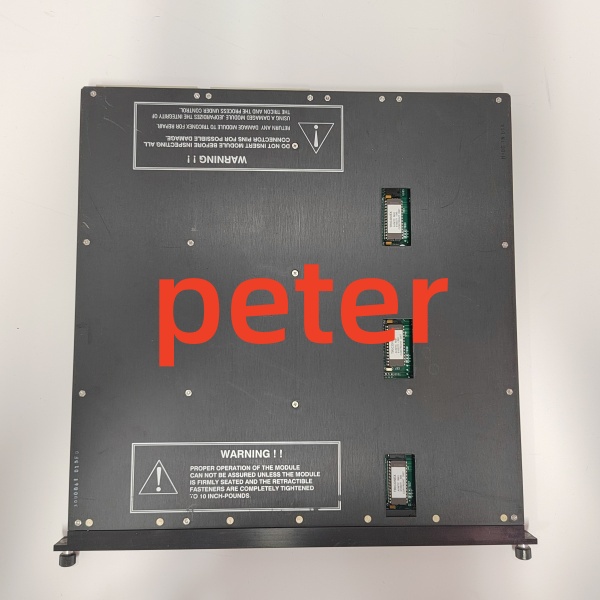
Operating Temperature: -40°C to +70°C (storage -40°C to +85°C)
Power Draw: <8W @5VDC backplane; 1.0A nominal
Safety Rating: IEC61508 SIL3, UL Class I Div 2, ATEX Zone 2
Dimensions: 114mm H × 127mm W × 108mm D
Weight: 1.5kg (3.3lbs)
Diagnostics: Per-channel open/short, load presence, pulse-test for hidden faults
The Real-World Problem It Solves
Standard DO cards can’t prove a safety coil is good until a trip happens; “dead but unknown” wiring/load failures cause ESD events to fail. This 3614E adds continuous load monitoring plus automatic pulse-testing to catch hidden faults before demand.Where you’ll typically find it:
Refinery ESD racks driving 24VDC shutdown solenoids and trip relays
Power plant BMS fuel gas valve interlocks and ignition permissives
Offshore F&G panels for critical isolation solenoids and alarm beaconsThis module eliminates latent safety circuit failures and ensures 100% coverage of wiring/load faults.
Hardware Architecture & Under-the-Hood Logic
It’s a TMR supervised DO with three independent logic legs, per-channel sense circuits, and non-commoned outputs; backplane-powered, no field power on board.
TriBus receives safety commands from Tricon controller to each TMR leg.
Each leg calculates output state independently; 2-out-of-3 vote enables output driver.
Each channel has voltage/current sense to verify load and wiring integrity.
Onboard pulse-test injects micro-pulses to detect open/short without tripping loads.
Hot-swap logic allows replacement without rack shutdown; outputs default off (fail-safe).
TRICONEX 3700A
Field Service Pitfalls: What Rookies Get Wrong
Confusing 3614E (8-Ch Non-Commoned) with 3624 (16-Ch Commoned)Techs swap 3614E and 3624 thinking they’re interchangeable. 3614E has half the channels and non-commoned wiring; field wiring won’t match, causing no-output or backfeed damage.
Field Rule: 3614E = 8-ch non-commoned; 3624 = 16-ch commoned. Match module to terminal block and wiring drawings.
Ignoring Pulse-Test Diagnostic AlarmsRookies disable or clear pulse-test “FAULT” alarms without troubleshooting. A failed pulse-test means the channel can’t verify load health—critical safety blind spot.
Quick Fix: Never disable pulse-test; investigate every alarm for loose wires, high-resistance connections, or marginal coils.
Overloading Channels with Inductive LoadsSpec says 2A continuous; rookies run unprotected solenoids. Inductive kickback damages output transistors and corrupts pulse-test readings.
Field Rule: Add 1N4007 freewheeling diode across all inductive loads; derate to 1.5A continuous for coils.
Commercial Availability & Pricing Note
Please note: The listed price is for reference only and is not binding. Final pricing and terms are subject to negotiation based on current market conditions and availability.