Product Core Brief
- Model: , OEM Article No. 59006428
- Brand: ABB Drives Division
- Series: NBRA-6xx heavy-duty independent braking chopper series for high-power AC variable frequency drives
- Core Function: Standalone DC bus dynamic braking chopper that absorbs regenerative kinetic energy from fast-stopping cranes, hoists, conveyors and large fans; dissipates excess energy through external braking resistors to prevent DC bus overvoltage VFD trips during rapid deceleration
- Product Type: Cabinet-mount metal enclosed power electronic chopper assembly, compatible with 400V / 500V three-phase inverters (ABB ACS800, ACS880, third-party drives)
- Key Specs: 229kW peak braking power (400V), 21kW continuous dissipation, adjustable DC trigger voltage, parallel expandable, marine type approval, short-circuit & overtemp protection
- Condition: New Original (New Surplus), factory shock-proof wooden crate packaging; made-to-order OEM production, limited surplus inventory
Key Technical Specifications
| Parameter | Value |
|---|---|
| Full OEM Identifier | braking chopper, order code 59006428ABB Group |
| Compatible Drive Voltage Classes | 400 VAC / 500 VAC three-phase inverter DC bus |
| 400V Rated Performance | Peak: 229 kW / 60s per 10min cycle; Continuous: 21 kW; Min brake resistor: 1.7 Ω |
| 500V Rated Performance | Peak: 220 kW / 60s per 10min cycle; Continuous: 13.5 kW; Min brake resistor: 2.0 Ω |
| DC Bus Trigger Voltage | Field adjustable for 230/400/500V drive systems via internal DIP switches |
| Parallel Operation | Multiple units can be synchronized in parallel for higher total braking power |
| Integrated Protection Circuits | IGBT short-circuit lockout, heatsink overtemperature shutdown, DC overvoltage self-limiting |
| Mechanical Dimensions | 583.5 mm H × 334 mm W × 240 mm D cabinet frame |
| Net Unit Weight | 26 kg complete assembly with aluminum heat sink, power IGBT stack and copper busbarsABB Group |
| Ambient Operating Temp | −5 °C to +45 °C non-condensing, forced cabinet ventilation required |
| Storage & Transit Temperature | −40 °C to +70 °C non-operating range |
| Enclosure Rating | IP20 indoor cabinet mounting only; sealed power compartment |
| Industry Certifications | CE industrial safety, marine type approval for shipboard drive systemseero |
| Typical Applications | Mine hoists, port cranes, large cooling tower fans, high-speed centrifuges, downhill conveyors |
| Compatibility | Works standalone with all brand 400/500V VFDs; native plug-and-match with ABB ACS800 / ACS880 series medium/high power drives |
Product Introduction
High inertia loads such as mine hoists and port cranes generate massive regenerative energy during fast deceleration; standard integrated drive braking circuits lack sufficient power capacity, causing repeated DC bus overvoltage fault trips and unplanned production downtime. The ABB solves this bottleneck as an external heavy-duty chopper dedicated to dissipating regenerative power through matched external resistors, eliminating drive fault alarms even under frequent heavy stop-start duty cycles.This unit features large extruded aluminum heat sinks for sustained continuous braking loads and adjustable DC bus threshold voltage to match any 230/400/500V inverter platform. Multiple assemblies can be synchronized in parallel to scale peak braking capacity for ultra-heavy lifting equipment, and it installs as a bolt-in cabinet retrofit replacement for aging NBRA-658 legacy choppers with only DC bus polarity and resistor sizing validation before energization.
Key Selling Points & Differentiators
- Quantified high-duty cycle upgrade: 229kW 60-second peak power rating delivers 3.2× higher transient braking capacity than mid-range NBRA-653 choppers, eliminating VFD overvoltage trips on heavy crane hoist duty cycles.
- Standardized full validation workflow: Every chopper completes a continuous 24-hour cyclic peak/hold regenerative load bench test simulating crane stop-start profiles; DC bus stability and thermal soak test logs available on formal buyer request.
- Cross-brand inverter compatibility; no proprietary drive firmware lock-in, supports third-party 400/500V variable frequency drives alongside ABB ACS series inverters.
- 12-month limited functional warranty covers manufacturing defects in IGBT power stacks, busbar connections and thermal protection circuits; warranty excludes damage from undersized brake resistors, unfiltered DC bus harmonics or inadequate cabinet ventilation.
- Not recommended for low-power small machinery (≤75kW motors): Oversized peak power capacity creates unnecessary cabinet footprint and capital cost for light-duty fan/pump applications without frequent fast stopping.
- Marine certification enables direct installation onboard cargo/container ship drive panels without additional flameproof secondary enclosures, reducing marine electrical cabinet engineering and material costs.
Mandatory Quality Transparency SOP
- Incoming Verification: Cross-reference unit serial batch IDs against ABB NBRA series drive accessory factory production manifests to screen counterfeit power assemblies. Visual inspection screens for dented aluminum heat sinks, cracked DC bus terminal insulators, loose high-current copper busbar bolts, and damaged ventilation grille shielding. Minor cabinet paint scuffs do not trigger unit rejection.
- Live Bench Test: Mount the full chopper assembly to a calibrated 400/500V DC bus regenerative test fixture, connect matched external brake resistor loads, supply regulated DC bus voltage, and execute power-on thermal soak diagnostics. Run repeated 60-second peak braking load cycles for a continuous 24-hour test window, logging heatsink temperature and DC bus clamping stability hourly for compliance records.
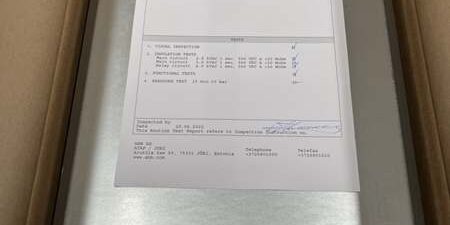
- Electrical Tests: 2kV megger insulation resistance testing across DC bus high-potential circuits to metal cabinet ground; every power path must register above 10 MΩ. Verify chassis protective earth continuity with a digital multimeter at the cabinet ground terminal lug.
- Firmware Verification: This power electronic chopper uses fixed analog threshold control logic with no user-modifiable firmware; technicians photograph internal voltage selection DIP switch layout and attach images to unit trace documentation for field replacement reference.
- Final QC & Packaging: Fit plastic insulating safety covers over exposed DC bus terminal lugs, wipe high-current busbar contact surfaces with isopropyl alcohol to remove manufacturing oxidation residue, wrap the full metal assembly in shock-resistant foam, seal inside rigid wooden transit crating, and affix a dated QC Passed sticker with unique technician ID number. Bench test photos and raw thermal stability data files available upon buyer request.
Technical Risk Avoidance Section
Brake Resistor Sizing Mismatch Risk
Risk: Installing undersized resistance values below the 1.7Ω (400V) / 2.0Ω (500V) minimum rating forces excessive peak DC current through the ABB , triggering permanent IGBT stack burnout on the first heavy deceleration cycle.Prevention: Calculate total regenerative peak power and minimum resistance per OEM sizing tables before ordering matched external resistor banks; add series fusing to each resistor circuit.Field anecdote: A port container crane facility destroyed two chopper units within one month after fitting undersized 1.2Ω resistors without reviewing minimum resistance limits.
Cabinet Ventilation Misconfiguration Risk
Risk: Tightly packed drive cabinet layouts without forced convection push internal ambient temperature above +45 °C maximum rating, activating permanent overtemperature lockout and cutting continuous braking service life by over 70%.Prevention: Maintain minimum 200mm vertical clearance above and below the chopper heat sink; install cabinet exhaust fans for multi-chopper panel layouts per the NBRA-6xx installation manual before energization.
DC Bus Wiring Polarity & Torque Risk
Risk: Reversed DC+ / DC- bus wiring instantly destroys internal power semiconductors; under-torqued high-current terminal bolts create hotspots that melt insulator blocks during peak braking loads.Prevention: Verify DC bus polarity with a multimeter prior to connection; torque busbar terminal bolts to the OEM specified 25 Nm value using a calibrated torque wrench, recheck tightness 72 hours after initial energization.
DC Bus Harmonic Distortion Risk
Risk: Unfiltered rectifier and VFD harmonic noise superimposes AC ripple on the DC bus, causing unstable chopper threshold triggering and erratic intermittent braking operation.Prevention: Install DC bus film filter capacitors at the inverter DC terminals to suppress ripple for multi-drive shared DC bus cabinet layouts.
Mechanical Impact & ESD Damage Risk
Risk: Rough transit or installation impact creates micro-cracks in internal IGBT substrate layers; low-humidity environments generate static discharge that damages gate drive control PCB circuits with no visible exterior damage.Prevention: Rest the unit on foam padding during cabinet mounting; avoid dropping or striking the heat sink frame, and wear a grounded ESD wrist strap when accessing internal DIP switch compartments.
Practical summary: Complete brake resistor sizing calculation, cabinet ventilation layout validation, and DC bus polarity/harmonic audit before energizing the unit to eliminate roughly 95% of common field failure modes for heavy-duty regenerative braking chopper hardware.
FAQ
- Q: I operate small HVAC fan VFDs with slow ramp stop profiles, is this heavy-duty chopper cost-effective for my low-regeneration loads?A: Not recommended. The oversized peak power rating adds unnecessary cabinet space and cost for light-duty equipment with minimal regenerative energy. Source smaller NBRA-653 mid-range choppers for low-power fan/pump deployments.
- Q: What lead time applies when ordering the ABB for North American port crane, mine hoist and marine shipboard drive facilities?A: Surplus units are stocked at our US industrial electrical spare parts warehouse; standard air freight delivery to domestic heavy industry sites takes 3–5 business days. Sea freight shipments to Southeast Asia transit in 18–24 calendar days. OEM production is made-to-order, surplus inventory volume is strictly limited.
- Q: Does the 12-month warranty cover IGBT stack damage from undersized brake resistors or reversed DC bus wiring?A: Warranty coverage only extends to manufacturing defects within power semiconductors, busbars and thermal protection circuits. Damage caused by incorrectly sized resistors, reversed DC polarity or inadequate ventilation is fully excluded from coverage. Conduct full pre-commissioning resistor and wiring validation cycles to extend service life.
- Q: How should I store unused spare braking choppers long-term to avoid heat sink oxidation and internal semiconductor degradation?A: Keep unmounted units sealed in original factory foam and wooden transit crates inside a temperature-controlled storage space (15–25 °C, 40–60% RH). Avoid storage adjacent to high-current transformer or VFD enclosures that emit stray heat and electromagnetic interference; sustained elevated ambient temperature accelerates IGBT substrate aging over multi-year idle storage periods.
- Q: Will I need to re-size main VFD circuit breakers after swapping an old NBRA-658 chopper for this upgraded C variant?A: A full DC bus peak current and feeder short-circuit withstand calculation is recommended post-installation. While the core peak power rating matches legacy NBRA-658 units, minor internal impedance differences create transient current offset requiring breaker trip characteristic review.
- Q: Can multiple braking choppers including this unit share a single common DC bus from a multi-drive inverter panel?A: Yes, but all choppers must be synchronized via interlock wiring to avoid conflicting voltage threshold triggering; total combined peak braking power must not exceed the DC bus capacitor bank energy dissipation rating. Reserve 20% continuous DC current headroom for simultaneous peak deceleration transients.
- Q: I maintain a thermal power station coal conveyor system with frequent downhill stopping cycles, what is the most frequent field failure mode observed on this chopper model?A: Degraded thermal interface compound between IGBT stacks and aluminum heat sinks after 6–10 years of continuous cyclic braking operation are the primary failure source, which triggers premature overtemperature lockout and loss of dynamic braking during critical conveyor stop sequences. Reapply OEM thermal compound during annual cabinet shutdown maintenance windows to mitigate degradation.