Quick Sizing & Sourcing Snapshot
- Manufacturer: GE Fanuc (Emerson Automation Solutions)
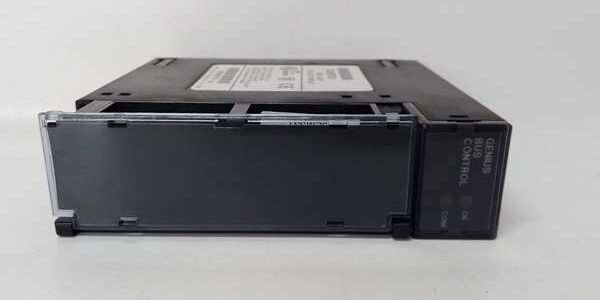
- Part Number: IC693BEM331
- System Platform: Series 90-30 PLC / PACSystems RX3i (Universal Backplane)
- Hardware Type: Genius Bus Controller (GBC) — Single Port
- Architectural Role: Plugs into a Series 90-30 (or RX3i) I/O slot to serve as the Bus Controller (Master) for a Genius Bus network, exchanging I/O data with up to 32 Genius devices (Blocks, BIUs, DCMs) via the VME/PCI backplane to the CPU.
- Key Specifications: 1 Genius Port (Twinaxial/STP), 32 Devices Max, 153.6 kbps, VME/PCI Backplane Interface.
System Architecture & Operational Principle
The sits at Purdue Level 2, occupying a standard I/O slot in a Series 90-30 rack (IC693CHS391) or an RX3i Universal Backplane. It is the Series 90-30 equivalent of the IC697BEM731 (90-70) or the IC670GBI002 (Field Control Head).
Upstream, it connects to the CPU (IC693CPU350/363/374 or RX3i CPU) via the backplane. The CPU writes output data to the BEM331’s dual-port memory and the BEM331 interrupts the CPU when new input data arrives.
Internal Processing, it manages the Genius Bus token pass at 153.6 kbps. It supports Global Data (EGD over Genius), alarm handling, and I/O sweep. Configuration (Station numbers, I/O sizes, Bus Parameters) is stored in the BEM331’s NVRAM and downloaded from Proficy Machine Edition (PME) or Logicmaster 90-30.
Downstream, it drives the Genius Bus via a Twinaxial Cable port (usually screw terminals or BNC depending on sub-rev) or via a 9-pin D-sub to Twinaxial adapter. It can control up to 32 Genius Devices (Blocks like IC660BBA026, BIU stations like IC670GBI002, DCMs). It does notsupport the second port found on the IC693BEM333 (Dual Port) — this is the single-port variant.
Core Technical Specifications
- Port Count: 1 Genius Bus Port (Twinaxial or STP w/ adapter)
- Device Capacity: 32 Genius Devices (Stations 1-31 + optional Broadcast)
- Bus Speed: 153.6 kbps (Fixed Genius Standard)
- Cable Type: Shielded Twinaxial (50 Ohm) or Shielded Twisted Pair (Belden 9841 or equiv)
- Max Distance: 7,500 ft (2.3 km) total daisy-chain (depends on cable & termination)
- Backplane Interface: VME-based (90-30) / PCI-based (RX3i Universal)
- Indicators: MOD OK (Green – Module Healthy), BUS ACT (Yellow – Token/Activity), FAULT (Red – Config/Comm Error)
- Config Storage: Non-Volatile RAM (Retains config through power loss)
- Isolation: 1500V AC (Bus to Backplane/Logic)
- Power: +5V DC Backplane Sourced (~500mA typical)
- Operating Temp: 0°C to +60°C
Customer Value & Operational Benefits
Distributed I/O for 90-30 (No Ethernet Required)
If you have a Series 90-30 CPU and need remote I/O 500+ feet away (pump house, weighbridge, crusher), the BEM331 + Genius Blocks/BIUs is often cheaper and simpler than adding an Ethernet switch, IP addresses, and an RX3i ETM001 with a DL580 cable. One Twinaxial pair runs 32 devices. For legacy plant extensions where the MCC already has Genius Blocks from a 90-70 retrofit, reusing the same topology on a 90-30 keeps spares common.
Deterministic I/O Sweep (Genius Token Passing)
The Genius Bus is a deterministic token-passing network. You know exactly when data updates (every bus sweep, typically 5-10ms for 32 stations). Unlike Ethernet (CSMA/CD — collision domain), there is no “retry and wait.” For Turbine Aux or Batcher Weigh Cells where a missed scan causes an overfill or synchronization error, the BEM331’s Genius link is preferred over unmanaged Ethernet for critical loops.
Built-in Diagnostics (Station Health)
The reports per-station status to the CPU: Last Response Time, Config Mismatch, No Response Counter, CRC Errors. The PLC program can read these via %Wx references or CommReq blocks. You don’t need a laptop on-site to know “Station 5 (Weight Belt) hasn’t answered in 3 scans” — the HMI can alarm it directly. This reduces MTTR for “Ghost” comm faults.