Quick Sizing & Sourcing Snapshot
- Manufacturer: GE (General Electric)
- Part Number: IS200TRLYH1B
- System Platform: Mark VI / Mark VIe (Speedtronic)
- Hardware Type: Trip Relay Output Terminal Board (TRLY)
- Architectural Role: Provides the field termination for 12 Form-C relays, interfacing TRLY logic processors (VCCC/VCRC) to high-voltage trip solenoids and interlocks.
- Key Specifications: 12 Form-C Relays (Socketed), 125V DC Field Power, Voted Coil Feedback, 48 Barrier Terminals.
System Architecture & Operational Principle
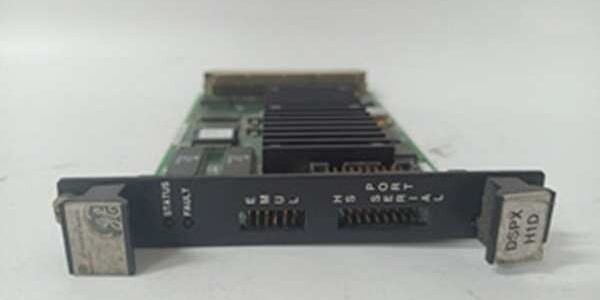
The is a passive terminal board residing in the Mark VI control cabinet, typically in the Trip Core (<T>). It bridges the gap between the active TRLY Processor (VCCC or VCRC) and the plant’s high-voltage trip hardware.
Physically, it mounts to the cabinet subplate (often near the TREG board). It connects to the processor via a 37-pin D-sub (JA1 for Simplex; JR1/JS1/JT1 for TMR). Upstream, the VCCC decides the state based on TMR voting and sends a 24V/125V signal to energize specific relay coils on this board. Downstream, this board handles the heavy lifting: it distributes field power (usually 125V DC) via onboard fuses (F1-F6) to the relay commons. The outputs are Form-C (SPDT) contacts terminating on two removable 48-position barrier terminal blocks.
The critical differentiator is Voted Coil Drive Feedback. The board senses actual current through the coil. If a coil wire vibrates loose or a fuse blows (F1-F6), it reports a diagnostic mismatch to the VCCC, preventing a “silent failure” where the relay looks commanded but doesn’t physically actuate. In TMR setups, three of these boards exist (R, S, T), one per core, ensuring physical isolation of the trip paths.
Core Technical Specifications
- Relay Count: 12 Independent Form-C (SPDT) Relays
- Relay Type: Socketed (Plug-in), Sealed Magnetic Latching (Usually)
- Coil Voltage: 24V DC (Standard) or 125V DC (Config via Jumpers JP1-JP6)
- Contact Rating: 3A @ 125V DC (Resistive), 3A @ 120/240V AC
- Field Power Input: 125V DC / 120V AC (Landed on JF1/JF2 or TB3)
- Fusing: 6 Fused Circuits (F1-F6 for Outputs 1-6), PTC/Trad’l Fuses
- Terminations: 2x 24-position Barrier Strips (Total 48 Terminals, #12-24 AWG)
- Processor I/F: 37-pin D-Sub (JA1 Simplex; JR1/JS1/JT1 TMR)
- Protection: MOV Suppression on coils & field power, Voted Coil Sensing
- Isolation: Channel-to-Channel (Via Relay Contacts), Grouped Commons
- Mounting: Chassis Mount (Cabinet Subplate) or DIN Rail (Adapter)
- Environmental: 0°C to +60°C, Conformal Coated (H1B Rev)
Customer Value & Operational Benefits
Fail-Safe Diagnostics (Voted Feedback)
The biggest value is the Coil Drive Feedback. Standard relay boards go “Blind” if a coil wire drops. The TRLYH1B measures current; if the coil is open but the VCCC commanded “ON,” it flags “Coil Drive Fail.” This gives you a pre-fault alarm during a turbine run (e.g., vibration check) rather than discovering the trip path is dead during an actual Overspeed event. It prevents “Silent Failures” that lead to catastrophic overspeed.
Physical Isolation & MTTR
Relays are socketed, not soldered. If Output 1 (Fuel Stop Valve) welds closed due to a voltage spike, you don’t replace the $2k board. You pull the 5-cent relay, pop in a new one. This cuts MTTR from hours (rerouting 48 wires) to minutes. The barrier blocks are also removable—unplug the block, swap the board, plug the block back in. No screwdriver dance on live 125V terminals.
TMR Path Separation
In a TMR config, this board ensures R, S, T isolation. Output 1-R, 1-S, 1-T are on separate physical boards. A short on the R-core’s solenoid (wire rub) blows the fuse on the R-board but leaves S/T operational, maintaining the 2oo3 vote and keeping the unit online.
Field Engineer’s Notes (From the Trenches)
The “Gotcha” is Fuse Population & Coil Voltage. The board ships with Fuse Clips (F1-F6) often empty. I’ve seen guys install it, command a trip, and nothing happens because the clip was empty.
Jumpers JP1-JP6 are the next trap. These set the coil drive voltage divider. If your VCCC sends 24V signals but the jumpers are on “125V” (factory default sometimes), the relay sees a voltage divider, gets <10V, and chatters or fails to pick. Set jumpers to match your VCCC Output Config (24V vs 125V).
Torque those 125V terminals. Outputs 1-6 (Fused) on TB1 carry the trip solenoid power. A loose “Common” creates an intermittent open. The turbine runs fine until a resonance event shakes the wire, opening the trip loop and causing a spurious “Trip A” or “Loss of Tray Power.” Use a 0.6 Nm torque driver, not finger tight. And for God’s sake, LOTO the 125V Field Supply at the PDM before pulling this board; a screwdriver slip bridging Common to Ground will trip your whole plant’s 125V bus.