Key Selling Points & Differentiators
- Correct G03 variant — 3 kHz LVT @ 19 Vpp: Not interchangeable with G01 (DC LVDT) or G02 (1 kHz). Using the wrong suffix causes loss of feedback or incorrect scaling. This unit is the exact G03 specified in Ovation turbine I/O lists.
- 1500 V DC galvanic isolation between channels and backplane reduces susceptibility to ground loops in noisy MCC-adjacent environments — a common failure mode we’ve seen on un-isolated third-party retrofits.
- Full bench-tested before ship: Power-on self-test, LVT output frequency/ amplitude verification, feedback simulation, and 24 h burn-in. Test report issued on request.
- 12-month warranty on new-surplus units from date of commissioning (pro-rated for DOA).
- Not recommended for non-Ovation DCS racks or standalone PLC applications — the proprietary Ovation backplane bus won’t enumerate on generic hardware. Also not a drop-in for Woodward or Triconex servo interfaces.
- Cross-reference note: 1C31199G01 (16 V DC LVDT) and 1C31199G02 (1 kHz LVT 19 Vpp) exist in the same family but differ in excitation type/frequency — confirm your loop drawing before substituting.
Quality Transparency SOP — Incoming Verification & Test
- Incoming Verification: Serial number and date-code traceability logged against anti-counterfeit checklist. Visual inspection for bent pins, corroded edge connector gold fingers, cracked housing, and correct Ovation keying tab. Accessories / documentation pack checked.
- Live Bench Test: Installed on dedicated Ovation-compatible test rack (or equivalent simulator where applicable). Power-on self-check passes. LVT output measured at 3 kHz ± tolerance, 19 Vpp AC verified with true-RMS scope. LVDT feedback simulated — module reports correct position to controller handshake. Full-scale I/O sweep performed. 24-hour continuous load / thermal soak test logged. Individual test report retained.
- Electrical Tests: Insulation resistance checked 500 V megger (> 10 MΩ backplane-to-ground typical). Ground continuity verified on chassis-earthing tabs.
- Firmware Verification: No user-flashable firmware on this module; DIP/jumper configuration (if present per date code) recorded and photo-documented.
- Final QC & Packaging: QC sign-off by test technician. Anti-static sealed in ESD bag, cushioned in rigid carton with shock corners. “QC PASSED — NEW SURPLUS” label affixed. Test photos/video available on written request.
Technical Risk Avoidance — Engineer Advisory
Firmware / Variant Mismatch
- Risk:Installing a 1C31199G01 or G02 where the control logic expects G03 (3 kHz LVT) results in open feedback or incorrect valve positioning because the excitation type/frequency differs.
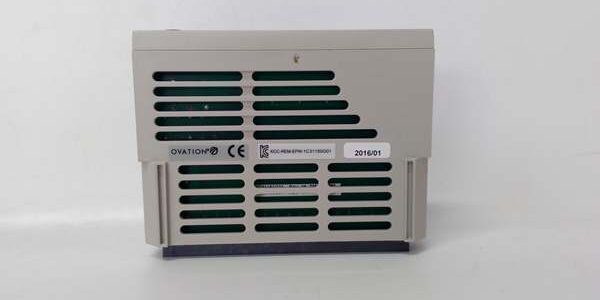
- Prevention:Cross-check the I/O list and loop schematic — G03 is explicitly called out when 3 kHz LVT excitation is required. Physically verify the silk-screened model before insertion.
- Field note:We’ve seen a site swap a failed G03 with a G02 from spares and wonder why the LVDT reads erratic — the 1 kHz vs 3 kHz mismatch matters on long-run shielded pairs.
DIP/Jumper Configuration Errors
- Risk:Some date codes carry configuration jumpers for feedback polarity or excitation range. Wrong setting inverts position feedback.
- Prevention:Photograph the original module’s jumper block before removal. Replicate exactly on the replacement.
Terminal / Cable Incompatibility
- Risk:LVDT primary/secondary pairs miswired to the Ovation termination block cause open-loop conditions.
- Prevention:Use the Emerson Ovation wiring diagram for the specific drop — primary (excitation) vs secondary (feedback) are not interchangeable. Shield drained to ground at one end only.
Power Budget Miscalculation
- Risk:Adding modules beyond the I/O carrier’s 24 V backplane current budget can cause intermittent resets under load.
- Prevention:Sum all module currents (this unit ~150–200 mA) against the carrier’s rated capacity per drop.
ESD Damage During Hot-Swap
- Risk:Inserting without wrist-strap can fry the backplane interface IC — latent failure may appear weeks later.
- Prevention:Always wear a grounded wrist strap when handling. Even if your Ovation rack supports hot-swap, discharge yourself first and insert squarely — don’t rock the module sideways on the pins.
FAQ
Q: Is the Westinghouse 1C31199G03 compatible with all Ovation I/O racks?
A: It fits standard Ovation I/O chassis with the correct keying slot. Verify your rack type — OC4000 and newer Ovation drops accept it; very early Westinghouse WDPF-II racks may use a different form factor and are not compatible. Check your I/O cabinet bill of materials.
Q: Can I use a 1C31199G02 instead of the G03 if G03 is out of stock?
A: Generally no unless your loop drawing specifically allows 1 kHz LVT excitation and the LVDT is specified for it. The G03 provides 3 kHz LVT @ 19 Vpp; the G02 provides 1 kHz. Mismatched excitation frequency can cause incorrect LVDT scaling or unstable feedback, especially on turbine governor loops. Only substitute if the OEM loop sheet confirms 1 kHz is acceptable.
Q: I’m getting a “Servo Feedback Open” alarm after installing this — what should I check first?
A: Verify three things in order: (1) LVDT primary/secondary wiring matches the Ovation termination diagram — don’t swap them. (2) Shield is grounded at one end only (typically at the termination block). (3) The LVDT itself is the correct impedance range for the Ovation servo driver — some aftermarket LVDTs need different excitation voltage. If the old module worked and the alarm appeared immediately after swap, compare jumper/DIP settings on the old vs new module.
Q: Does this module come with a warranty and test certificate?
A: Yes. New-surplus units include a 12-month warranty against DOA and functional failure in normal service. A bench-test summary is available on request; full test report can be issued for critical spares orders.
Q: Is this a new or refurbished part?
A: Condition is New Original (New Surplus) — unused, factory-sealed vintage stock from decommissioned new-build projects or OEM over-order. Not refurbished. Each unit undergoes incoming inspection and functional verification before shipment.
Q: What’s the typical lead time if I order today?
A: In-stock items ship same business day or next morning (depending on cut-off). International shipments typically 3–7 business days by express courier. DDP/DAP terms available on request for NA/EU destinations.