Customer Value & Operational Benefits
Actionable Diagnostics Reduce MTTR
The biggest operational win with the over “dumb” blocks is the granularity of fault reporting. If a proximity sensor wire breaks, a standard input goes “0” (same as the door closed). The configured as “Tristate” sees the floating voltage, reports an “Open Wire” fault on that specific %G register, and you know to dispatch the electrician to the machine head, not the control room. This turns ambiguous “Sensor Not Seeing” calls into “Replace the cable at Station 4” actions, cutting troubleshooting time by 50%.
Configurable I/O Saves Hardware
Having 16 points that can be any mix of Input or Output (e.g., 12 In / 4 Out) on one block saves panel space and part numbers. We often use one for a small machine guard: 8 inputs for e-stops/light curtains, 4 inputs for position switches, and 4 outputs for reset stack lights/solenoids. You don’t need to stock separate input blocks and output blocks for small cells. The software configuration (via Handheld Monitor or software) sets the direction, so the same spare part works for multiple roles.
Source Type Simplifies PNP Wiring
In North American machinery, PNP (Source) sensors are standard. The (Source type) aligns with this. You land your 24V DC supply on the block’s power terminal, the sensor switches the positive to the input terminal, and the block sinks the current to its internal common. No interposing relays or sinking input cards required. This keeps the field wiring intuitive for maintenance electricians used to “Positive Switching” logic.
Field Engineer’s Notes (From The Trenches)
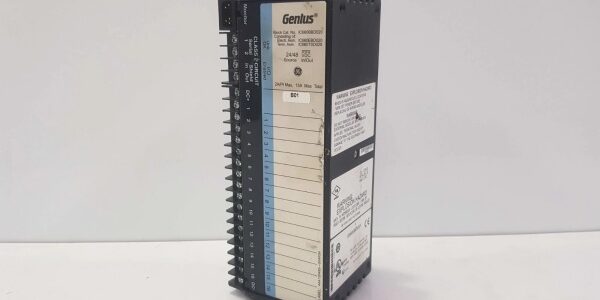
The Terminal Assembly (TA) compatibility is the #1 procurement mistake. The Electronics Assembly (the blue board) must match the Terminal Assembly (the white plastic block with screws). For the BBD020, you need IC66 TSD020 Version C or later. If you try to plug a “BBD020” into an old “ELD020” or “EBD020” terminal block, the keying won’t match, or worse, you’ll force it and misalign the pins.
Also, Genius Bus Termination. The has “Serial 1 In/Out” and “Serial 2 In/Out” terminals for daisy chaining. Only the two end-most blocks on the bus loop should have the 150 Ohm termination resistors jumpered (usually S1 Out to S2 In on the last device). If you terminate every block, you attenuate the signal and lose comms. If you terminate none, reflections cause CRC errors.
Finally, Heat. At 2A per point, if you have 16 outputs on (e.g., 16 solenoids), that’s 32A at 24V = ~768W dissipated as heat in one block. The will go into thermal fault (LED flash) fast. Derating is real—don’t load all 16 points to 2A continuously in a hot panel.
Real-World Applications
- Automotive Welding Cell I/O: The is mounted in a local NEMA 12 box on the robot riser. Channels 1-8 are Tristate Inputs for PNP weld fixtures clamps (detecting Open Wire); Channels 9-12 are Outputs driving 24V DC pneumatic valves; Channels 13-16 are Inputs for light curtain EDM resets. The Genius Bus runs one cable back 200 ft to the main 90-30 rack, eliminating 50+ home-run wires.
- Material Handling Divert Gates: On a parcel sorter, the (48V DC version) controls 16 divert solenoid valves. The 48V reduces voltage drop over long cable runs to the gates. The block’s “Output Pulse Test” feature is used during startup to momentarily pulse each valve (configurable milliseconds) to prove wiring without moving the gate full stroke, saving commissioning time.
High-Frequency Troubleshooting FAQ
The block has power and passed self-test, but the Genius Bus Controller (e.g., IC697BEM731) has not enabled it yet. This happens if the PLC is in Program Mode, the I/O Configuration in the software hasn’t been downloaded, or the Block ID (set via DIP switches or Handheld Monitor) doesn’t match the ID configured in the PLC software. Check the PLC logic/fault table for “Block Not Responding” and verify the ID rotary switches on the face match the %Gaddress assignment.
No. The IC660BBD022 is a 24V DC onlySource block. The is 24/48V DC selectable (via software/config). If your field devices are wired for 48V DC, the BBD022 will not drive them correctly (it lacks the internal regulation/steps for 48V). Conversely, do not put a BBD020 set to 48V in a 24V system; you will over-voltage the sensors. Stick to the BBD020 for 24/48V flexibility.
My Tristate Input reports “Open Wire” but the sensor works. Why?
Check the 3-wire sensor wiring. For Tristate to work, the sensor needs a solid +24V (Brown), Ground (Blue), and Signal (Black) connection. If the Blue (Ground) wire has high resistance (bad crimp), the return current is compromised, and the block may see the signal pin float intermittently. Also, ensure the Input Filter is set appropriately (10-20ms for sensors, 100ms for dry contacts) in the configuration; too short a filter can mistake contact bounce for an open circuit.
No. The Genius I/O blocks (including ) do not support hot-swapping. You must power down the block (or the entire Genius Bus segment if using a redundant power supply setup) before removing or inserting the electronics assembly from the terminal assembly. Removing it live can cause arcing on the pin array and potentially damage the module or cause bus communication errors.
Please note: The listed price is not the actual final price. It is for reference only and is subject to appropriate negotiation based on current market conditions, quantity, and availability.