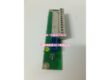
Product Core Brief
- Model: DSQC608
- Order Code: 3HAC12934-1
- Brand: ABB
- Series: ABB IRC5 Robot Controllers
- Core Function: High-density digital I/O module that serves as the interface between the IRC5 robot controller and external automation equipment — manages digital input/output signal transmission for sensors, actuators, safety devices, conveyors, and end-of-arm tooling.
- Product Type: Digital I/O Module
- Key Specs: 16 digital inputs + 16 digital outputs | Galvanic signal isolation | DIN-rail mount inside IRC5 cabinet | Plug-and-play with IRC5 internal I/O bus
- Condition: New Original / New Surplus

Key Technical Specifications
- Product Type: High-Density Digital I/O Module for ABB IRC5 Robot Controllers
- Brand: ABB
- Model Number:
- Order Code: 3HAC12934-1
- Series: ABB IRC5 Robot Controllers
- Core Function: Serves as the interface between the IRC5 controller and external automation equipment — manages digital input/output signal transmission for sensors, actuators, safety devices, conveyors, and end-of-arm tooling
- I/O Channels: 16 digital inputs (24 VDC) + 16 digital outputs (relay or transistor, model-dependent), supporting PNP/NPN and dual redundancy configurations
- Signal Isolation: Built-in galvanic isolation to prevent electrical noise from affecting robot performance — especially useful in high-interference environments like welding zones
- Communication Interface: Connects directly to the IRC5’s internal I/O bus via dedicated backplane connector — ensures low-latency, deterministic communication essential for synchronized robotic operations
- Response Time: Input response ≤1ms, output response ≤3ms, command delay ≤5ms — enables fast emergency stop triggering and minimizes risk in safety-critical applications
- Safety Compliance: Complies with industrial safety standards including EN ISO 13849-1 (Performance Level PL d) and IEC 61508 — features dual safety circuit design and enhanced anti-interference architecture
- Status Indicators: Clear LED feedback per channel for fast troubleshooting — field technicians can quickly verify signal states without relying solely on software diagnostics
- Mounting Method: DIN-rail mount inside IRC5 control cabinet — enables straightforward like-for-like replacement during maintenance
- Power Requirements: Supplied via IRC5 backplane (typically 24 VDC)
- Operating Temperature: 0°C to +55°C
- Environmental Rating: IP20 (control cabinet environment)
- Product Status: Discontinued (spare parts supply) — compatible with ABB IRC5 controller ecosystems
- Typical Applications: I/O communication for ABB IRC5-controlled industrial robots — managing signal exchange with peripheral devices in automotive assembly, material handling, welding, palletizing, and other automation applications; serving as a critical spare part for lifecycle support of mature IRC5 robot installations where I/O module replacement is required
Product Introduction
The ABB DSQC608 (order code 3HAC12934-1) is a high-density digital I/O module designed for ABB’s IRC5 robot controller platform, engineered to serve as the critical interface between the robot system and external automation equipment. In an automated robot cell, the DSQC608 handles the essential task of managing digital input/output signal transmission — receiving signals from external sensors, limit switches, safety gates, and other devices, and sending control signals to actuators, relays, and end-of-arm tooling. This bidirectional communication enables the robot to coordinate its actions with the broader production environment, ensuring synchronized operation with conveyors, fixtures, vision systems, and other automation components.
What distinguishes the DSQC608 in IRC5 installations is its combination of high channel density and robust signal integrity. With 16 digital inputs and 16 digital outputs in a compact DIN-rail mountable form factor, it eliminates the need for additional PLCs or remote I/O racks in many applications, reducing system complexity and cost. The built-in galvanic isolation protects the robot controller from electrical noise — a critical feature in welding cells and other high-interference environments where signal corruption can cause intermittent faults that are difficult to diagnose.
The DSQC608 connects directly to the IRC5’s internal I/O bus via a dedicated backplane connector, ensuring low-latency, deterministic communication that is essential for synchronized robotic operations. Its fast response times (input ≤1ms, output ≤3ms) make it suitable for safety-critical applications where rapid emergency stop triggering is required. The module complies with EN ISO 13849-1 (PL d) and IEC 61508 safety standards, featuring a dual safety circuit design for enhanced reliability.
For system integrators and maintenance engineers supporting mature IRC5 robot installations, the DSQC608 is a critical spare part. As a discontinued product, availability of genuine units is essential for lifecycle support — an I/O module failure can prevent the robot from communicating with peripheral devices, effectively halting production. The DSQC608’s modular design allows for straightforward replacement: remove the terminal block, unlatch the unit, and install a new one — the IRC5 will auto-detect it upon reboot.
QA & Testing SOP
Every unit undergoes a standardized verification process before shipment:
- Visual & Anti-Counterfeit Check: Inspect the module housing for proper ABB branding and part number marking (DSQC608, 3HAC12934-1). Check for physical damage including cracked housing, damaged connector pins, burnt components, or signs of moisture ingress (corrosion, white residue on contacts).
- Connector Pin Inspection: Examine all connector pins (I/O terminals, backplane interface) for straightness, corrosion, or bending. Damaged pins can cause intermittent connections or signal errors.
- Communication Interface Test: Establish communication with an IRC5 controller and verify that the DSQC608 is recognized correctly with no communication errors. Verify that command transmission and response times are within specification.
- I/O Channel Test: Test each digital input and output channel individually — apply known input signals and verify correct detection, then command output signals and verify correct voltage levels. Ensure all channels respond accurately and within specification.
- Signal Isolation Test: Verify that galvanic isolation between channels and the backplane is functioning correctly — this prevents electrical noise from propagating between field devices and the controller.
- Safety Function Test: Verify that safety-related I/O channels respond within specified time limits (input ≤1ms, output ≤3ms) and that dual safety circuit redundancy is intact.
- Long-Duration Stability Test: Run the DSQC608 under continuous I/O cycling for an extended period to verify stable performance with no signal dropouts, communication errors, or channel failures.
- Anti-Static & Mechanical Protection: After passing all tests, the module is placed in anti-static shielding with protective caps on connectors. It is then packed in rigid cardboard with foam cushioning to prevent mechanical shock and ESD damage during transit.
Installation Pitfalls & Guide
Real-World Risks When Replacing This Module:
❗ Controller Compatibility: The DSQC608 is designed exclusively for ABB IRC5 robot controllers. It is not compatible with older S-Series (S3/S4/S4C) controllers or OmniCore controllers, which use different I/O architectures. Always verify your controller model before ordering.
❗ I/O Configuration: The IRC5 controller stores I/O configuration parameters (channel assignments, signal types, device mappings) in the controller memory. After installing a replacement DSQC608, the controller should recognize the module automatically if the configuration is intact. However, if the controller memory has been lost or if the replacement module has different firmware, you may need to reconfigure the I/O assignments from the teach pendant before the robot can communicate correctly with peripheral devices.
❗ Incorrect Slot Placement: The DSQC608 must be installed in the correct DIN-rail position inside the IRC5 control cabinet as specified in the controller’s configuration. Installing it in the wrong position can prevent the controller from recognizing the module, resulting in I/O communication errors. Always verify the slot assignment matches the system documentation before insertion.
❗ Wiring Verification: After replacing the module, verify that all I/O wiring connections are secure and correctly terminated. Loose wiring can cause intermittent signal errors that are difficult to diagnose. Verify that terminal connections are tight and that wire labels match the I/O assignment documentation.
❗ External Load Protection: The DSQC608 uses solid-state outputs — short circuits can cause permanent damage. Always fuse external loads appropriately to protect the module’s output channels.
❗ Grounding Requirements: Ensure that the I/O module and connected devices share a common ground reference. Improper grounding can cause signal noise, false triggers, and communication errors.
❗ Power-Down Requirement: Always power down the IRC5 controller before inserting or removing I/O modules. Handling modules while the system is powered can cause electrical damage to the module or controller.
4-Step Replacement Guide:
- Pre-Install: Identify the failed DSQC608 DIN-rail position in the IRC5 control cabinet. Document the existing I/O configuration from the teach pendant or backup files. If possible, back up the current controller configuration before proceeding. Power down the IRC5 controller and disconnect the main power supply.
- Removal: Disconnect all I/O wiring from the DSQC608 terminal block. Remove the terminal block, unlatch the module from the DIN rail, and carefully slide the old module out. Inspect the DIN rail connector and cables for damage or debris.
- Install: Insert the new DSQC608 module into the correct DIN-rail position, ensuring proper alignment with the backplane connector. Latch the module securely. Reattach the terminal block and reconnect all I/O wiring, verifying correct terminal assignments and that connectors are fully seated.
- Power-On Test: Reconnect the main power supply and power up the IRC5 controller. Verify that the controller recognizes the DSQC608 module with no I/O communication errors. Check the module status LEDs for normal operation. Test each I/O channel by triggering known inputs and verifying outputs respond correctly. Run a test program that exercises the I/O signals to verify stable performance.
Technical FAQ
What is the difference between the DSQC608 and DSQC651? The DSQC608 is a high-density digital I/O module with 16 DI + 16 DO channels, designed for DIN-rail mounting inside the IRC5 cabinet. The DSQC651 is a standard I/O board with 8 DI + 8 DO + 2 AO channels, typically mounted on the DeviceNet bus. The DSQC608 offers higher channel density and faster response times, making it better suited for applications requiring more I/O points or faster safety response.
What are common failure modes for this module? Common failure modes include: connector pin damage from repeated insertion/removal or loose wiring; I/O channel failure from electrical overstress or short circuits (solid-state outputs are particularly vulnerable); communication interface failure from electrical noise or connector issues; and signal processing errors from component aging. In most cases, a failing DSQC608 will trigger I/O communication errors in the controller diagnostics, which can be read from the teach pendant to identify the specific fault type.
Is the DSQC608 still in production? The DSQC608 is a discontinued product, with supply now limited to spare parts inventory (New Original / New Surplus). ABB announced that the IRC5 controller platform will be gradually phased out starting June 2026, with OmniCore as its replacement. However, ABB has committed to continuing spare parts and service support for IRC5 installations throughout the remaining service life of deployed robots. For plants maintaining IRC5 robot installations, having verified genuine DSQC608 modules on hand is critical for lifecycle support.
What warranty do you offer on New Surplus parts? We provide a full 12-month warranty on all New Original / New Surplus units. This is fundamentally different from refurbished or pulled modules, which often carry 30–90 day warranties and come with unknown operational history, potential connector wear, and degraded component performance. For an I/O module that is critical to robot-peripheral communication, the reliability difference between new surplus and refurbished directly impacts production uptime and the risk of unexpected I/O faults.