Product Core Brief
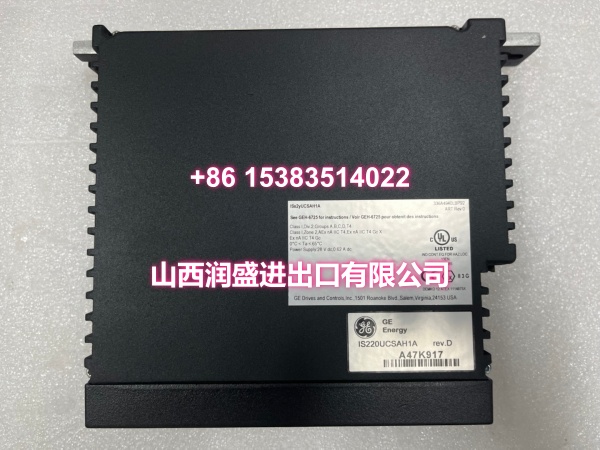
- Model: IS220UCSAH1A
- Brand: General Electric (GE)
- Series: Mark VIe (Speedtronic)
- Core Function: UCS (Universal Control System) processor module — the main controller brain for GE Mark VIe turbine and industrial control systems, executing real-time control logic, I/O processing, and network communication.
- Product Type: UCS Processor / Embedded Controller Module
- Key Specs: Freescale PowerPC 667MHz CPU | 256MB DDR SDRAM | QNX Neutrino RTOS | 5× 10/100BaseTX Ethernet ports | 18-36VDC power | TMR redundancy support | NFPA Class 1 Div 2 rated
- Condition: New Original / New Surplus
Product Introduction
The GE IS220UCSAH1A is the UCS (Universal Control System) processor module at the heart of GE’s Mark VIe Speedtronic control platform. It serves as the main controller for gas turbine, steam turbine, and industrial process control applications — executing real-time control logic, managing distributed I/O modules, and coordinating communication across the control network.
At its core, the IS220UCSAH1A runs a Freescale PowerPC PowerQUICC II Pro processor at 667MHz, paired with 256MB DDR SDRAM and the QNX Neutrino real-time operating system (RTOS). This combination delivers deterministic control response times critical for turbine protection and safety functions. The module supports Triple Modular Redundant (TMR) architecture — up to three IS220UCSAH1A units can be mounted side-by-side in the same cabinet, voting on control outputs to provide fault-tolerant operation. If one controller faults, the other two continue to operate without interruption.
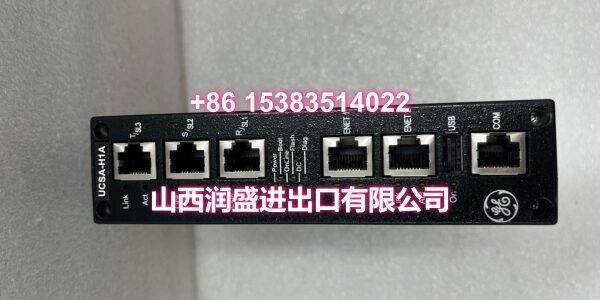
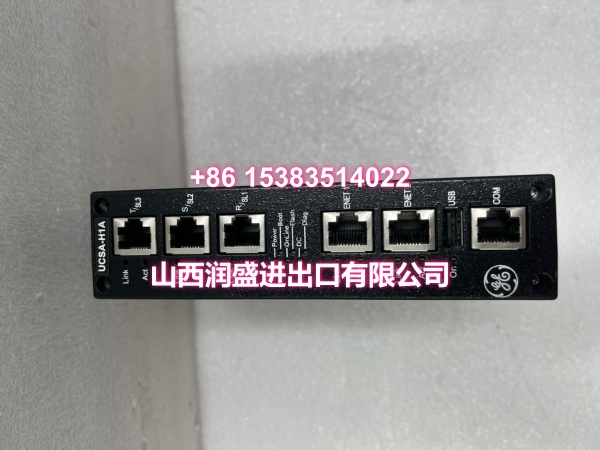
The module features five 10/100BaseTX Ethernet ports: two dedicated to the Unit Data Highway (UDH) for controller-to-controller and controller-to-HMI communication, and three for IONet connections to distributed I/O packs. A front-panel RS-232C serial port and USB port support local configuration, firmware updates, and data exchange. The compact single-box design mounts on a DIN rail or baseplate, with passive convection cooling — no fan required even at the top of its 0-65°C operating range.
The IS220UCSAH1A is NFPA Class 1, Division 2 rated, making it suitable for hazardous location installations where flammable gases or vapors may be present. Built-in diagnostics continuously monitor processor health, memory integrity, and network connectivity, alerting operators via the CIMPLICITY HMI before a fault escalates into a trip.
Key Technical Specifications
| Parameter | Value |
|---|---|
| Manufacturer | General Electric (GE) |
| Product Type | UCS Processor Module |
| Series | Mark VIe (Speedtronic) |
| Processor | Freescale PowerPC PowerQUICC II Pro, 667MHz |
| Memory | 256MB DDR SDRAM |
| Operating System | QNX Neutrino RTOS |
| Ethernet Ports | 5× 10/100BaseTX (2× UDH + 3× IONet) |
| Serial Port | 1× RS-232C (front panel) |
| USB Port | 1× USB (front panel, for config/data) |
| Power Input | 18-36VDC |
| Power Consumption | ~12W typical |
| Operating Temperature | 0°C to 65°C (passive cooling, no fan) |
| Humidity | 5%-95% non-condensing |
| Hazardous Rating | NFPA Class 1, Division 2 |
| Redundancy | Simplex, Dual, TMR (up to 3 units) |
| Dimensions | 150mm × 100mm × 50mm |
| Weight | ~660g |
| Mounting | DIN rail or baseplate |
| Application | Gas/steam turbine control, industrial process automation |
| Origin | USA |
Quality Control Process
Every IS220UCSAH1A goes through a full functional bench test before it ships. We start with a visual inspection — checking for cold solder joints, burnt traces, swollen capacitors, and verifying the integrity of all connector headers (Ethernet jacks, USB port, RS-232C port, and power terminals). Processor modules are sensitive to electrostatic discharge and thermal cycling, which can degrade the CPU socket and memory chips over time.
Then we power it up on a regulated 24VDC supply and verify the power draw is within the ~12W typical spec. We confirm the QNX RTOS boots correctly by monitoring the front-panel LED sequence (Power → Boot → Online → Flash → Diag) and verifying the module completes its POST (Power-On Self-Test) without errors. We test all five Ethernet ports by connecting to a network switch and confirming link/activity LEDs illuminate on each port, then verifying the module registers on the UDH and IONet networks with its correct hardware ID.
We test the RS-232C serial port by establishing a terminal connection and confirming bidirectional data transfer. We test the USB port by connecting a flash drive and confirming read/write functionality for firmware updates and data logs. We verify the TMR synchronization function by connecting two or three IS220UCSAH1A units together and confirming they vote correctly on control outputs. We run a stress test by exercising the processor with continuous I/O scan cycles for several hours, monitoring for memory leaks or CPU overload. Each unit ships in anti-static foam with a moisture barrier bag.
Replacement Pitfall Guide
❗ Verify the firmware revision matches your existing system. The IS220UCSAH1A runs QNX Neutrino RTOS with application-specific firmware. If the replacement module’s firmware revision doesn’t match the other controllers in your TMR system, the new unit will fail to synchronize and will be voted out immediately. Always check the firmware version on your existing controllers (visible via the CIMPLICITY HMI or front-panel diagnostics) and confirm the replacement matches before installation.
❗ Confirm the IONet and UDH network configuration. The five Ethernet ports have specific roles — two for UDH (controller-to-controller/HMI) and three for IONet (controller-to-I/O). If you connect IONet devices to a UDH port (or vice versa), the controller will not communicate with those devices. Always verify the port assignments in your Mark VIe network configuration before connecting cables.
❗ Check the TMR voting configuration before going live. If you’re replacing a controller in a TMR system, the new unit must be properly configured as a voting member before the system will accept its outputs. If the replacement is configured as a simplex unit, it will not participate in the voting logic, leaving your system without redundancy. Verify the TMR configuration in the controller software after installation.
❗ Don’t skip the POST and diagnostics check. After installing the replacement, monitor the front-panel LED sequence during boot. A fault during POST (indicated by the Diag LED) means the module has a hardware issue and should not be put into service. Also verify the module reports no memory errors or CPU overload conditions via the CIMPLICITY HMI diagnostics page.
❗ Watch for passive cooling requirements. The IS220UCSAH1A relies on passive convection cooling — no fan. If the module is installed in a tightly enclosed cabinet with poor airflow, it can overheat even within its 0-65°C rated range. Ensure adequate clearance around the module (especially the side ventilation grilles) and verify cabinet temperature stays within spec during operation.
Keep these in mind and you’ll cut 90% of rework time.
Compatibility Matrix & Benchmarks
| Original Model | Replacement / Successor Model | Compatibility Level | Migration Notes |
|---|---|---|---|
| IS220UCSAH1AK | Direct | Enhanced revision with improved performance; drop-in compatible | |
| IS220UCSAH1B | Direct | Later revision; verify firmware match | |
| Mark VIe legacy UCS | Direct | Drop-in for Mark VIe UCS racks | |
| IS420UCSCH1A | Needs Adaptation | Mark VIeS variant; requires full network and I/O migration |
- Processor: Freescale PowerPC 667MHz with QNX Neutrino RTOS for deterministic control
- Redundancy: TMR architecture — up to 3 controllers voting for fault-tolerant operation
- Networking: 5× Ethernet ports (2× UDH + 3× IONet) for distributed control architecture