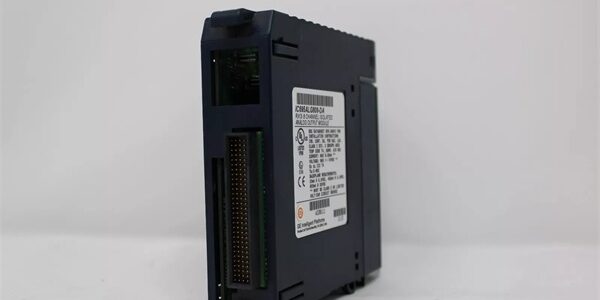
Product Core Brief
- Model:
- Brand: GE Fanuc / GE
- Series: Series 90-30 PLC
- Core Function: Acts as Genius serial bus master, enabling Series 90-30 CPU to communicate with Genius remote I/O blocks, Genius controllers and field devices on the Genius network.
- Product Type: Early Generation Genius Bus Master Communications Module
- Key Specs: Max 32 bus nodes | Fixed 153.6 kbps baud rate | RS485 field bus interface Note: Discontinued legacy hardware; factory new stock no longer available, surplus and refurbished units widely traded. Early Genius master variant, mechanically compatible with later BEM331 series but lacks adjustable baud rate. Hot swapping is not supported for Series 90-30 backplanes.
Key Technical Specifications
- Bus Mode: Genius Serial Bus Master only; slave operation unsupported
- Baud Rate: Fixed 153.6 kbps (no software selectable speed options)
- Maximum Connected Nodes: 32 Genius bus devices per module
- Per-Device Data Exchange: 128 bytes input, 128 bytes output per node
- Global Broadcast Data: 128 bytes transmit / 128 bytes receive
- Field Interface: Screw terminal RS-485
- Required Termination: External 120 Ω resistor installed at both physical cable endpoints
- Maximum Cable Length: 1066 m at 153.6 kbps
- Backplane Power Draw: 30 mA @5 VDC
- Status LEDs: OK (module health), COM (bus activity indicator)
- Operating Temperature: 0°C to 60°C horizontal cabinet mounting
- Storage Temperature: -40°C to 85°C
- Form Factor: Single-width Series 90-30 rack slot
- Compatible Chassis: IC693CHS391, IC693CHS392, IC693CHS397, IC693CHS398
- Supported Programming Software: Logicmaster 90, Proficy Machine Edition
Product Introduction
This early-generation communication module serves as a bridge between Series 90-30 controllers and legacy Genius distributed I/O systems. It continuously scans all Genius bus nodes and exchanges I/O data with the host CPU over the PLC backplane.
Distinct from IC693BEM331 variants, this module runs at a fixed 153.6 kbps baud rate. It is commonly encountered on older machine and process plant installations where the Genius network was originally commissioned at maximum speed. Multiple modules can be fitted to one rack to run independent Genius bus segments.
QA & Testing SOP (Transparency Building)
- Incoming Inspection: Verify part marking and hardware revision. Inspect backplane edge pins for bending or corrosion; check terminal block housing for cracks.
- Live Testing: Mount into validated Series 90-30 rack, apply rack power. Establish Genius bus connection to a test Genius node and run continuous 24-hour cyclic data exchange.
- Electrical Testing: Use Fluke 115 to monitor backplane rail stability. Insulation resistance testing must exceed 10MΩ between field terminals and chassis protective ground.
- Firmware/Config Backup: Record module firmware revision. Photograph terminal wiring arrangement before disassembly.
- Final QC & Packaging: Place unit inside anti-static shielding. Attach dated QC test tag confirming Genius bus communication validation prior to shipment.
Installation Pitfalls & Guide (Engineer to Engineer)
❗ No Hot Swap Support: Series 90-30 backplanes lack hot-swap bus logic. Live removal disrupts the entire Genius bus and risks permanent backplane damage. Full rack power shutdown mandatory. ❗ Fixed Baud Rate Limitation: This module only operates at 153.6 kbps. It cannot replace IC693BEM331 on networks running 38.4 kbps or 76.8 kbps without reconfiguring all Genius field nodes. ❗ Missing Bus Termination: Uninstalled 120 Ω end resistors create signal reflections, leading to CRC errors and intermittent node dropouts. Terminate both physical cable ends. ❗ Cross-Model Replacement Risk: Mechanically interchangeable with IC693BEM331, but baud rate constraints must be validated before substitution. ❗ ESD Dangers: Un-grounded handling can damage RS485 transceiver circuitry. Static faults often appear as random communication glitches without visible external damage. ❗ Platform Restriction: Designed exclusively for Series 90-30 racks; cannot be used inside PACSystem RX3i chassis.
Replacement Guide:
- Pre-install: Activate lockout-tagout on rack power; back up hardware configuration, record Genius node address table and photograph field bus wiring. Confirm all Genius nodes are set to 153.6 kbps.
- Removal: Disconnect Genius bus terminal wiring, unlatch module and slide straight out without twisting backplane connectors.
- Install: Seat new unit fully into vacant slot, lock latches, reattach RS485 bus wiring and install required termination resistors.
- Power-on Test: Restore rack power, download saved configuration, verify OK and COM LED activity; confirm all Genius nodes are recognized by the CPU.
FAQ (Frequently Asked Questions)
Q: Does this module support hot swapping? A: Physically insertion is possible, but Series 90-30 backplane does not support controlled hot swap. Live removal disrupts the whole Genius bus and may trigger process faults. Planned replacement requires rack power shutdown.
Q: What is the core difference between and IC693BEM331? A: only supports fixed 153.6 kbps. IC693BEM331 supports 38.4 kbps,76.8 kbps,153.6 kbps selectable baud rates. They are mechanically compatible, but network speed must match all field nodes for successful operation.
Q: Can multiple modules run separate independent Genius networks? A: Yes. A single Series 90-30 rack can host multiple modules, each controlling an isolated Genius bus segment with separate wiring.
Q: Can this module be installed inside PACSystem RX3i racks? A: No. Form factor and backplane signaling are exclusive to Series 90-30 chassis. RX3i systems use IC694BEM331 for Genius bus master functionality.
Q: Can this module operate as Genius bus slave device? A: No. It functions exclusively as bus master. Slave mode requires different Genius hardware.
Q: Will existing configuration download directly to a replacement unit? A: Configuration imports without modification. Confirm all field Genius nodes are set to 153.6 kbps and verify bus termination after replacement.
Q: Can Genius handheld monitors (HHM) tap onto this bus? A: Yes. A compatible Genius HHM can connect to the active bus for live diagnostics and node configuration while the CPU remains online.