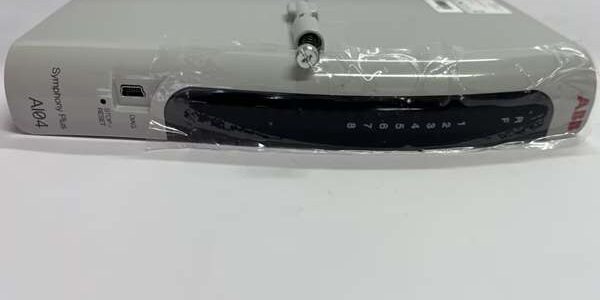
Product Core Brief
- Model: AI04
- Brand: ABB
- Series: Symphony Plus SD Series Singular I/O
- Core Function: Converts 16-channel thermocouple/millivolt field signals to digital bus data for HN800 DCS controllers, with configurable cold junction compensation.
- Product Type: Rack-mount thermocouple analog input I/O module
- Key Specs: 16 multi-type TC/mV channels | 16-bit A/D resolution | 1500 VAC group isolationNote: Obsolete EOL OEM spare, limited new surplus inventory; no native HART or RTD excitation support.
Key Technical Specifications
- Operating supply: 24 V DC ±10 %, 65 mA typical, 73 mA maximum power draw
- Supported input signals: Thermocouple types B, E, J, K, L, N, R, S, T, U; 0–100 mV / -100–+100 mV bipolar mV ranges
- A/D hardware: Four independent 4-channel converters, 16-bit resolution with polarity bit
- Full 16-channel scan cycle: 300 ms total refresh rate
- Measurement accuracy: ±0.05 % full scale (200 mV FSR) at 25 °C ambient
- Galvanic isolation: 1500 VAC 1-minute group-to-backplane isolation, IEC 61010-1 certified
- Noise rejection: Min -70 dB normal-mode, min -90 dB common-mode noise suppression
- Cold junction compensation (CJC): Three configurable modes – base-mounted RTD, external field RTD, software fixed offset
- Fault detection: Thermocouple wire-break detection triggers within 5 seconds per channel
- Calibration: Onboard automatic self-calibration; no manual offset trim required
- PCB coating: Full acrylic conformal coating for dust, humidity and light industrial fume resistance
- Status indicators: Individual LED per input channel, global POWER and COMM fault lamps
- Mechanical form: Slide-in Singular card for VBS01-TC DIN rail mounting base, no hot-swap capability
- Operating ambient: -25 °C to +70 °C, linear performance derating above 65 °C
- Storage range: -40 °C to +85 °C, non-condensing 5–95 % relative humidity
- Max field wiring length: 600 meters for shielded thermocouple extension wire
- Dimensions: 190 mm H × 106 mm D × 27 mm W
- Net weight: 0.228 kg
Product Introduction
This I/O card is a dedicated low-level temperature acquisition component built exclusively for Symphony Plus SD DCS racks. It reads thermocouple signals used for furnace, turbine, stack and high-temperature process monitoring.Group galvanic isolation blocks high common-mode noise from nearby variable frequency drives, limiting temperature reading fluctuation to less than 0.1 °C during large motor load transients. Auto CJC circuitry eliminates manual cold-jump trim adjustments required on older discrete thermocouple interface hardware.
QA & Testing SOP
- Incoming Inspection: Cross-reference serial numbers against ABB Symphony spare part databases. Inspect conformal coating for delamination, terminal block spring tension and full LED channel functionality. Reject units with damaged factory anti-static packaging to eliminate counterfeit stock.
- Live Testing: Seat the device in a VBS01-TC test base paired with a HN800 controller simulator. Run a continuous 24-hour cyclic scan test across all 16 channels while logging stable 24VDC supply via Fluke 115 multimeter. Simulate open-circuit thermocouple wiring faults to validate alarm reporting timing.
- Electrical Testing: Use a 500V Megger to measure insulation resistance between field channel groups and backplane logic; pass threshold set at ≥10 MΩ. Inject 50Hz differential ground-loop noise to confirm no false wire-break fault flags.
- Firmware/Config Backup: Record factory thermocouple type and CJC preset values via Control Builder M software. Capture high-resolution photos of all mechanical keying tabs and terminal pin labels for field commissioning reference.
- Final QC & Packaging: Fit plastic dust caps over the front terminal header. Place the PCB inside foam-lined anti-static shielding bag, affix a dated QC pass label before sealing in original factory carton.
Installation Pitfalls & Guide
❗Firmware Rev Mismatch Risk: HN800 controller firmware older than v6.0.8 lacks register mapping for multi-mode cold junction compensation logic. Post-replacement, the DCS will show skewed temperature values and throw intermittent AI COMM LOSS alarms. Remediation: Flash matching firmware revision to the main controller before rack insertion.❗Mechanical Keying Errors: The mounting base uses plastic key pins to block incompatible I/O cards. Always photograph key tab positions on the old unit before removal and replicate exact cutout alignment; miskeying causes partial backplane contact and missing channel temperature data.❗Wiring Incompatibilities: Unshielded thermocouple extension wire introduces mains interference into mV inputs, creating ±0.4 °C reading drift. Use OEM matched thermocouple extension cable with single-point chassis ground at the I/O rack terminal bar, follow 0.8 N·m torque specs for terminal screws.❗Backplane Power Draw Changes: A degraded rack 24VDC supply with less than 20% current headroom cannot support the unit plus multiple analog output cards during controller startup, triggering repeated backplane resets and total I/O data loss. Recalculate total rack load before swapping the card.❗ESD Dangers: Ungrounded handling exposes low-level mV analog traces to static discharge from dry control room air. Field records show unprotected handling burns input signal circuits; full process unit downtime labor cost exceeds $1,620. Remediation: Place anti-static mat under the I/O rack, wear grounded wrist strap, touch bare chassis ground for 3 seconds before handling the PCB.
4-step replacement guide
- Pre-install: Lock out and tag all rack 24VDC auxiliary power. Photograph old unit mechanical key positions and field thermocouple wiring layout per channel.
- Removal: Release the rack slide latch, pull the old card free and disconnect terminal wiring one channel at a time to avoid cross-channel miswiring.
- Install: Transfer wiring harness to the new unit’s terminal header, match photographed mechanical key settings, slide the card fully into the VBS01-TC base and lock the latch.
- Power-on Test: Restore 24VDC auxiliary power first; verify all channel LEDs activate correctly, connect a precision mV simulator to confirm accurate temperature readings before restoring full DCS bus communication.
FAQ
Q: Can this unit be hot-swapped while the Symphony rack remains powered?A: No. It shares a common HN800 backplane data bus with critical control I/O. Removing it live creates voltage transients that corrupt controller scan tables and can permanently damage adjacent analog modules. Full lockout of rack auxiliary power is mandatory for replacement.Q: Does this card carry original OEM factory warranty when purchased as new surplus?A: ABB factory warranty expired at product end-of-life. All surplus inventory passes full in-house QA testing and carries a 12-month internal stock replacement warranty, limited to manufacturing defects detected during bench validation.Q: Can AI03 serve as a direct drop-in replacement for the device?A: Mechanical fit only. AI03 is an 8-channel RTD board with no mV/thermocouple input circuitry. Swapping without reworking field sensor wiring and DCS control logic will disable all high-temperature thermocouple monitoring loops.Q: What minimum controller firmware version enables full multi-mode cold junction compensation support?A: HN800 DCS controller firmware v6.0.8 or newer. Older builds lack register addresses for external RTD CJC inputs, only supporting fixed software offset with large measurement drift.Q: Will the unit retain thermocouple type and CJC mode settings after power loss?A: No calibration or configuration data stores on-board. All channel TC parameters and CJC selections reside in the HN800 controller’s non-volatile memory. No re-calibration of the device itself is needed post-swap.Q: Is the unit compatible with System 800xA AC 800M controllers?A: No. The card uses the proprietary Symphony I/O backplane bus, which is electrically incompatible with AC 800M CI8xx I/O fieldbus interfaces.Q: How often should the conformal coating be inspected in a power plant boiler control room environment?A: Under continuous moderate flue gas and dust exposure, the coating maintains full insulation performance for roughly 6 years. Annual visual inspection of the PCB surface is recommended to track coating cracking or discoloration from airborne contaminants.