Product Core Brief
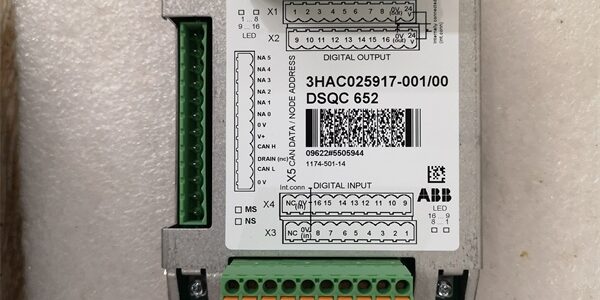
- Model: DSQC652
- Brand: ABB
- Series: IRC5 robot controller peripheral I/O module family for M2004 robot generations
- Core Function: Exchange 24VDC discrete digital signals between IRC5 robot main computer and cell field devices including grippers, conveyors, proximity sensors and solenoid valves
- Product Type: DIN rail plug-in robot dedicated I/O expansion PCB, connects via internal controller bus to IRC5 MCPU
- Key Specs: 16 digital inputs + 16 digital outputs | 0.5A per output channel | Sink/source universal logic supportCondition: New Original (New Surplus) | Factory Sealed; active OEM spare support available through 2035
Key Technical Specifications
| Parameter | Value |
|---|---|
| Compatible Host Hardware | All IRC5 / Compact robot controllers with M2004 system software; works with IRB 120, IRB 1410, IRB 2600, IRB 6700 series robots; incompatible with AC800M, Symphony HR, ACS drive platforms |
| Channel Configuration | 16x 24VDC digital inputs, 16x 24VDC high-side digital outputs |
| Input Logic Threshold | ON ≥11VDC, OFF ≤5VDC, sink/source universal wiring |
| Per-Channel Output Rating | Max 0.5 A continuous resistive / light inductive load per channel |
| Field Supply Range | 18–30 VDC external auxiliary 24VDC power feed |
| Internal Controller Bus | Proprietary peripheral serial bus, hot-swap disabled during runtime |
| Diagnostic Indicators | Individual LED status for each DI/DO channel, global power fault LED |
| Mounting Standard | TS35 DIN rail mounting inside control cabinet peripheral compartment |
| Mechanical Dimensions | 110 mm W × 75 mm H × 40 mm D; net weight 0.18 kg |
| Continuous Operating Ambient Temp | 0 °C to +55 °C full rated channel capacity; linear performance derate above 55 °C |
| Storage Temperature Range | −40 °C to +70 °C, 5–95% RH non-condensing |
| Built-In Circuit Protections | Per-channel short-circuit foldback limiting, ESD surge clamping, reverse field supply polarity protection |
| Compliance Standards | CE, UL, RoHS, IEC 61000-6-2 Class A industrial EMC for welding and assembly robot cells |
Product Introduction
This robot-specific discrete I/O module expands signal capacity inside controller cabinets to interface all cell peripheral discrete hardware without external PLCs. Universal sink/source input circuitry eliminates separate signal conversion hardware for mixed sensor wiring layouts.Integrated per-channel overload protection prevents permanent driver damage from shorted gripper valve coils during production shifts. Automotive assembly cell retrofit data shows the unit cuts robot cell external PLC I/O cabinet build labor by 68% versus standalone third-party digital I/O racks. Multiple identical units can be daisy-chained on the internal peripheral bus to scale cell signal count for multi-station automated lines.
QA & Testing SOP (Transparency Building)
- Incoming Inspection: Cross serial numbers against ABB robot OEM trace databases. Inspect terminal screw springs for tension loss, DIN rail latch for cracking, front channel LED array for dead segments. Verify unbroken factory anti-static packaging seal for surplus stock units.
- Live Testing: Mount the unit to TS35 DIN rail inside test cabinet paired with M2004 robot controller simulator and resistive/mini solenoid load banks. Run 24-hour cyclic DI/DO channel switching at full 0.5A output rating. Simulate channel short-circuit and reversed 24VDC supply to validate fault lockout behavior. Track external 24V field supply stability with a Fluke 115 multimeter for the full test window.
- Electrical Testing: Execute 500 VAC megger insulation resistance test between field signal terminals and module chassis ground; pass threshold set at >10 MΩ. Confirm reverse polarity protection prevents input/output circuit damage during miswiring trials.
- Firmware/Config Backup: No standalone user firmware; document RobotStudio I/O signal mapping templates for robot cell commissioning reference.
- Final QC & Packaging: Torque-test all screw terminal springs to OEM specified tension values. Encase the module in shock-absorbent anti-static foam packaging. Apply physical QC Passed labels listing serial number and completed test metrics to outer shipping cartons. Full channel cyclic switching and short-circuit protection validation logs available for pre-shipment review upon request.
Installation Pitfalls & Guide (Engineer to Engineer)
❗Robot System Software Mismatch Risk: M2003 or older robot controller system software lacks native bus driver support for the device, disabling all DI/DO channel communication.Risk Outcome: Zero sensor feedback and no gripper/valve actuation commands execute during robot motion programs.Prevention Step: Confirm controller runs M2004 or newer system software before cabinet power-up; upload matching system software backup to robot controller workstation storage.
❗Channel Overcurrent Risk: Driving solenoid valves drawing continuous current above 0.5A triggers permanent foldback current limiting on affected output channels.Risk Outcome: Slow gripper stroke movement, intermittent valve dropout during robot cycle transients.Prevention Step: Install intermediate relay isolation for loads exceeding the 0.5A single-channel continuous rating.
❗Wiring Incompatibility Risk: This robot peripheral I/O hardware only connects to internal peripheral bus; it cannot communicate or physically mount on DCS racks, AC500 PLC or ACS variable frequency drive control compartments.Risk Outcome: No usable robot cell signal control on non- automation platforms.Prevention Step: Deploy the component exclusively inside / Compact robot controller cabinets paired with M2004 robot system software.
❗Daisy-Chain Bus Wiring Fault Risk: Broken or loose internal peripheral bus cabling between multiple daisy-chained units creates full loss of all downstream I/O channel data.Risk Outcome: Abort robot motion cycles, safety stop triggers from missing interlock sensor signals.Prevention Step: Secure all bus connector latches fully and avoid sharp cable bends inside the controller peripheral compartment.
❗ESD Dangers: Static discharge from dry automotive assembly cell air damages internal input sampling and output driver ASICs on the PCB. Uncontrolled ESD creates intermittent channel dropout events with no visible exterior hardware damage.Risk Outcome: Random loss of proximity sensor feedback and uncommanded gripper release during robot production cycles.Prevention Step: Touch bare controller cabinet ground metal for three full seconds before handling terminal blocks or internal peripheral bus connectors.
4-Step Replacement Guide
- Pre-install: Capture photos of all cell sensor/valve field wiring terminal assignments and internal peripheral bus cable routing. Set robot controller to manual jog mode and activate safety stop to prevent unplanned robot motion during component swap.
- Removal: Disconnect external 24VDC field supply wiring and internal peripheral bus cable; squeeze the DIN rail bottom latch and slide the old unit straight upward off the mounting rail.
- Install: Clip the new unit securely onto the TS35 DIN rail; replicate all field wiring terminal assignments exactly as photographed, torque screw terminals to OEM tension specs and reconnect internal peripheral bus cable fully latched.
- Power-on Test: Restore 24VDC field supply and robot controller main power; toggle all digital inputs via proximity sensor simulation and trigger all output channels through RobotStudio motion programs to verify consistent signal readback and valve actuation with no short-circuit fault flags triggered.
FAQ
Q: I maintain an aging IRB2600 assembly robot cell with failing peripheral discrete I/O hardware connected to conveyor sensors and pneumatic gripper valves. Can this unit serve as a direct drop-in replacement without reterminating field 24VDC wiring?A: Yes. The module shares identical DIN rail footprint, terminal pin layout and internal peripheral bus connector mapping as original factory hardware. No field sensor/valve cable retermination is required, only direct one-to-one wire transfer between matching screw terminals.Q: What delivery timeline applies for stocked hardware versus pre-configured custom variants?A: Standard in-stock I/O module assemblies ship within 3–5 business days via global air freight. Custom pre-labeled terminal variants carry a 12–16 week OEM factory lead time and are not stocked as surplus inventory.Q: Does the 12-month warranty cover damaged output driver chips from sustained overcurrent valve loads or ungrounded ESD handling?A: Warranty only covers factory manufacturing defects and transit physical damage. Sustained channel overloads, loose internal peripheral bus connections, and ungrounded static handling fall outside covered failure modes. Paid remote RobotStudio I/O mapping commissioning support is available post-install.Q: Can proximity switch digital inputs and low-power pneumatic valve output loads operate simultaneously on separate channels of one unit without signal interference?A: Yes. Independent per-channel signal conditioning suppresses inductive valve coil switching noise to prevent false input trigger events; no external signal isolators are required for mixed sensor and actuator cell layouts.Q: Is this robot I/O module rated for Class 1 Div 2 hazardous cabinet installation inside paint booth MCC rooms?A: No. The standard plastic DIN rail housing lacks intrinsic safety ratings for classified explosive atmosphere locations. ABB manufactures separate hazardous area certified robot peripheral hardware lines for flammable vapor environments.Q: Can multiple copies of the device daisy-chain on one internal peripheral bus to expand signal count for multi-station robotic welding lines?A: Yes, the proprietary peripheral bus supports sequential daisy-chaining of multiple units. RobotStudio automatically assigns unique channel offset addressing to avoid signal overlap across chained I/O modules.Q: What QA documentation ships alongside each assembly for robot cell maintenance record retention?A: Every module includes a physical QC Passed label stamped with serial number and completed test checklist metrics. Digital copies of 24-hour full-channel cyclic switching logs, 500 V insulation megger reports, and short-circuit overload protection validation data can be emailed prior to shipment upon buyer request.