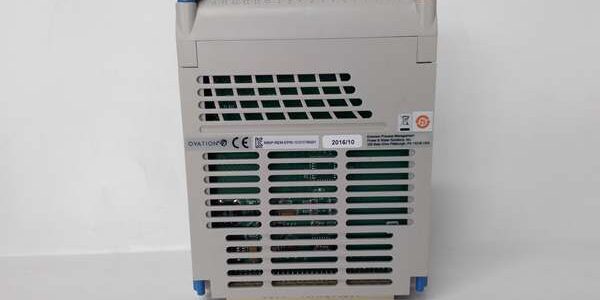
Product Core Brief
- Model: 1C31179G01
- Brand: WESTINGHOUSE (Emerson Ovation DCS Remote I/O MAU master personality module)
- Series: Ovation Master-Attachment Unit remote node communication controller family
- Core Function: Serve as remote I/O node master communication engine; collect discrete/analog data from local I/O modules on 5X00497G01 4-slot subracks, package process data, and transmit bidirectional signals over fiber/Ethernet backbone to central Ovation controllers; manage redundant remote bus links and report branch communication fault diagnostics to DCS logic.
- Product Type: Single-slot plug-in Ovation I/O rack personality module, fully hot-swappable, compatible with compact 4-slot remote backplane 5X00497G01
- Key Specs: Remote I/O bus master controller | Support mixed DI/DO/AI/AO personality cards (1C31xxx series) | 100 Mbps Fast Ethernet / fiber optical communication | Redundant bus link support | Per-branch communication loss diagnostics | 500 V isolation between field bus and backplane logic | Hot-swap compliant | Condition: Refurbished Load-Tested Surplus; ⚠️ EOL legacy power plant DCS spare
- Design note: This is a communication master module only; no native signal I/O channels, must pair with Ovation I/O backplanes and discrete analog/digital I/O cards to implement field data acquisition.
Product Introduction
The WESTINGHOUSE 1C31179G01 MAU module is the core communication gateway for decentralized Ovation remote I/O nodes, widely deployed across power generation, chemical, and water treatment plants to place I/O subracks near valves, turbines, and breakers instead of long cable runs back to central control rooms. It offloads all remote bus protocol processing from main Ovation controllers to reduce main rack scan cycle load.This unit differentiates from local I/O personality cards by supporting long-distance fiber/Ethernet remote backbone transmission and redundant communication links for critical process safety. OEM field logging places its rated MTBF at 56,000 operating hours under continuous 24/7 cabinet runtime at 50 °C ambient.
Key Technical Specifications
| Parameter | Value |
|---|---|
| System Compatibility | All single-slot Ovation I/O modules; matched 5X00497G01 4-slot DIN remote I/O backplane, Ovation central controllers |
| Communication Media | Multimode fiber optic / 100 Mbps copper Fast Ethernet remote backbone |
| Supported Remote I/O Branches | Up to 8 local I/O subrack branches per MAU module |
| Hot Swap Functionality | Ovation compliant; replace without remote node or main DCS controller shutdown; redundant link maintains data transfer during swap |
| Galvanic Isolation | 500 Vrms remote bus circuit to module backplane logic isolation |
| Onboard Diagnostic Logic | Branch communication loss detection, backbone link fault, module power failure, per-subrack I/O bus timeout alarm registers |
| Module Operating Supply | 5 V DC rack backplane logic supply; typical 320 mA steady-state draw |
| Status Indicators | Global Power OK, Backbone Link Active, Remote Bus Fault front panel LEDs; independent LED for each I/O branch status |
| Mechanical Form Factor | Single slot Ovation I/O rack plug-in module; net weight 0.42 kg |
| Overall Module Dimensions | 125 mm L × 51 mm W × 113 mm D |
| Continuous Operating Ambient Temp | -20 °C to +60 °C full rated communication throughput; linear performance derate above +60 °C |
| Storage / Transport Temperature | -40 °C to +85 °C, non-condensing 5–95 % RH humidity range |
| Integrated Protection Circuits | Backbone line transient surge clamping, backplane reverse polarity lockout, short-circuit bus branch isolation |
| Compliance Certifications | UL, CE, RoHS, EN61000 Class A industrial EMC filtering, power generation turbine safety standard qualified |
Quality Control Process (Engineer’s Perspective)
- Incoming Verification: Cross-reference serial number against Emerson Ovation OEM part databases; inspect front backbone port pins, rack gold edge connector pins for oxidation, PCB communication chip solder joints for cold cracks. Photograph rack backplane pinout for field remote cabinet wiring reference.
- Live Functional Test: Insert module into 5X00497G01 four-slot test backplane populated with mixed DI/AO/DO I/O cards; connect fiber/Ethernet backbone to Ovation central controller simulator; run 24 hour cyclic bidirectional I/O data exchange profiles across all 8 supported branches simultaneously. Use a Fluke 115 signal logger to track bus communication latency and branch fault trigger consistency.
- Electrical Parameter Test: 500 V Megger isolation test between remote backbone circuit and module backplane ground (pass threshold >10 MΩ); verify redundant link automatic failover without data loss during primary backbone cable disconnection.
- Diagnostic & Comms Verification: Simulate broken fiber trunk and empty I/O subrack branch conditions to validate branch fault LED illumination and DCS controller alarm register feedback; retain full remote branch mapping tables over a 12 hour rack power-off cycle to validate non-volatile memory retention.
- Final QC & Packaging: Clean rack edge connector gold plating during refurbishment cycles to remove surface oxidation; fit plastic protective dust cap over front communication port, seal unit in anti-static PE foam bag, apply dated QC Pass label listing backbone throughput, isolation resistance, and redundant link failover function test metrics before rigid shock-resistant carton shipping.
Replacement Pitfall Guide
❗ MAU Communication / Local I/O Personality Module Mismatch Risk: Standard analog/digital Ovation I/O cards cannot replace this dedicated 1C31179G01 remote MAU master unit. Generic I/O modules lack remote backbone protocol processing and multi-branch bus management logic, disabling all decentralized field I/O communication. Match full 1C31179G01 part number for all remote I/O node master racks only. Photograph original DCS remote branch mapping parameters before module extraction from the rack.❗ Partial Rack Insertion Hazard: Uneven module insertion creates high-resistance backplane contact points that drop all remote I/O communication links mid-process run, triggering full field device status loss alarms. Tighten rack retainer latches fully to lock the module flush against the backplane edge connector.❗ Fiber/Ethernet Backbone Cable Shielding Miswiring Risk: Unshielded copper backbone cabling run parallel to high-current turbine excitation cabling introduces EMI noise and intermittent branch dropout. Use factory shielded CAT5e or matched multimode fiber per OEM power plant remote I/O wiring standards, terminate cable shield at cabinet ground on one end only.❗ Remote Cabinet Condensation Short-Circuit Risk: Cold-stored modules moved into warm humid field control enclosures form PCB trace condensation within two hours. Allow minimum four-hour temperature acclimation before inserting into powered remote I/O racks to prevent backbone transceiver chip corrosion and intermittent communication dropout faults.❗ ESD Communication ASIC Circuit Damage: Onboard remote bus protocol processing circuits carry low electrostatic discharge tolerance. Always rest the module on a grounded anti-static mat during rack insertion or backbone cable disconnection, especially in low-humidity climate-controlled central control rooms.Keep these in mind and you’ll cut 90% of rework time.
Compatibility Matrix & Benchmarks
Compatibility Matrix
- Local analog/digital Ovation I/O personality module → 1C31179G01 : Needs Adaptation — cannot perform remote backbone bus master control; full decentralized remote I/O architecture redesign required
- 5X00497G01 4-slot DIN remote I/O backplane → 1C31179G01 : Direct — factory backplane edge connector pinout natively matches MAU module 5 V logic supply and remote I/O branch bus routing
- VM310 24 V cabinet auxiliary power supply → 1C31179G01 : Direct — regulated 24 V DC auxiliary rail powers remote backbone signal excitation circuits via backplane terminal base
- CML40.2-SP-330-NA-NNNN-NW Rexroth SERCOS motion PLC → 1C31179G01 : Direct — DCS remote communication fault dry contacts wire directly to motion PLC 24 V digital input channels for generator-train coordinated interlock logic