Customer Value & Operational Benefits
Mixed TC Types on One Block
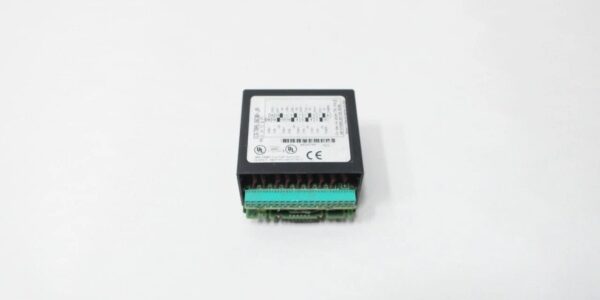
You aren’t locked into “All J-Type.” On one ALG630, you can set Channel 1 to J-Type (Exhaust Stack), Channel 2 to K-Type (Bearing), Channel 3 to S-Type (Furnace Hearth), and Channel 4 to mV (Custom Pyrometer). This mixes signals on a single $600 block, avoiding the need to buy a dedicated J-type block and a separate K-type block. It optimizes I/O point cost in skid-mounted packages (e.g., heat treat ovens, reactor jackets).
Precision via External CJC (CHS004)
The standard internal CJC is okay, but if the module is warmer than the terminal block (common in hot MCCs), you get reading errors. Using the IC670CHS004 Terminal Block (with thermistors right at the screw terminals) gives you local CJC. This improves accuracy by 1-2°C in variable ambient conditions, which is critical for B/T/S-Type high-temp loops (e.g., 1200°C furnace) where 1°C error is a lot of mV drift.
Built-in Diagnostics (Open Wire)
The module detects Open Thermocouple (broken wire or bad connection) and reports it to the BIU/PLC immediately. In a rack system, a broken TC often just reads “0” or “32767,” leaving you guessing. The ALG630 tells you “Channel 3 Open Wire.” This cuts troubleshooting time from 1 hour to 5 minutes during a 2 AM call-out on a reactor interlock.
Field Engineer’s Notes (From the Trenches)
The “Gotcha” is Terminal Block Selection (CHS vs CHS004) and CJC.
CHS004 for TCs: If you are wiring real Thermocouples (not just mV simulators), use the IC670CHS004 Terminal Block. The standard CHS001/CHS002 blocks have the CJC sensor on the module, away from the terminals. If your cabinet heats up to 40°C but the terminals are at 25°C (due to wire routing), the internal CJC assumes 40°C, adding a +15°C error to your Type K reading. The CHS004 puts the thermistor at the screw, correcting for the terminal temp.
TC Polarity: TCs are polarity sensitive (Seebeck effect). Reverse the leads (+, – swapped) on the terminal block, and the temperature will read negativeor inversely wrong (e.g., 200°C reads as -200°C or drops when heat rises). Always land TC (+) to Terminal (+), TC (-) to Terminal (-). Use a multimeter on mV setting: Heat the junction; if mV goes positive, polarity is correct.
Noise on mV Ranges: If using the ±19.5mV or ±39mV range (high resolution for low temp spans), the leads are acting as antennas. Use Shielded Twisted Pair (STP). Land the shield drain at the CHS004 terminal block ground (usually a specific terminal or the DIN rail if grounded), notat both ends. Floating shields pick up VFD noise, making your 0.1°C resolution read like a sawtooth.
Real-World Applications
- Heat Treat Furnace (Steel Mill): An ALG630 on a base reads 8 x Type S (Platinum-Rhodium) TCs from the furnace crown and hearth. The ‘s local thermistors correct for the 45°C MCC ambient, ensuring the 1050°C soak is accurate within 2°C, preventing scrap batches.
- Chemical Reactor Jacket (Pharma): Using the ALG630 to read 4 x Type T (Copper-Constantan) TCs on the reactor jacket (Coolant In/Out) and 4 x 4-20mA transmitters (scaled to mV input) for internal batch temp. The “Open Wire” detection caught a corroded TC lead in the wash cycle, preventing a runaway exotherm during the next batch.
High-Frequency Troubleshooting FAQ
Q: Module LED is Blinking, BIU shows “Config Mismatch” or “Fault” for this block.
A: Config Not Downloaded or Station Number Issue.
- Ensure the Station Number set via the BIU/HHP matches what is defined in the BIU’s I/O configuration for this block.
- The ALG630 stores its config in the BIU, not on the module itself. If you replaced a block, the BIU should auto-download the config when it powers up (if “Auto Config” is enabled).
- If not, use the Hand-Held Programmer (HHP) to “Send Configuration” from the BIU to the block, or power cycle the BIU station to force a re-download.
Q: Temperature reads “0”, negative, or wildly incorrect, but TC checks out with a meter (mV is correct).
A: Polarity or CJC Issue.
- Polarity: Swap the TC leads at the terminal block (+ to -, – to +). If the reading flips sign (e.g., -150°C to +150°C), your polarity was wrong. TC mV is polarity dependent.
- CJC Source: Ensure you are using the if relying on local CJC. If using a standard CHS001/002, the CJC is internal to the module; if the module is hotter than the terminals, you get an offset error.
- Config: Verify the Thermocouple Type in the config (e:g, J vs K). Setting a J-Type TC but configuring the channel for K-Type will give a wrong reading (different Seebeck coefficient).
Q: “Open Wire” alarm on a channel, but the TC is continuous (multimeter shows low ohms).
A: Trouble Shooting the Open Detect Current.
- The ALG630 sources a tiny current (<2µA) to check for continuity. If you have a grounded TC sheath (common in grounded junction TCs) and the other terminal is grounded elsewhere, or there is moisture in the junction box, the current finds a path to ground, fooling the detector.
- Test: Disconnect the TC at the terminal block. Measure resistance between the (+) terminal and the (-) terminal. Should be low ohms (wire resistance). Measure between (+) and Ground (Earth). Should be Megohms (Open). If low (kΩ), you have a grounded lead or moisture short, not an open wire. The “Open” alarm is a symptom, not the root cause.
Please note: The listed price is not the actual final price. It is for reference only and is subject to appropriate negotiation based on current market conditions, quantity, and availability.