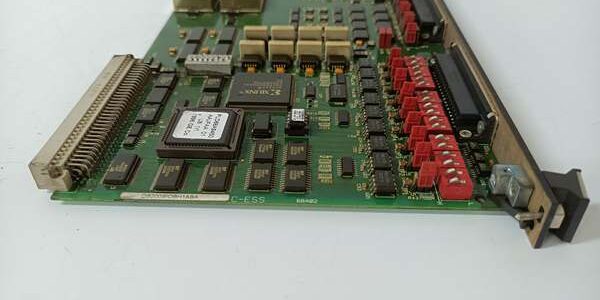
Core Technical Specifications
- Input Channels: 12 (Dry/Wet Contact Sensing, Optically Isolated)
- Input Voltage Range: 5 V DC to 125 V DC (Config via Terminal Board)
- Input Filter: Fixed 4 ms Hardware Debounce (Rejects <4ms transients)
- Output Channels: 12 (Form-C Relay Drivers / Low-Side Switches)
- Output Capability: Sinks ~1A @ 28V DC (Drives external relay coils)
- Communication: 2x 10/100Base-TX (RJ45), Auto-MDIX, Redundant IONet
- Field Interface: 1x DC-62 (37-pin D-sub) to TDBS (Simplex) or TDBT (TMR)
- Power Input: 27.4 – 28.0 V DC (3-pin Micro-Fit, Soft-Start enabled)
- Isolation: 1500 Vrms (Inputs), 2500 Vrms (Coil to Contacts on TB)
- Diagnostics: Status, Boot, Fault, Active, Net A, Net B LEDs (Faceplate)
- Mounting: DIN Rail (TS-35) or Direct-to-Board (TDBS/TDBT)
- Environmental: -30°C to +65°C, Conformal Coated
Customer Value & Operational Benefits
Cabinet Density & Cost Efficiency
The PDIO concept merges 12 DI and 12 DO into one unit. This cuts I/O slot count (or DIN rail space) by ~50% compared to deploying PDIA + PDOA pairs. In skid-mounted controls or retrofits with tight panel real estate, this avoids upsizing enclosures, saving on fabrication costs and cable tray congestion.
Deterministic Local Processing
The onboard processor handles the 4ms hardware debounce and I/O scanning locally. It only reports state changes to the controller, preventing EMI spikes from VFDs or contactors from triggering false inputs or flooding the IONet bandwidth. This improves signal integrity for critical loops like lube oil pump status or ESD pushbutton monitoring.
Simplified Spares Strategy
Since one PDIO replaces two spare types, your warehouse only stocks the IS220PDIOH1B. Whether a balance-of-plant skid loses an input channel or a cooling fan output, the same module works for both. This eliminates “wrong spare” downtime scenarios and reduces inventory carrying costs.
Field Engineer’s Notes (From the Trenches)
The “Gotcha” on the H1B (and H1A) is the Output Wiring Logic. These are Low-Side Switches (Sinks), not power sources.
You must land your 24V/125V DC Positive (+) on the coil of the external relay/solenoid, and land the Negative (-/Return) from the coil onto the PDIO’s terminal board (e.g., TB1 on TDBS). When commanded ON, the PDIO connects that terminal to Ground (DGND).
If you land 24V+ directly to the PDIO terminal thinking it’s a sourcing output, you will instantly fry the output driver transistor on the pack ($3k mistake).
Also, DC-62 Connector Stress: That 37-pin connector carries all 12 inputs and 12 drive signals. If DIN rail mounted separately from the TB, turbine vibration will work it loose. Use strain relief on the cable. Check the 3-pin Power Plug seating too; the H1B has undervoltage lockout (~27.4V). If your 28V supply sags to 24V under load, the pack shuts down, killing all I/O on that node.
Real-World Applications
- Auxiliary Lube Oil Skid (Simplex): Mounted on a TDBS terminal board. Inputs 1-6 read “Pump Run” aux contacts and “Low Oil Pressure” switches. Outputs 1-4 drive the 24V DC coils of SRLY (Starter Relays) for lube oil pumps. The 4ms filter ignores mechanical switch bounce.
- Steam Turbine Trip Interlocks (TMR): Three PDIO packs mounted on TDBT boards (R, S, T). They read “Overspeed Trip” dry contacts and “Vacuum Breaker Open” limits. Outputs drive the TRLY coil circuits. The TMR architecture ensures a loose field wire on ‘R’ doesn’t trip the unit.