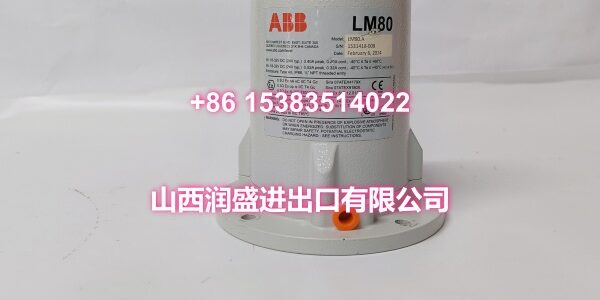
Product Core Brief
- Model: .A
- Brand: ABB
- Series: LM80 Laser Level Transmitter
- Core Function: Non-contact continuous level and distance measurement using pulsed laser technology for solids and opaque liquids.
- Product Type: Laser Level Transmitter / Laser Level Sensor
- Key Specs: Up to 100 m level range | Up to 150 m positioning range | 4–20 mA + relay output
- Condition: New Original / New Surplus
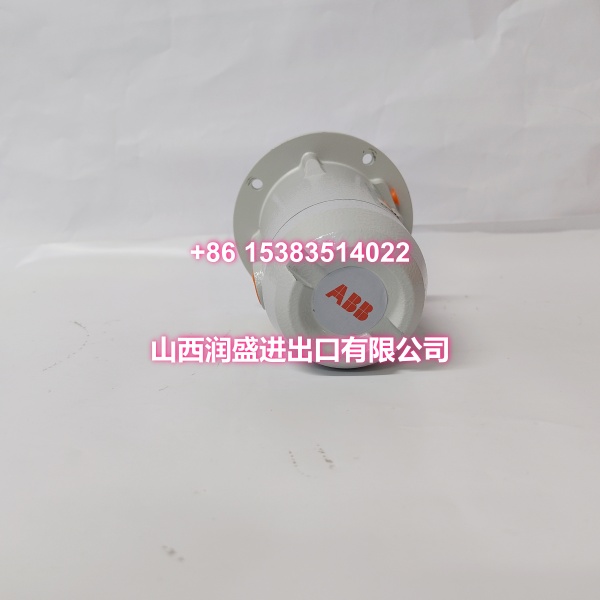
Key Technical Specifications
- Measurement principle: Pulsed laser time-of-flight
- Level measurement range: Up to 100 m (330 ft)
- Positioning / distance range: Up to 150 m (500 ft)
- Output signals: Continuous 4–20 mA + single-point relay
- Target media: Granular solids and opaque liquids
- Beam characteristic: Narrow laser beam for reduced false echoes
- Alignment aid: Built-in laser pointer
- Housing: Aluminum; stainless-steel option available
- Hazardous-area approvals: CSA, ATEX, IECEx options
- Configuration: LCD2 handheld configurator
- Optional features: Non-condensing heated lens; hygienic clamp flange
- Maintenance: Non-contact, generally low-maintenance operation
Product Introduction (No Fluff)
The ABB LM80.A is a pulsed laser level transmitter designed for continuous, non-contact measurement in silos, hoppers, crushers, and bulk-material handling systems. It works well where radar or ultrasonic sensors struggle with dust, irregular surfaces, or opaque liquids.
Its main advantage is measurement stability over long distances without physical contact. The narrow laser beam and time-of-flight calculation help reduce false echoes from internal structures, falling material, or steep vessel walls. With 4–20 mA and relay output, it integrates directly into existing process control loops.
QA & Testing SOP (Dynamic & Transparent)
For surplus or inventory laser transmitters, visual inspection alone is not enough. Here is how we verify units before dispatch:
- Inbound authenticity check: Verify ABB branding, model marking, housing finish, connector type, and documentation consistency. Units with mismatched labels or reworked housings are quarantined.
- Optical window inspection: Check the laser window for scratches, condensation residue, coating damage, or dust ingress that could weaken return signals.
- Power-up and self-test: Apply rated supply and confirm startup, internal diagnostics, and fault indication behavior.
- Output verification: Use a calibrated loop tester or Fluke multimeter to confirm 4 mA and 20 mA output stability, checking for drift or noisy signals.
- Relay and configuration check: Verify relay actuation and confirm that the unit accepts configuration via the LCD2 hand terminal or designated interface.
All units are packed in anti-static, moisture-controlled packaging with protective caps on optical surfaces.
Installation Pitfalls & Guide (Engineer to Engineer)
❗ Do not ignore beam alignment. Even a narrow laser beam can hit agitators, ladders, fill chutes, or vessel walls. Use the built-in laser pointer and confirm the return path before final tightening.
❗ Dust and condensation matter. Heavy dust, steam, or a fogged lens can reduce signal quality. If the process generates condensation, consider the heated-lens option or plan regular optical inspections.
❗ Verify hazardous-area certification before installation. ATEX, IECEx, and CSA options are application-specific. Do not install a general-purpose unit in a classified zone without confirming the nameplate rating.
❗ Check output wiring and loop power. A 4–20 mA loop wired incorrectly will not damage every transmitter immediately, but it will create unstable readings or fault states. Confirm polarity, loop supply, and load resistance before commissioning.
Replacement steps:
- Pre-install: Confirm model, output type, supply voltage, approval markings, and vessel drawing.
- Removal: Isolate power, lock out the circuit, and remove wiring while noting terminal assignments.
- Install: Mount the LM80.A with correct aiming, sealing, and mechanical support.
- Power-on test: Verify 4–20 mA output, relay function, and measured level against a known reference.
Technical FAQ
1. Is the ABB LM80.A compatible with the standard LM80 series?
It belongs to the LM80 laser level transmitter family, but the “.A” suffix may indicate a specific housing, output, approval, or configuration variant. Always compare nameplate data and documentation before treating it as a direct replacement.
2. Can it measure clear liquids?
It is intended mainly for granular solids and opaque liquids. For clear liquids or applications with strong transparency, laser return quality may be inconsistent. Radar or guided-wave radar may be more suitable depending on the vessel.
3. What output signals does it provide?
It provides a continuous 4–20 mA analog output plus a single-point relay for high/low level alarms or switching functions.
4. How long is the warranty?
Warranty terms depend on condition and supplier policy. New original units typically carry a standard manufacturer-aligned warranty, while surplus stock may carry a shorter coverage period. Confirm before ordering.
5. Is this unit still supported?
The LM80 laser level transmitter has been used in industrial level measurement for solids and liquids, but availability and support depend on region and stock condition. For new projects, verify current ABB documentation and approval status before standardizing on this model.