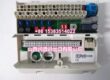
Product Core Brief
- Model: LS4000 (LaserSpeed series; variants include LS4000-101, -103, -106, -110)
- Brand: ABB (Beta LaserMike LaserSpeed family)
- Series: LaserSpeed LS4000
- Core Function: Non-contact laser Doppler measurement of line speed and product length for extrusion, cable, wire, and converting lines.
- Product Type: Laser Speed and Length Measurement System
- Key Specs: Accuracy < ±0.05% | Repeatability < ±0.02% | IP67 enclosure
- Condition: New Original / New Surplus
Key Technical Specifications
- Measurement principle: Laser Doppler velocimetry (non-contact)
- Accuracy: Better than ±0.05% of reading
- Repeatability: Better than ±0.02%
- Enclosure rating: IP67
- Speed output: RS-232 and 0–2 V analog (user-selectable scaling)
- Length output: Quadrature pulse output (user-selectable resolution); index pulse for cut-to-length or print marking
- Status output: RS-232 or analog voltage (0–1 V)
- Inputs: Measurement hold, shutter control, laser lock
- Measurement distance / depth: Varies by sub-model; e.g., LS4000-101 around 15 mm, LS4000-103 around 35 mm, LS4000-106 around 50 mm, LS4000-110 around 75 mm
- Speed range: Varies by sub-model; higher-range models support faster lines, while lower-range models cover slower processes
- Options: Air purge, quick-change window, mounting bracket, analog output converter
Product Introduction (No Fluff)
The ABB LS4000, part of the LaserSpeed family originally developed under Beta LaserMike, is a non-contact laser Doppler system for measuring speed and length on moving product lines. It is commonly used on extrusion, cable, wire, film, foil, and converting lines where contact encoders slip, wear, or mark the product.
Because the sensor reads surface velocity directly with a laser Doppler method, it avoids mechanical coupling errors. That makes it especially useful where line tension, surface finish, or product temperature makes encoder wheels unreliable. The IP67 housing and configurable pulse/analog outputs allow straightforward integration into PLC-based length control, cut-to-length, or print-mark systems.
QA & Testing SOP (Dynamic & Transparent)
Laser Doppler speed heads are sensitive to optics, alignment, and signal conditioning. Here is how we check them before shipment:
- Inbound authenticity check: Confirm ABB/Beta LaserMike branding, LS4000 model label, serial number, connector type, and mechanical condition. Units with mismatched labels or damaged optical windows are flagged.
- Optical window inspection: Inspect the measurement window for scratches, coating wear, contamination, or condensation. A degraded window reduces Doppler signal quality and creates unstable readings.
- Power-up and self-diagnostics: Apply rated supply and verify startup, laser emission status, fault indicators, and communication response.
- Output verification: Check RS-232 communication, 0–2 V speed output, and pulse/encoder-style length output using a loop tester, oscilloscope, or PLC high-speed counter. Confirm scaling matches the configured pulses per unit length.
- Functional simulation: Where possible, validate response to a moving target or simulated signal to confirm stable speed tracking and clean pulse edges.
All units are shipped with anti-static and moisture-controlled packaging. Protective caps are fitted to optical surfaces when available.
Installation Pitfalls & Guide (Engineer to Engineer)
❗ Do not ignore stand-off distance. Each LS4000 sub-model has a specific measurement distance. Mounting too far or too close will cause signal loss or unstable speed readings. Verify the exact variant before bracket fabrication.
❗ Keep the optical window clean. Dust, oil mist, plasticizer buildup, and moisture will degrade performance. Use the air-purge option in dirty environments and plan regular window inspections.
❗ Surface condition affects signal. Very glossy, transparent, or highly reflective surfaces may require adjusted aiming, scaling, or process trials. The Doppler method needs sufficient surface scatter.
❗ Check pulse scaling before tying into cut-to-length. If pulses per foot or pulses per meter are misconfigured, length totals will drift even when speed looks correct. Validate with a measured run before full production.
Replacement steps:
- Pre-install: Confirm sub-model, measurement distance, supply voltage, output type, and mounting bracket.
- Removal: Isolate power, label cables, remove mounting hardware, and protect the optical window.
- Install: Mount at the correct stand-off distance, aim per the product manual, connect purge air if fitted, and verify cable shielding.
- Power-on test: Verify speed output, pulse rate, RS-232 data, and length accumulation against a known reference distance.
Technical FAQ
1. Is the ABB LS4000 a direct replacement for older LaserSpeed units?
Often yes, but not automatically. The LS4000 family includes multiple sub-models with different stand-off distances and speed ranges. Confirm the exact part number, output configuration, and mounting geometry before replacing an existing sensor.
2. Can it replace a contact encoder on an extrusion line?
In many cases it can. Because it measures surface velocity without physical contact, it avoids encoder slip, wheel wear, and product marking. However, surface finish, line vibration, and aiming angle must be checked during commissioning.
3. What outputs does it provide?
It typically provides RS-232 communication, a 0–2 V analog speed output, and a quadrature pulse length output with an index pulse. Some configurations also support a 0–1 V status output.
4. What is the warranty on surplus stock?
Warranty depends on condition and supplier policy. New original units usually carry a standard warranty, while surplus inventory may have a shorter coverage period. Confirm terms before purchase.
5. Is this product still supported?
The LaserSpeed LS4000 series has been used in industrial speed and length measurement for many years, but current support, spares, and documentation availability should be verified against the specific sub-model and region. For new installations, confirm the latest ABB product documentation before standardizing on this series.