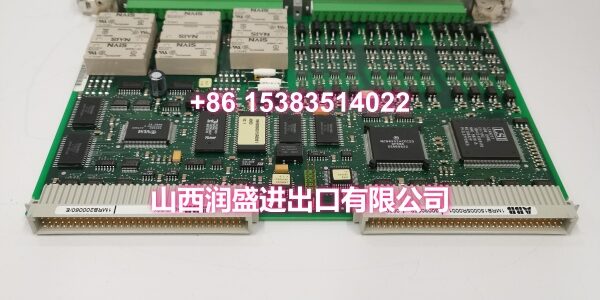
Product Core Brief
- Model: 500BIO01 / 1MRB150005R1/J
- Brand: ABB
- Series: ABB 500-Series Control System Racks / UNITROL Excitation Systems
- Integration Role: Binary input/output module for ABB UNITROL-based excitation and turbine control systems — aggregates cabinet-level digital interlocks, alarms, and permissives while driving relay outputs for trip logic, breaker control, and field forcing sequences. Provides 24VDC opto-isolated I/O with backplane integration, ideal for generator excitation panels, turbine governor cabinets, and brownfield replacements in power generation and process control.
- Product Type: Binary Input/Output Module
- Key Specs: 24VDC binary I/O | Opto-isolated inputs and outputs (channel-to-channel and channel-to-backplane) | Backplane communication via ABB 500-series rack bus — no external fieldbus addressing | Parameter-configurable debounce, output mapping, and alarm logic | Built-in I/O event timestamping for sequence-of-events (SOE) recording | High EMC immunity for substation and generator room environments | Rack plug-in design for quick replacement
- Note: Condition: New Original (New Surplus)
Key Technical Specifications
- Product Type: Binary Input/Output Module
- Brand: ABB
- Model Number: 500BIO01 / 1MRB150005R1/J
- Series: ABB 500-Series Control System Racks / UNITROL Excitation Systems
- Signal Type: 24VDC binary (digital) input and output channels, opto-isolated
- Input Channels: Opto-isolated binary inputs with software-configurable debounce and oscillation signal recognition — rejects contact bounce and noise on long cable runs
- Output Channels: Relay outputs with high current capacity; supports “select-before-execute” logic for critical trip and breaker commands
- Isolation: Channel-to-channel and channel-to-backplane galvanic isolation — breaks ground loops and suppresses switching noise in high-EMI environments (substations, generator rooms, drive cabinets)
- Communication: Proprietary ABB 500-series backplane bus — direct plug-in to rack, no separate network addressing required; communicates with main controller for real-time I/O exchange
- Timestamping: Each I/O event is locally timestamped on the module for sequence-of-events (SOE) recording and post-trip analysis
- EMC Robustness: Designed for industrial environments with high electromagnetic interference — compliant with EN 61000 series standards for immunity to switching transients, harmonics, and ESD
- Configuration: Input debounce timing, output mapping, and alarm logic are configured from ABB system engineering tools (no hardware jumpers)
- Power Supply: Module power via system backplane, 24VDC (±20%)
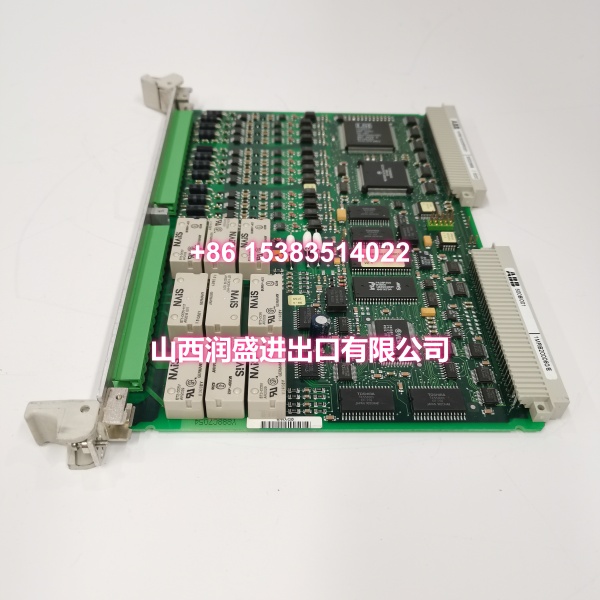
- Mounting Method: Slide-in module for ABB 500-series / UNITROL control racks — quick replacement with minimal downtime
- Dimensions: 180mm × 120mm × 50mm (per manufacturer listing)
- Operating Temperature: -25°C to +60°C (typical for ABB 500-series modules — verify against your specific cabinet rating)
- Typical Applications: Generator excitation panels (UNITROL systems); turbine governor cabinets; power plant protection and interlock systems; brownfield replacements in oil & gas, chemical, and steel process control; substation automation cabinets; any ABB 500-series rack application requiring aggregated binary I/O with SOE capability
Product Introduction
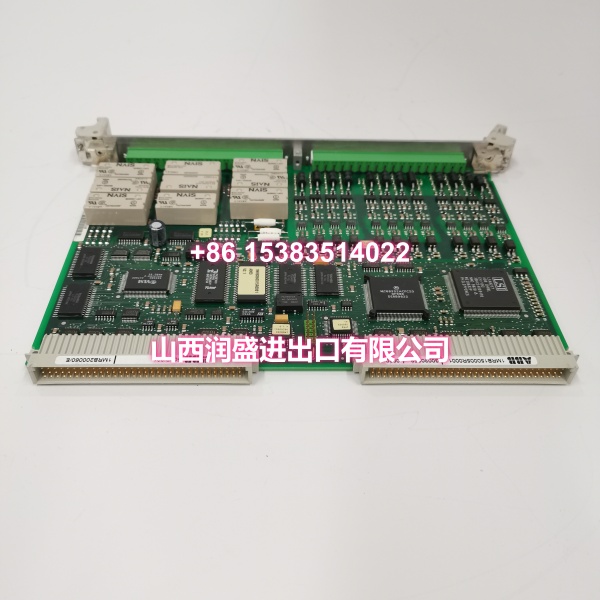
The ABB 500BIO01 (order code 1MRB150005R1/J) is a binary input/output module designed for ABB 500-series control racks and UNITROL-based excitation and turbine control systems. It serves as a critical I/O aggregation point that collects cabinet-level digital inputs — status signals, trip commands, permissives, and interlock conditions — while driving relay outputs to external devices such as trip relays, indicator lamps, breaker coils, and field forcing circuits.
This module is particularly valued in power generation and process control brownfield maintenance. Generator excitation panels and turbine governor cabinets are among the most critical systems in a plant, and the 500BIO01 sits at the heart of these panels, tying protection logic, breaker control, and field forcing sequences together with the electrical isolation and EMC robustness required in substation and generator room environments.
The module’s opto-isolated architecture is a key feature for these demanding applications. Channel-to-channel and channel-to-backplane galvanic isolation breaks ground loops between field devices and the controller, preventing switching noise, harmonics, and voltage transients from corrupting digital signals or damaging the CPU — a common challenge in cabinets shared with VFDs, contactors, and high-voltage switchgear.
The built-in I/O event timestamping capability is essential for post-trip analysis and sequence-of-events (SOE) recording. Each binary input and output transition is locally timestamped on the module, allowing engineers to reconstruct the exact order of events during a fault or trip — critical for compliance with NERC PRC-002 and similar protection system performance standards.
Input channels feature software-configurable debounce and oscillation signal recognition, which rejects contact bounce on mechanical switches and filters noise on long cable runs without requiring external hardware. Output channels support “select-before-execute” logic for critical commands, ensuring that trip and breaker signals are only issued after intentional operator or logic confirmation — a safety feature that prevents accidental operations.
The module communicates with the main controller via the proprietary ABB 500-series backplane bus — no external fieldbus adapters or network addressing are required. All configuration (input debounce timing, output mapping, alarm logic) is done from ABB system engineering tools, eliminating the need for hardware jumpers or DIP switches.
The slide-in rack design enables quick replacement during planned outages or emergency maintenance, with minimal disturbance to existing cabinet wiring. This makes the 500BIO01 a preferred choice for brownfield upgrades where downtime is costly and reworking the entire I/O scheme is not an option.
System integrators and power plant maintenance engineers specify this module for its proven compatibility with UNITROL excitation systems, reliable binary I/O performance in high-EMI environments, and SOE timestamping capability that supports forensic trip analysis and regulatory compliance.
Installation & Integration Notes
- Backplane Compatibility: This module is designed for ABB 500-series control racks and UNITROL excitation system cabinets. Verify that your backplane revision is compatible with the 500BIO01 before installation. The module communicates over the proprietary ABB 500 backplane bus — no external communication dongles or adapters are required.
- Input Signal Verification: Confirm that your field devices provide 24VDC signals compatible with the module’s opto-isolated input channels. The software-configurable debounce should be tuned to match the characteristics of each field signal — use longer debounce times for mechanical contacts (pushbuttons, limit switches, relay contacts) and shorter times for fast electronic sensors.
- Output Load Verification: The relay outputs have high current capacity, but verify that your connected loads (trip coils, breaker coils, indicator lamps) are within the module’s rated output current. Exceeding the rated current can damage the output relays and cause trip logic failures.
- Select-Before-Execute Configuration: For critical trip and breaker commands, enable the “select-before-execute” function in the system engineering tool. This adds a confirmation step that prevents accidental output activation — essential for safety-related interlocks.
- SOE Timestamping: The built-in I/O event timestamping is used for sequence-of-events recording. Ensure that the module’s clock is synchronized with the system time source (typically via the backplane from the main controller) for accurate SOE analysis.
- Shielded Cable Requirement: Use shielded twisted-pair cable for all binary signal connections, especially for long cable runs in high-EMI environments. Ground the shield at the cabinet end only (single-point grounding) to minimize electromagnetic interference from nearby power cables and switchgear.
- Isolation Verification: The module provides channel-to-channel and channel-to-backplane galvanic isolation. Ensure that field wiring does not bypass this isolation by incorrectly commoning signal grounds — doing so defeats the noise-rejection benefit and can introduce ground loops.
- Power Supply Verification: Confirm your cabinet’s 24VDC backplane supply is within the ±20% tolerance and can deliver sufficient power for the module plus all connected output loads. An unstable or under-powered supply can cause input misreads or output relay chattering.
- ESD-Safe Handling: As a rack-mounted control module, the 500BIO01 requires ESD-safe handling procedures. Always use an anti-static wrist strap when handling the module outside of its protective packaging. Avoid touching terminal blocks or circuit traces directly.
- Compatibility Note: Always cross-reference the full part number (1MRB150005R1/J) against your system’s spare parts list. The “R1/J” suffix indicates a specific hardware/firmware revision — verify compatibility with your existing UNITROL or 500-series system before ordering.
Integrator’s FAQ
What is the difference between 500BIO01 and 500BIM01/500BOM? The 500BIO01 is a combined binary input/output module that provides both input and output channels on a single board, making it suitable for applications where I/O density is moderate and you want to minimize the number of modules in the rack. The 500BIM01 is a dedicated 16-channel binary input module (no outputs), and the 500BOM is a dedicated binary output module with relay outputs. Choose the 500BIO01 when you need a mix of inputs and outputs in a compact footprint; choose separate BIM/BOM modules when you need maximum channel count for either inputs or outputs.
Can this module be used in non-UNITROL ABB 500-series systems? Yes, the 500BIO01 is compatible with ABB 500-series control racks beyond UNITROL excitation systems. It can be used in any ABB 500-series rack application that requires aggregated binary I/O with SOE timestamping capability. However, verify backplane compatibility and engineering tool support for your specific controller type before integration.
How does the SOE timestamping work? Each binary input transition and output activation is locally timestamped on the module with millisecond-level resolution. The timestamps are transmitted to the main controller via the backplane bus and can be logged for sequence-of-events analysis. This allows engineers to reconstruct the exact order of events during a fault or trip — critical for forensic analysis and regulatory compliance in power generation applications.
What is “select-before-execute” and when should I use it? “Select-before-execute” is a safety feature for output channels. When enabled, the operator or logic must first “select” the output (acknowledge the intended action) and then “execute” it in a separate step. This prevents accidental activation of critical outputs such as trip commands or breaker operations. It should be used for any safety-related or high-consequence output where an unintended activation could cause equipment damage or personnel injury.
How do I configure the input debounce time? Input debounce timing is configured from the ABB system engineering tool (no hardware jumpers). Set the debounce time based on the field device type: 5–16 ms for mechanical contacts (pushbuttons, limit switches) to filter contact bounce; 0.1–2 ms for fast electronic sensors (proximity switches, encoder signals) to maintain response time. The module also has oscillation signal recognition that can detect and flag rapidly toggling inputs.
What warranty do you offer on New Surplus parts? We provide a full 12-month warranty on all New Original / New Surplus units. This is fundamentally different from refurbished I/O modules, which often carry 30–90 day warranties and come with unknown thermal cycling history, degraded opto-isolators, and worn relay contacts. For binary I/O modules used in trip logic and protection systems, the reliability difference between new surplus and refurbished is critical — it’s the difference between a dependable trip signal and a failed output during a fault condition.
Why is your pricing lower than OEM direct but higher than used parts? Our pricing reflects New Original / New Surplus inventory sourced from factory overstock and authorized distributors. You pay less than OEM list because these are surplus units, not current production. You pay more than used/refurbished because the part has zero operating hours, no degradation of the opto-isolators or relay contacts, and no wear on the backplane connectors. For I/O modules in protection and trip logic applications, the difference between new surplus and refurbished is not marginal — it directly impacts system safety and availability.