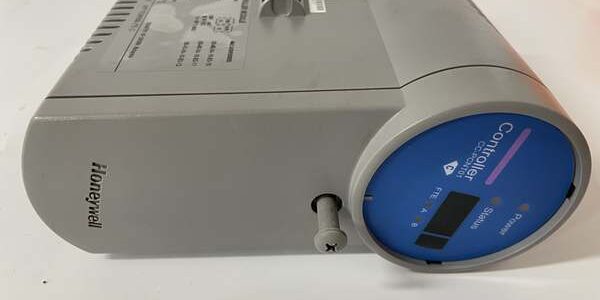
Component Snapshot At-a-Glance
- Model: CC-PCNT01, factory P/N 51405046-175
- Alt. P/N: CC-TCNT01 (FTE fault-tolerant Ethernet CPU variant, IOTA/backplane incompatible); CC-PCNT02 (newer generation controller, firmware cross-check required)
- Product Series: Honeywell Experion PKS Series C standard non-FTE C300 controller platform
- Hardware Type: Rack-mount main CPU processor module, hot-swap capable, mates exclusively with CC-TCNT01 standard non-FTE controller IOTA
- Key Feature: Conformal coated PCB, dual redundant I/O Link ports, deterministic control execution, native 1:1 controller redundancy
- Primary Field Use: Execute regulatory control, sequence logic, interlock safety logic, and handle all Series C I/O communication for non-FTE C300 control cabinets.
Hard-Numbers: Technical Specifications
- Protocol Support: Honeywell proprietary I/O Link bus, CEE control execution engine, Modbus RTU via optional communication modules, system diagnostic telemetry
- Port Count: Dual I/O Link backplane interfaces; front panel serial config port; redundancy sync port; gold finger edge connector to CC-TCNT01 IOTA
- Baud/Data Rate: Deterministic scan cycles configurable 20ms / 50ms; I/O Link fixed proprietary high-speed bus timing
- Operating Temperature: 0°C to +60°C cabinet operational; -40°C to +85°C storage
- Isolation Rating: 1500Vrms isolation between I/O Link field side and CPU logic core
- Power Draw: 24VDC ±10% rack supply, nominal 320mA, total module power draw ~7.7W
- Onboard Memory: 16MB Flash firmware storage, 16MB RAM for control strategy execution
- Max Control Capacity: Up to 4095 tagged control blocks, 32768 memory units
- Redundancy Switchover Time: ~500ms bumpless transfer between primary/backup CC-PCNT01 pair
- Certifications: CE Class B EMC, ATEX Ex ec IIC T4 Zone 2 cabinet compliant, IEC 61508 SIL3 capable
- Physical Weight: 0.48kg single module assembly
The Real-World Problem It Solves
FTE CC-TCNT01 controller hardware adds unnecessary cost and complex dual network cabling for sites that do not require fault-tolerant Ethernet plant LAN architecture. Third-party controller CPUs lack native CEE deterministic scheduling, creating scan jitter that destabilizes tight flow/temperature control loops.Without onboard dual I/O Link redundancy, single backplane cable faults drop all I/O points tied to the controller, triggering mass interlock trips during plant upsets. Uncoated unprotected CU-series CPU boards corrode rapidly in humid offshore/refinery cabinet environments, shortening MTBF by 60% compared to conformal coated CC-PCNT01 hardware.Where you’ll typically find it:
- Refinery non-FTE standalone control racks for distillation column continuous regulatory loops
- Fossil power plant balance-of-plant auxiliary control panels with non-critical pump/valve sequencing
- Chemical batch DCS cabinets without enterprise FTE network uplink requirementsThis conformal coated standard non-FTE C300 CPU delivers deterministic control execution, dual I/O Link redundancy, and eliminates overbuilt FTE hardware expense for sites with simple single-path control networking.
Hardware Architecture & Under-the-Hood Logic
This module houses a dedicated real-time RISC processor core isolated from I/O communication hardware, split into separate control execution and I/O handling subsystems to eliminate scan cycle jitter.
- Regulated 24VDC power from CC-TCNT01 IOTA feeds isolated internal power rails for CPU core, memory, and dual I/O Link transceivers.
- Real-time CEE operating system schedules all PID, logic, batch sequence blocks on fixed 20/50ms deterministic scan intervals, no background task priority bleed-through.
- Dual independent I/O Link transceivers maintain two separate communication paths to Series C I/O racks; auto-failover if one link cable shorts or disconnects.
- Dedicated redundancy sync port continuously mirrors control strategy, PV values, and interlock status to paired backup CC-PCNT01 module for bumpless switchover.
- Onboard cyclic self-test checks RAM, Flash firmware, I/O link integrity, and CPU core health; all fault codes pushed to Experion HMI event log via serial uplink.
- Front panel multi-color LED bank displays RUN status, primary/backup redundancy role, I/O Link fault, memory error, and general CPU fault for quick cabinet troubleshooting.
Field Service Pitfalls: What Rookies Get Wrong
Installing CC-TCNT01 FTE CPU Into Standard CC- Non-FTE IOTA Base
New techs swap FTE CC- spares into non-FTE controller IOTA slots to reduce spare inventory. Mismatched pinout and network hardware prevent CPU initialization, controller locks into permanent FAULT state, all control loops freeze at last output value.Field Rule: Only mount CC-PCNT01 on standard non-FTE CC- IOTA assemblies; segregate FTE and standard controller spares in labeled storage bins to avoid cross-installs.
Mismatched Firmware Versions Between Primary/Backup Redundant CPU Pair
Apprentices load different Experion R-release firmware onto paired CC-PCNT01 modules during spare swap. Redundancy sync handshake fails, backup never takes over on primary fault, creating single point of failure for all process control logic.Quick Fix: Flash identical firmware revision to both primary and backup CC-; force primary CPU fault during annual proof test to verify seamless 500ms switchover.
Skipping Conformal Coating Inspection Before Spare Storage
Crews store used CC- modules without checking coating scratches or corrosion. Exposed PCB copper absorbs cabinet humidity, creating intermittent memory parity faults that only surface during hot summer cabinet operating conditions.Field Rule: Inspect conformal coating for cracks/scratches on all spare CC- units; seal damaged boards with factory coating touch-up before stocking in field spare cabinets.
Commercial Availability & Pricing Note
Please note: The listed price is for reference only and is not binding. Final pricing and terms are subject to negotiation based on current market conditions and availability.