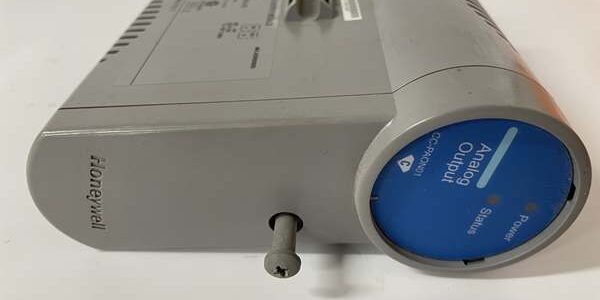
Component Snapshot At-a-Glance
- Model: CC-TAON01
- Alt. P/N: CC-PAON01 (standard non-FTE AO card, backplane pinout incompatible); CC-TAOX01 (16-channel FTE AO, cannot direct swap)
- Product Series: Honeywell Experion PKS Series C FTE Fault Tolerant Ethernet I/O, matched to C300/C200 FTE controllers
- Hardware Type: Rack-mount 8-channel analog output module, hot-swap capable, requires dedicated FTE IOTA terminal base
- Key Feature: FTE dual-redundant backplane interface, per-channel galvanic isolation, native HART 5/7, live output current readback
- Primary Field Use: Convert controller digital setpoints to 4–20mA drive signals for HART valve positioners, pump actuators, and modulating VFDs on fault-tolerant I/O racks.
Hard-Numbers: Technical Specifications
- Protocol Support: FTE redundant I/O backplane bus, HART 5 / HART 7, chassis fault diagnostic telemetry
- Port Count: 8 isolated analog output channels; FTE gold finger backplane connector; mates exclusively with FTE wiring IOTA base
- Baud/Data Rate: Fixed 100ms full module scan cycle; HART digital signal superimposed on analog current loop
- Operating Temperature: 0°C to +60°C cabinet operational; -40°C to +85°C storage
- Isolation Rating: 500Vrms channel-to-backplane galvanic isolation per channel
- Power Draw: 24VDC ±10% rack supply, typical module power draw 3.1W
- DAC Resolution: 16-bit digital-to-analog conversion
- Output Signal Ranges: Software selectable 4–20mA, 0–20mA current loop
- Max Allowable Loop Load: 750Ω per channel with 24V field supply
- Accuracy: ±0.1%FS at 25°C, ±0.15%FS full operating temperature range
- Built-In Diagnostics: Open wire detection, short circuit current limiting, setpoint vs readback discrepancy alarm, HART communication loss flag
- Certifications: ATEX Ex ec IIC T4 Zone 2 cabinet compliant
- Physical Weight: 0.32kg single module assembly
The Real-World Problem It Solves
Standard CC-PAON01 AO cards lack FTE backplane hardware, cannot mount in fault-tolerant I/O racks, forcing full cabinet rework for sites running FTE redundant control architecture. Non-isolated shared output stages on older 8-channel AO cards let single-channel shorts crash the entire card, cutting all valve control loops simultaneously.Without native HART modulation, technicians must carry handheld communicators to site to pull valve stroke, calibration and actuator fault data, adding unplanned field trips during outages. Cards missing real-time readback cannot alert operators when valve position drifts away from controller demand, allowing off-spec process operation undetected.Where you’ll typically find it:
- Refinery FTE redundant I/O racks feeding reactor feed, reflux and ESD modulating valve positioners
- Fossil power plant boiler fuel gas, feedwater and steam turbine actuator control FTE panels
- Chemical batch DCS cabinets driving HART pump VFDs and pH modulating control valvesThis FTE-native isolated AO card eliminates external HART tools for routine valve diagnostics, fits fault-tolerant I/O backplanes, and catches output drift or wiring faults before process upsets occur.
Hardware Architecture & Under-the-Hood Logic
This module uses independent isolated DAC drive circuits for every output channel, paired with an FTE dedicated communication ASIC to transmit redundant control frames without taxing the C300 main CPU.
- Digital setpoint commands from the C300 FTE controller pass through dual redundant FTE backplane transceivers to the on-board DAC processing ASIC.
- Per-channel 16-bit DAC converts digital control values to reference voltage, driving a precision current stage to generate stable 4–20mA loop output.
- Separate HART modulation circuit overlays digital actuator diagnostic data onto the analog loop without shifting the primary control current level.
- Continuous readback sampling circuit measures live loop current; triggers discrepancy alarm if measured value drifts beyond user-configured deadband from the controller setpoint.
- Fast current limiting circuit activates instantly during field wiring short circuits to protect PCB drive stages; open wire detection flags broken loop wiring to the DCS event log.
- Front panel multi-color LED array displays module RUN status, individual channel fault flags, HART activity, and dual FTE backplane link health for quick cabinet troubleshooting.
Field Service Pitfalls: What Rookies Get Wrong
Installing CC-PAON01 Standard AO Card Into FTE IOTA Chassis
New techs swap non-FTE CC-PAON01 spare cards into FTE rack slots to reduce spare inventory. Mismatched backplane pinout breaks all FTE communication, the module locks into permanent FAULT state, and all 8 control valves drop to programmed fail-safe position.Field Rule: Only install CC-TAON01 modules on FTE I/O chassis; segregate FTE and standard Series C AO spares in clearly labeled storage bins to prevent cross-installs.
Exceeding 750Ω Maximum Loop Load Resistance Per Channel
Apprentices run excessively long field cable or daisy-chain multiple positioners to one output channel, pushing total loop resistance above 750Ω. The output driver cannot sustain full 20mA current, valve position creeps, and constant readback discrepancy alarms fill the system log.Quick Fix: Limit each CC-TAON01 channel to one HART valve positioner; calculate total wire resistance during cabinet build to stay under 750Ω total load.
Defaulting All Channels To “Hold Last Value” For ESD Safety Loops
Crews skip custom fail-state programming on emergency shutdown valves and leave factory default hold-last-value active. If the I/O module faults during a process upset, critical shutdown valves stay at operating position instead of moving to safe closed/open state.Field Rule: Program unique safe shutdown values for every ESD/SIL valve channel on CC-TAON01; force module fault during annual proof testing to verify correct fail-state valve travel.
Commercial Availability & Pricing Note
Please note: The listed price is for reference only and is not binding. Final pricing and terms are subject to negotiation based on current market conditions and availability.