Field Engineer’s Notes (From the Trenches)
Cable Length and Signal Degradation are your biggest enemies.
Pulse signals, especially at lower voltage levels like 5V, are highly susceptible to capacitance and electromagnetic interference (EMI) over long cable runs. If you are pulling a pulse signal from a flow meter more than 100-150 feet away, do not run it directly to the 1C31147G01. Use a local signal conditioner or repeater to boost the signal to a robust 24V logic level, then step it down at the cabinet.Also, always use twisted-pair, individually shielded cabling for pulse inputs. Terminate the shield at the cabinet ground only—grounding both ends creates a ground loop that will inject 60Hz noise right into your pulse train, causing the card to “count” phantom pulses and wrecking your totalization accuracy.
Real-World Applications
- Natural Gas Custody Transfer Metering:
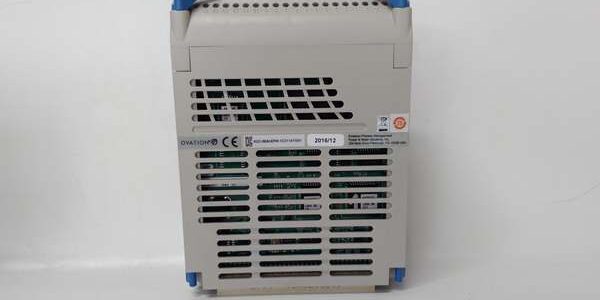
In pipeline compressor stations, the 1C31147G01 interfaces directly with ultrasonic or turbine flow computers that output a pulse per specific volume (e.g., 1 pulse = 10 standard cubic feet). The module’s high-speed hardware counter ensures that every single pulse is logged for billing purposes, providing the absolute accuracy required for fiscal metering and regulatory compliance. - Steam Turbine Overspeed Protection:
In power generation, magnetic pickup sensors (MPUs) on a turbine shaft generate a high-frequency sine wave proportional to RPM. This signal is conditioned and fed into the 1C31147G01. The module provides the Ovation controller with real-time, lag-free speed data, allowing the control logic to execute an emergency trip within milliseconds if the turbine exceeds its safe mechanical speed limit.
High-Frequency Troubleshooting FAQ
Q: My pulse accumulator is counting, but the total is consistently lower than the field mechanical totalizer. Why?
A: This is almost always a signal integrity issue. The most common culprits are a slow rise/fall time on the pulse signal (making it look like a ramp instead of a square wave to the card) or electrical noise causing the input threshold to be missed. Check your cable shielding, verify the pulse voltage at the card terminals with an oscilloscope, and ensure the pulse frequency isn’t exceeding the module’s maximum rated Hz input.
Q: Can the 1C31147G01 accept a 4-20mA analog signal?
A: No. The 1C31147G01 is strictly a discrete pulse/digital input module. It counts on/off transitions. If you have a 4-20mA flow transmitter, you need a standard Analog Input (AI) module. If you need pulse output from a 4-20mA device, you must use a transmitter that offers a separate, isolated pulse output option.
Q: The module is installed, but the pulse count in the Ovation database remains at zero. How do I troubleshoot?
A: First, verify the field device is actually generating pulses (use a handheld multimeter with a frequency setting). Next, check the DC voltage at the module’s input terminals to ensure it meets the 5V/12V logic threshold. Finally, verify in the Ovation configuration software that the specific channel is enabled and scaled correctly. A common “gotcha” is a blown fuse on the external power supply feeding the field pulse transmitter.
Commercial Availability & Pricing
Please note: The listed price is not the actual final price. It is for reference only and is subject to appropriate negotiation based on current market conditions, quantity, and availability.