Quick Sizing & Sourcing Snapshot
- Manufacturer: GE Fanuc (Emerson Machine Automation)
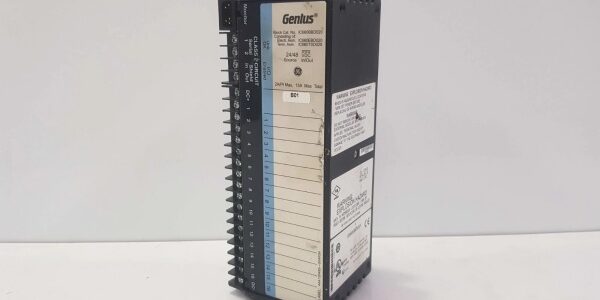
- Part Number: IC660BBD120
- System Platform: GE Genius I/O System (Block I/O)
- Hardware Type: 16-Point Digital Output Block (Source / PNP Type)
- Architectural Role: Standalone Genius Block interfacing to the Genius Bus, sourcing +24V DC to field loads (solenoids, pilot relays, indicators) under Bus Controller command.
- Key Specifications: 16 Outputs (24V DC Source), 0.5A/pt (2A/group, 8A max), 4 Groups of 4, Genius Bus Interface, Conformal Coat (typical).
System Architecture & Operational Principle
The is a self-contained Genius I/O Block operating at Purdue Level 1 (Actuation). It connects directly to the Genius Bus (daisy-chained Twinaxial or STP) and is controlled by a Bus Controller (IC697BEM731, IC693BEM331, or IC670GBI002).
Upstream, it receives Output Image bits from the Bus Controller via the Genius Protocol (153.6 kbps token-passing). It reports back status (Fuse Blown, Overload, Wire Break) to the PLC.
Internal Processing, it has 4 groups of 4 outputs. Each group has an electronic fuse (typically 2A). When the Bus Controller commands Output 1 ON, the block closes an internal high-side FET, connecting the Output terminal to the internally buffered +24V DC (sourced from the external 24V DC supply landed on the block’s V+ / 0V terminals).
Downstream, it Sources Current (PNP): +24V DC appears at the Output terminal when ON → flows through the field load (solenoid/relay coil/LED) → returns to 0V DC Supply Common (landed at the block’s 0V terminal). The block requires a 24V DC external power supply (18–30V DC typical, 20–32V DC range on some revisions).
Core Technical Specifications
| Parameter | Value |
|---|---|
| Outputs | 16 (4 Groups × 4 pts) |
| Type | 24V DC Source (PNP / High-Side Switch) |
| Voltage Range | 18–30V DC (Nominal 24V DC) |
| Current / Point | 0.5A Continuous (Resistive) |
| Current / Group | 2.0A Max (Electronic Fuse) |
| Total Module | 8.0A Max (All Groups) |
| Off-State Leakage | < 0.1 mA |
| On-State Drop | < 0.5V DC |
| Response Time | ≤ 1 ms (On/Off) |
| Required Field Power | 24V DC (+V & 0V terminals on block) |
| Genius Bus | 1 In / 1 Out (Daisy Chain, 50Ω Termination at ends) |
| Indicators | Unit OK (Green), I/O Enabled (Green), Fuse/Blown (Amber per group), Force (Red per point) |
| Config | Station Number (Rotary or Software), Output Defaults (Off/On/Fail-Safe), Filter Time |
| Operating Temp | -40°C to +70°C (Block type dependent) |
Customer Value & Operational Benefits
Distributed Sourcing (PNP) — No Interposing Relays
The BBD120 directly switches 24V DC loads. If your plant standardizes on 24V DC Pilot Relays (e.g., Finder/Magnecraft 24V DC coils) or 24V DC Solenoids with PNP logic, this block drives them directly. You eliminate the panel space, wiring, and failure points of 24V→120V interposing relays + 120V AC control power. For a skid with 16 outputs, that’s 16 less DIN-terminal, 16 less relay socket, and one less control xfmr to maintain.
Per-Group Electronic Fusing (Fault Isolation)
Each 4-output group has independent electronic protection. If a mechanic shorts Outputs 5-8 (Group 2), onlyGroup 2 disables (Fuse LED lights). Groups 1, 3, 4 keep running. In a non-fused block, one short could kill all 16 outputs and cause a full line stop. This limits blast radius to 25% of the I/O, letting the rest of the machine function during fault-finding.
Smart Status Reporting (Fuse / Wire Break)
Unlike a dumb relay, the BBD120 tells the PLC exactlywhich group blew or which point has an open wire (on some firmware versions with open-wire detect on source outputs). The PLC can annunciate “Station 4, Group 2 Fuse Blown — Check Solenoid Valve A2” on the HMI. This turns a 2-hour wire chase into a 5-minute localized check.