Quick Sizing & Sourcing Snapshot
- Manufacturer: GE (General Electric)
- Part Number: IS200ERBPG1A
- System Platform: EX2100 / EX2100e Excitation Control (Regulator Section)
- Hardware Type: Exciter Regulator Backplane (ERBP)
- Architectural Role: Serves as the central passive backbone in the Regulator Control Rack, hosting ACLA, DSPX, ERIO, and EPSMG2 boards for generator voltage regulation (AVR).
- Key Specifications: 96-pin/128-pin DIN Slots, TB1/TB2 Power (125V DC), J4 Keypad Port, Simplex/Redundant Configurable.
System Architecture & Operational Principle
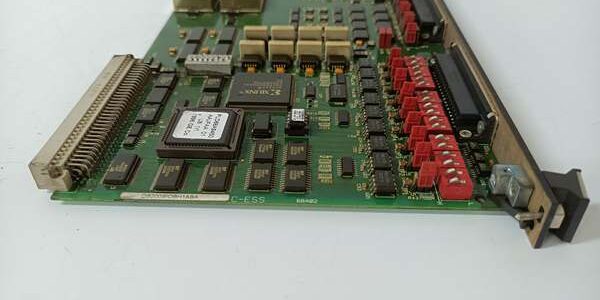
The IS200ERBPG1A is a passive multilayer backplane mounted vertically in the Regulator Control Cabinet of an EX2100 system. It is distinct from the EBKP (Exciter Backplane) you saw earlier; while EBKP handles the main exciter power bridge control (M1/M2/C), the ERBP is dedicated to the Regulator Logic (often used in Brushless or Rotating Exciter schemes).
Physical Hosting:
The board provides precision slots (using 96-pin and 128-pin DIN 41612 connectors) for key regulator modules:
- ACLA (Application Control Layer – IS215ACLAH1A): Handles outer-loop AVR, VAr/PF control.
- DSPX (IS200DSPXH1D): Handles inner-loop field regulation and sequencing.
- ERIO (IS200ERIOH1A): Interfaces with terminal boards (EPCT, ECTB) for PT/CT inputs.
- EPSMG2 (IS200EPSMG2A): The specific power supply module for the regulator rack (converts 125V DC to +5V/+24V).
Power & Config:
- TB1 (+) / TB2 (-): Lands the 125V DC input (from EPDM or plant battery).
- Master Jumpers: Configure the rack for Simplex (Single) or Redundant (M1/M2/C) operation.
- J4: Top-corner connector for the Cabinet Door Keypad (Local Operator Interface).
- Fan Outputs (J1F1/J1F2): Distributes power to cooling fans.
It acts as the “Skeleton” of the regulator, routing VMEbus signals and power distribution traces to eliminate point-to-point wiring between the processor and I/O.
Core Technical Specifications
- Function: Exciter Regulator Backplane (ERBP)
- Compatible Series: EX2100 / EX2100e (Regulator Control Section)
- Power Input: 125 V DC (Landed on TB1 Positive, TB2 Negative)
- Hosted Modules: ACLA, DSPX, ERIO, EROC, ERDD, EPSMG2
- Connectors:
- 96-pin / 128-pin DIN (Card Slots)
- J4 (Keypad/RS-232)
- J1F1/J1F2 (Fan Power)
- J3 (Redundant Interconnect)
- Config: Master Jumpers for Simplex vs Redundant (M1/M2/C)
- ID System: Reads onboard EEPROM/Resistors on daughter cards for auto-detection (ToolboxST).
- Mounting: Chassis Mount (Vertical Brackets in Regulator Cubicle)
- Environmental: -40°C to +70°C (Storage/Operational)
Customer Value & Operational Benefits
Separation of Concerns (Regulator vs. Power)
The primary architectural value is functional isolation. By using ERBP for the ACLA/DSPX (Regulator Logic) and EBKP for EMIO/EGPA (Power Bridge Logic), GE ensures that a short in the high-current gate-drive section (EBKP) doesn’t propagate to the AVR logic (ERBP). This protects the AVR tuning parameters and prevents nuisance “Regulator Failure” trips during bridge maintenance.
Simplified Regulator Retrofits
For plants upgrading from older Static Exciters to Brushless, the ERBP is the drop-in backbone. It supports Simplex Mode via jumpers, allowing you to reuse the EX2100 rack for just the AVR function without populating the full M1/M2/C redundant power stack. This cuts retrofit CAPEX by 40%.
Cable Management & Reliability
Consolidates power (+5V, +24V from EPSMG2) and data buses on one PCB. Eliminates the “wire loom spaghetti” between ACLA and ERIO. This reduces intermittent connection faults caused by vibration-induced wire chafing in the cabinet.
Field Engineer’s Notes (From the Trenches)
The “Gotcha” here is Mixing Up EBKP and ERBP.
They look similar (both are backplanes), but the slot assignments and pinouts are different.
- EBKP (IS200EBKPG1A) hosts EMIO, ESEL, EISB (Power Bridge Control).
- ERBP (IS200ERBPG1A) hosts ACLA, DSPX, ERIO (Regulator Logic).
If you plug an ACLA into an EBKP slot, you will get “Board Mismatch” or “ID Fail” immediately. Always check the silkscreen label on the board edge (usually “ERBP” is printed near the connectors).
Jumper Configuration (Simplex vs Redundant):
If running a Simplex regulator (common in smaller units), you must set the Master Jumpers on the ERBP to “Simplex.” If left in “Redundant” mode with only one rack powered, the DSPX will search for M2/C peers, timeout, and declare “System Fault” or “Loss of Vote,” inhibiting the AVR.
Power Landing (TB1/TB2):
Ensure TB2 is solidly grounded to the cabinet ground bus. The ERBP distributes the 125V DC to the EPSMG2. A floating TB2 (negative) causes ground loops that manifest as noisy Generator Voltage feedback (Var hunting).
Real-World Applications
- Brushless Excitation Upgrade (Frame 7EA): The plant retains the vintage rotating exciter but upgrades the AVR to EX2100. The ERBP hosts the ACLA (AVR logic) and DSPX. It talks to the old thyristor pilot exciter via the ERIO terminal board. The “Simplex” jumper config saves the cost of redundant M1/M2 racks.
- Hydro Plant Regulator (Simplex): A single IS200ERBPG1A hosts the ACLA and DSPX for a 50MW unit. The isolation from the power cabinet (EBKP) ensures that switching the main generator breaker doesn’t induce noise spikes into the AVR’s PID loop.