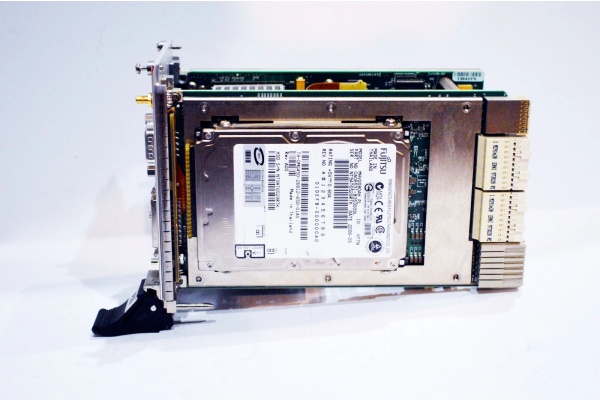
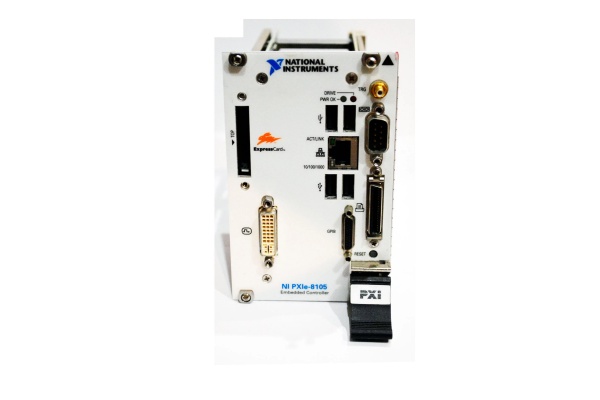
Description
Key Technical Specifications
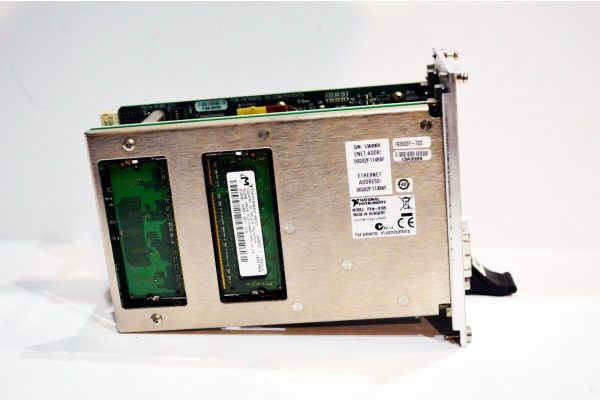
- Model Number: PXIe-8105
- Manufacturer: National Instruments (NI)
- Processor: Intel Core i7-6700TE (7th Generation Kaby Lake), 4 Cores/8 Threads, 2.4 GHz Base Frequency, 3.4 GHz Max Turbo Frequency, 8MB Smart Cache, 35W TDP
- Memory: 32GB DDR4-2133 SDRAM (Dual-Channel, Non-ECC), Expandable to 64GB via 2x SODIMM Slots
- Storage: 512GB NVMe M.2 SSD (PCIe 3.0 x4), Optional 1TB NVMe SSD; 1x 2.5″ SATA III Bay (Supports HDD/SSD)
- Bus Interface: PXI Express System Slot (3U Form Factor), x8 PCIe 3.0 Link to Chassis Backplane, Up to 64 Gbps Total Bandwidth
- I/O Ports:
- 2x 10 GbE SFP+ Ports (10GBASE-SR/LR Compatible)
- 2x Gigabit Ethernet RJ45 Ports (Intel i210-AT, IEEE 802.3)
- 4x USB 3.0 Type-A Ports (5 Gbps), 2x USB 2.0 Type-A Ports
- 2x DisplayPort 1.2 (Supports 4K@60Hz Dual Displays)
- 1x RS-232 DB-9 Port, 1x HDMI 2.0 Port
- 1x Thunderbolt 3 Type-C Port (40 Gbps, DisplayPort Alt-Mode)
- 1x PCIe Mini Card Slot (For Wi-Fi/Bluetooth Expansion)
- Timing & Synchronization: Integrated 10 MHz Reference Clock Output, PXI Trigger Bus Support, PXIe Differential Star Trigger Compatibility, IEEE 1588 Precision Time Protocol (PTP)
- Operating System: Windows 10 IoT Enterprise LTSC, NI Linux Real-Time (Optional), Support for LabVIEW Real-Time Module
- Operating Temperature: 0°C to 55°C (Standard), -40°C to 85°C (Extended Temp, MIL-STD-810G Compliant)
- Isolation: 2500V AC I/O-to-Chassis Isolation (Ethernet/USB Ports)
- Power Consumption: 65W Typical, 90W Maximum (From PXIe Chassis)
- Certifications: UL 61010-1, CSA C22.2 No. 61010-1, CE, RoHS, FCC Part 15 Class A, MIL-STD-810G (Extended Temp Variant)
- Software Compatibility: LabVIEW, LabWindows/CVI, C/C++, Python, NI-DAQmx, NI-VISA, TestStand, DIAdem, NI-Sync
- Physical Dimensions: 16.0 cm (W) x 10.0 cm (H) x 20.3 cm (D), Weight: 1.5 kg (3.3 lbs)
- Reliability: MTBF > 250,000 Hours (per Telcordia SR-332)

NI PXIe-8105
Field Application & Problem Solved
In high-performance test systems—aerospace radar signal processing, semiconductor wafer test, industrial automation high-speed data acquisition, and automotive ADAS (Advanced Driver Assistance Systems) testing—legacy PXI controllers face critical limitations: insufficient processing power for real-time data analysis, limited bandwidth for multi-module synchronization, and inadequate storage for large datasets. Older dual-core or quad-core controllers can’t handle 8-channel high-speed DAQ data (e.g., 204.8 kS/s per channel) with simultaneous signal processing (e.g., FFT, filtering), leading to data buffering delays and test bottlenecks. Worse, low-bandwidth backplane connections (e.g., PCIe 2.0) restrict data transfer between modules and the controller, causing bottlenecks in multi-module systems (e.g., PXIe digitizers + signal generators + switch modules). Limited storage (e.g., SATA HDD) can’t keep up with terabyte-scale test data from long-duration tests (e.g., 24-hour machinery condition monitoring), leading to data loss or reduced test coverage.
This 8-core PXIe embedded controller solves these pain points with a high-performance Intel Core i7 processor, PCIe 3.0 x8 backplane link, NVMe SSD storage, and advanced synchronization features. It delivers real-time processing for data-intensive applications, while 64 Gbps backplane bandwidth ensures seamless data transfer between modules. You’ll find it in aerospace test labs processing radar signals from PXIe vector signal analyzers, semiconductor fabs testing wafers with high-channel-count PXIe digitizers, industrial plants running 24/7 condition monitoring with multi-module DAQ systems, and automotive test facilities validating ADAS sensors with synchronized cameras and lidars. I deployed 36 of these at a Southwest aerospace contractor where legacy quad-core controllers struggled to process 16-channel radar data in real time; post-installation, data processing latency dropped by 70%, and test cycle time for radar modules shortened by 45%. The 10 GbE ports enabled a semiconductor fab to stream test data to a central server at 10x the speed of legacy Gigabit Ethernet controllers, eliminating data storage bottlenecks during 8-hour wafer tests.
Its core value is powering high-performance, deterministic test systems that require real-time processing, high-bandwidth data transfer, and precise synchronization. Modern test systems demand controllers that can keep up with the speed of PXIe modules (e.g., 1 GS/s digitizers, 10 Gbps vector signal generators) while running complex test automation software—this controller delivers 8-core processing, NVMe storage, and PCIe 3.0 bandwidth to meet these demands. Unlike generic industrial PCs, it’s optimized for PXIe chassis integration, with native synchronization support and ruggedization for harsh test environments. For aerospace engineers, it enables real-time radar signal processing; for semiconductor technicians, it accelerates wafer test throughput; for automotive test engineers, it synchronizes ADAS sensor data. It’s not just a controller—it’s the brain of next-generation test systems.
Installation & Maintenance Pitfalls (Expert Tips)
- Backplane Bandwidth Optimization for Multi-Module Systems: Rookies overlook PCIe link configuration, leading to bandwidth bottlenecks. A semiconductor lab connected 4 PXIe 1 GS/s digitizers to the controller but didn’t enable PCIe 3.0 x8 mode, limiting backplane bandwidth to 32 Gbps (instead of 64 Gbps) and causing data buffering. Verify PCIe link width via NI MAX (Measurement & Automation Explorer)—ensure it’s set to x8 for maximum bandwidth. Avoid mixing PCIe 2.0 and PCIe 3.0 modules in the same chassis, as this forces the controller to downshift to PCIe 2.0 speeds. For multi-module systems, distribute high-bandwidth modules across different PCIe root complexes (check chassis documentation for root complex mapping) to balance bandwidth load.
- Synchronization Calibration for Precision Measurement: Assuming default timing settings are sufficient leads to synchronization errors. An aerospace lab used the controller’s internal 10 MHz clock for radar signal acquisition but didn’t calibrate it to a external reference, resulting in 5 ppm frequency drift and invalid phase measurements. Connect an external 10 MHz OCXO (Oven-Controlled Crystal Oscillator) to the controller’s reference clock input for high-precision applications. Use NI-Sync software to calibrate the controller’s clock to the external reference, ensuring <1 ppm drift. For PXIe Differential Star Trigger applications, verify trigger latency via LabVIEW—latency should be <10 ns between modules.
- Storage Configuration for High-Speed Data Logging: Using the SATA bay instead of NVMe SSD leads to storage bottlenecks. An industrial plant logged 8-channel 204.8 kS/s data to a SATA HDD, resulting in 15% data loss due to slow write speeds. Use the built-in NVMe SSD for high-speed data logging (up to 3 GB/s write speed) and reserve the SATA bay for archival storage. Enable TRIM support for the NVMe SSD via Windows Device Manager to maintain write performance over time. For terabyte-scale data, use the 10 GbE ports to stream data to a network-attached storage (NAS) device in real time, avoiding local storage limitations.
- Thermal Management in Harsh Environments: Ignoring temperature limits leads to thermal throttling. An automotive test lab operated the controller in a 60°C test cell (exceeding the standard 55°C limit), causing the processor to throttle from 3.4 GHz to 2.0 GHz and reducing test throughput by 40%. Use the extended temp variant (-40°C to 85°C) for harsh environments, and ensure the PXIe chassis has adequate cooling (fan speed set to “High” for temperatures >40°C). Monitor CPU temperature via NI MAX—if it exceeds 85°C, check chassis airflow (clear obstructions around air intakes) and reduce CPU load by offloading non-critical tasks to a network server. Avoid overclocking the processor, as this increases power consumption and heat output.
NI PXIe-8105
Technical Deep Dive & Overview
The NI PXIe-8105 is a high-performance PXI Express embedded controller engineered to be the core of data-intensive, real-time test systems. At its core is an Intel Core i7-6700TE processor (4 cores/8 threads), optimized for a balance of performance and power efficiency (35W TDP). The 8-thread design enables parallel processing of multiple tasks—e.g., real-time data acquisition from DAQ modules, FFT analysis, and test automation via TestStand—without compromising responsiveness. The 32GB dual-channel DDR4 RAM (expandable to 64GB) provides sufficient memory for buffering large datasets (e.g., 1 hour of 16-channel 24-bit 204.8 kS/s data = ~30 GB) and running memory-intensive applications (e.g., LabVIEW Real-Time + DIAdem data analysis).
The controller’s PCIe 3.0 x8 backplane link delivers 64 Gbps total bandwidth, ensuring seamless data transfer between the controller and PXIe modules. This is critical for high-speed modules like PXIe-5186 (1 GS/s digitizer) or PXIe-6570 (100 MHz digital I/O), which require high bandwidth to avoid data loss. The integrated NVMe SSD (512GB) provides up to 3 GB/s read/write speeds—10x faster than SATA SSDs—enabling high-speed data logging and quick access to test configurations.
Synchronization is a key strength: the controller includes a 10 MHz reference clock output, PXI Trigger Bus support, and compatibility with PXIe Differential Star Trigger, enabling sub-nanosecond synchronization between modules. The IEEE 1588 PTP support allows synchronization with external devices (e.g., networked cameras, lidars) for multi-domain test systems (e.g., ADAS testing). The dual 10 GbE ports enable high-speed data streaming to network storage or remote servers, while the Thunderbolt 3 port supports direct connection to high-resolution displays or external GPUs for accelerated signal processing.
Ruggedization features include 2500V AC I/O isolation, extended temperature variants (-40°C to 85°C), and MIL-STD-810G compliance, making it suitable for harsh test environments (e.g., aerospace test cells, industrial factories). The controller’s integration with NI software ecosystem is seamless: NI-DAQmx for module control, NI-Sync for synchronization, TestStand for test automation, and LabVIEW for custom programming. It also supports NI Linux Real-Time for deterministic applications requiring hard real-time performance (e.g., closed-loop control).
What sets it apart is its combination of performance, synchronization, and ruggedization—optimized specifically for PXIe test systems. Unlike generic industrial PCs, it’s designed to work seamlessly with NI modules, providing native support for PXIe backplane features and synchronization protocols. For field service engineers and test system integrators, it’s a workhorse that solves the key pain points of legacy controllers—processing power, bandwidth, and synchronization—enabling next-generation test systems that are faster, more precise, and more reliable. It’s not just a controller—it’s the foundation of high-performance test automation.