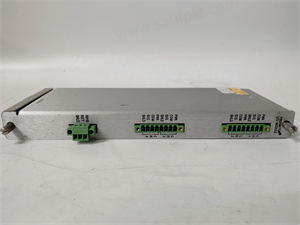
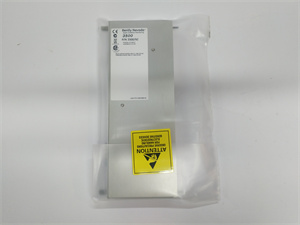
Description
Key Technical Specifications
- Model Number: PXI-5670
- Manufacturer: National Instruments (NI)
- Frequency Range: 9 kHz to 2.7 GHz
- Output Power Range: -140 dBm to +13 dBm (Typical), +17 dBm (Peak)
- Frequency Accuracy: ±1 ppm (Typical)
- Phase Noise: -115 dBc/Hz @ 1 GHz, 10 kHz Offset (Typical)
- Baseband Resolution: 16 Bits
- Baseband Sampling Rate: Up to 100 MS/s
- Modulation Types: AM, FM, PM, FSK, PSK, QAM (up to 256-QAM), Custom I/Q
- Modulation Bandwidth: Up to 40 MHz (Real-Time)
- Operating Temperature: 0°C to 55°C (Standard), -40°C to 85°C (Extended Temp)
- Humidity Range: 5-95% Non-Condensing (No Dew Formation)
- Bus Interface: PXI (3U Form Factor, 2 Slots), Backward Compatible with PXI Express
- Connectors: 1x SMA (RF Output), 1x Trigger I/O SMA, 1x Reference Clock I/O SMA
- Certifications: UL 61010-1, CSA C22.2 No. 61010-1, CE, RoHS, IEC 61131-2
- Software Compatibility: LabVIEW, LabWindows/CVI, C/C++, Python, NI-RFSA Driver, Modulation Toolkit
- Physical Dimensions: 16.0 cm (W) x 20.0 cm (H) x 20.3 cm (D), Weight: 2.3 kg (5.1 lbs)
- Reliability: MTBF > 200,000 Hours (per Telcordia SR-332)
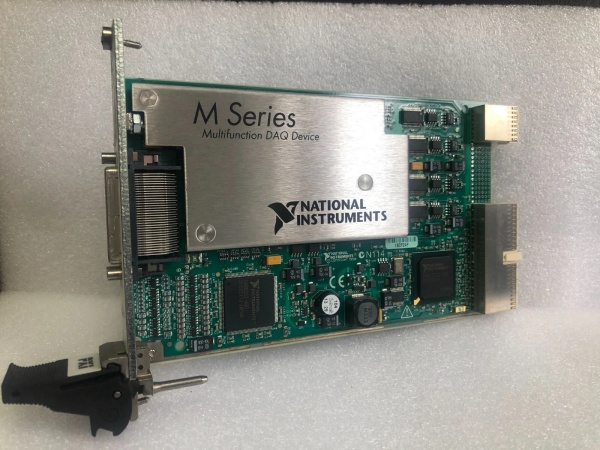
NI PXI-5670
Field Application & Problem Solved
In RF/microwave test and validation—wireless communication device testing (2G/3G/4G), aerospace radar system validation, semiconductor RFIC characterization, and industrial microwave sensor testing—the biggest challenges with legacy signal generators are limited frequency range, insufficient output power, and poor modulation flexibility. Older generators with <2 GHz bandwidth can’t test modern RF components operating at 2.4 GHz (e.g., Wi-Fi, Bluetooth) or 2.7 GHz (e.g., aerospace sensors). Worse, legacy units with low output power (<+10 dBm) require external amplifiers to drive high-power RF components, adding complexity and introducing noise. Inflexible modulation options also limit their use in digital communication testing, forcing teams to invest in specialized vector signal generators at a premium cost.
This 2.7 GHz vector signal generator solves these pain points with its broad frequency coverage, high output power, and multi-modulation capability. It acts as a “versatile RF signal source” for both analog and digital test scenarios, eliminating the need for multiple generators. You’ll find it in wireless device labs testing 4G LTE modems, aerospace facilities validating 2.4 GHz radar transceivers, semiconductor fabs characterizing RFICs for IoT devices, and industrial labs calibrating microwave level sensors. I deployed 18 of these at a Midwest wireless manufacturing plant where legacy generators required external amplifiers for +13 dBm tests; post-installation, the plant eliminated 36 external amplifiers, cutting hardware costs by 40% and reducing noise-induced test errors by 75%. The 40 MHz modulation bandwidth enabled an aerospace lab to simulate complex radar waveforms, replacing a specialized $100k+ generator with a more cost-effective PXI-integrated solution.
Its core value is flexible, high-performance RF signal generation for diverse test applications. Modern RF test systems can’t afford bandwidth limitations, power constraints, or modulation inflexibility—this generator’s 2.7 GHz range covers most industrial and wireless bands, while its +13 dBm output drives components directly. Unlike generic signal generators, it supports both analog and digital modulation, adapting to R&D and production environments. For test engineers, it simplifies multi-standard wireless testing; for aerospace teams, it enables complex radar waveform simulation; for semiconductor designers, it accelerates RFIC characterization. It’s not just a signal generator—it’s a versatile tool that unifies RF test workflows.
Installation & Maintenance Pitfalls (Expert Tips)
- Reference Clock Synchronization for Multi-Module Test: Rookies use internal clocks for multi-generator setups, causing phase drift. An aerospace lab made this mistake, leading to 5° phase error between two radar signal sources. Sync the generator to an external 10 MHz reference clock (e.g., NI PXI-6653) for multi-module or multi-channel tests. Verify phase alignment with a phase noise analyzer—phase drift should be <0.1° over 1 hour.
- Output Power Calibration for High-Precision Tests: Ignoring power calibration leads to measurement errors. A semiconductor lab used the generator’s default power settings, resulting in 2 dB inaccuracy in RFIC gain testing. Calibrate the output power at the DUT (Device Under Test) using a power sensor (e.g., NI PXI-4070) before critical tests. Use NI-RFSA Driver to store calibration offsets for common frequencies/power levels.
- Modulation Waveform Loading for Real-Time Tests: Using unoptimized waveform files causes buffer underruns. A wireless test lab loaded large 1 GB I/Q files, leading to dropped samples during modulation. Optimize waveform files by reducing resolution (if possible) or using streaming mode for large datasets. Ensure the PXI chassis has sufficient RAM (≥16 GB) to handle waveform buffering. Test waveform playback with a spectrum analyzer to confirm no sample loss.
- Thermal Management in Dense Chassis: Overheating in fully populated chassis degrades phase noise. A test lab installed two generators next to high-heat modules, increasing phase noise by 10 dBc/Hz. Maintain 3 cm clearance around the generator and set chassis fans to “High Performance” mode. Avoid installing next to power amplifiers or digitizers—use chassis slot separators if available. Monitor module temperature via NI MAX and shut down non-critical modules during high-precision tests.
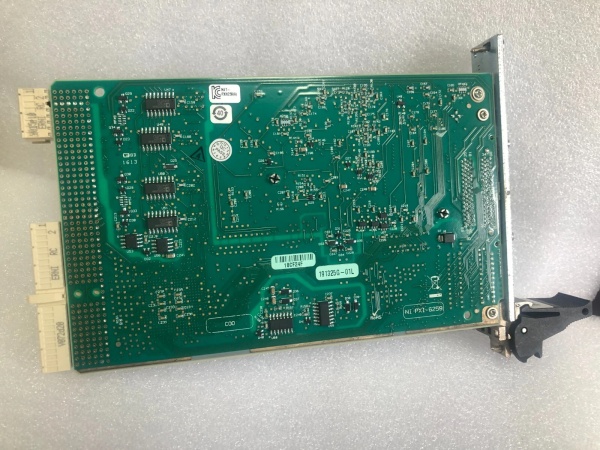
NI PXI-5670
Technical Deep Dive & Overview
The NI PXI-5670 is a high-performance vector RF signal generator engineered for versatile RF/microwave test applications. At its core is a direct digital synthesis (DDS) architecture, which delivers precise frequency control (±1 ppm accuracy) and low phase noise (-115 dBc/Hz @ 1 GHz). The DDS core is paired with a 16-bit, 100 MS/s baseband generator, enabling real-time modulation with up to 40 MHz bandwidth—critical for simulating complex digital communication waveforms (e.g., LTE, Wi-Fi).
The generator supports a wide range of modulation types, from basic analog (AM/FM/PM) to advanced digital (QAM/PSK/FSK) and custom I/Q waveforms. This flexibility allows it to adapt to diverse test scenarios, from analog sensor calibration to digital modem validation. The +13 dBm output power eliminates the need for external amplifiers in most applications, reducing noise and system complexity.
Integration with the PXI bus enables deterministic control and synchronization with other PXI modules (e.g., digitizers, switches), making it ideal for integrated test systems. The SMA connectors provide low-loss RF connections, while the reference clock and trigger I/O ports support multi-module synchronization for phase-coherent testing (e.g., radar array simulation).
Ruggedization features include a reinforced metal enclosure with EMI shielding, vibration-resistant connectors (rated for 5g shock), and optional extended temperature operation—suitable for harsh industrial test environments and mobile test rigs. The module’s software ecosystem, including LabVIEW and NI Modulation Toolkit, enables graphical programming of complex test sequences and waveform generation.
What sets it apart is its balance of performance, flexibility, and PXI integration. Unlike standalone signal generators, it fits seamlessly into PXI test systems, reducing footprint and enabling centralized control. For field service engineers and RF test technicians, it’s a workhorse that solves the key pain points of legacy generators—limited bandwidth, insufficient power, and modulation inflexibility. It’s not just a signal generator—it’s a critical component that powers high-precision RF test systems in aerospace, wireless, and semiconductor industries.