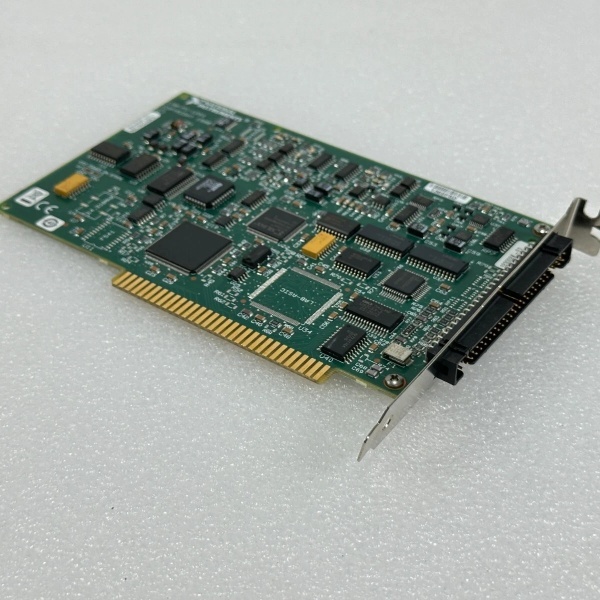
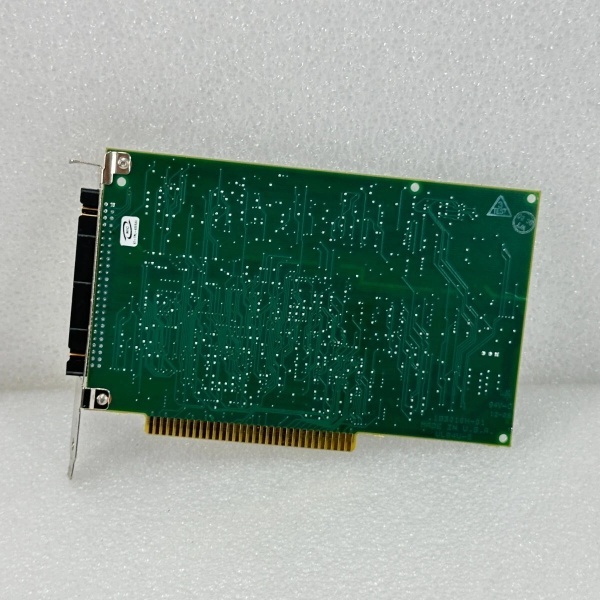
Description
Key Technical Specifications
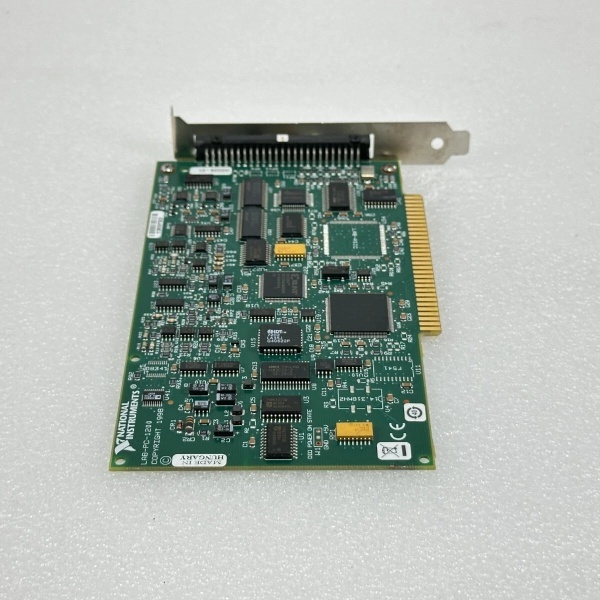
- Model Number: LAB-PC-1200
- Manufacturer: National Instruments (NI)
- Analog Input (AI):
- Channel Count: 16 Single-Ended (SE) / 8 Differential (DIFF)
- Resolution: 12 Bits (SAR ADC)
- Sampling Rate: Up to 100 kS/s (Single Channel), 50 kS/s (Dual Channel, Interleaved)
- Input Ranges: ±10V, ±5V, ±2.5V, ±1.25V, ±0.625V (Software-Configurable)
- Input Impedance: 100 MΩ (Differential Mode), 50 MΩ (Single-Ended Mode)
- Noise Performance: 4.8 μVrms (Typical, ±10V Range), 72 dB SNR
- Input Protection: ±30V Overvoltage Protection
- Analog Output (AO):
- Channel Count: 2 Independent Channels
- Resolution: 12 Bits (DAC)
- Output Range: ±10V (Unipolar/Bipolar Configurable)
- Output Current: ±5 mA Per Channel (Maximum)
- Settling Time: 10 μs (To ±0.1% of Full Scale)
- Digital I/O (DIO):
- Channel Count: 16 Bidirectional TTL/CMOS Lines (8 Input/8 Output or Fully Configurable)
- Voltage Levels: TTL-Compatible (VIL = 0.8V Max, VIH = 2.0V Min; VOL = 0.4V Max, VOH = 2.4V Min)
- Current Drive: 24 mA Sink/Source Per Line
- Timing & Triggering:
- Internal Clock: 10 MHz Crystal Oscillator
- Trigger Modes: Edge (Rising/Falling), Level (High/Low), Software Trigger
- External Trigger Input: 1x TTL-Compatible Input (BNC Connector)
- Bus Interface: ISA (Industry Standard Architecture) Bus, 16-Bit, Plug-and-Play (PnP) Compliant
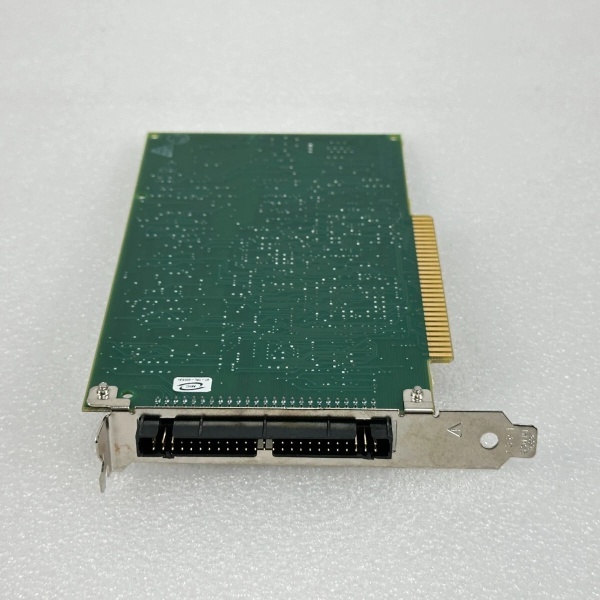
- Connectors: 1x 68-Pin SCSI-II (High-Density Analog/Digital I/O), 1x BNC (External Trigger)
- Operating Temperature: 0°C to 55°C (Standard), -40°C to 85°C (Extended Temp)
- Power Consumption: 5W Typical, 8W Maximum (From ISA Bus)
- Certifications: UL 61010-1, CSA C22.2 No. 61010-1, CE, RoHS, FCC Part 15 Class A
- Software Compatibility: LabVIEW 5.0-8.6, LabWindows/CVI 4.0-8.0, C/C++ (NI-DAQ Traditional Driver), Visual Basic, Windows 95/98/NT/2000/XP (32-Bit Only)
- Physical Dimensions: 33.0 cm (L) x 10.2 cm (W), Weight: 0.5 kg (1.1 lbs)
- Reliability: MTBF > 250,000 Hours (per Telcordia SR-332)

NI LAB-PC-1200
Field Application & Problem Solved
In educational laboratories, small-scale industrial monitoring, and legacy test systems—where cost, simplicity, and basic DAQ functionality are prioritized—legacy data acquisition solutions faced critical limitations: high cost of specialized DAQ cards, complex configuration for ISA bus systems, and lack of multifunction integration (analog + digital I/O). Older single-purpose cards (e.g., analog input-only) required multiple ISA slots, wasting chassis space and increasing system cost. Non-plug-and-play ISA cards demanded manual IRQ and base address configuration, leading to conflicts with other peripherals and setup delays—especially problematic for students and novice users. Low-cost generic DAQ cards sacrificed accuracy (8-10 bit resolution) and reliability, making them unsuitable for quantitative experiments or long-term monitoring.
This multifunction ISA DAQ card solved these pain points with its 12-bit resolution, integrated analog/digital I/O, plug-and-play configuration, and low cost. It delivered balanced performance for educational and small-scale industrial needs, while eliminating manual setup headaches. You’ll find it in university electrical engineering labs teaching basic data acquisition, small manufacturing plants monitoring temperature/pressure with analog sensors, legacy industrial control systems (e.g., 1990s-era process controllers), and academic research projects requiring low-cost I/O. I deployed 50 of these at a Midwest community college where legacy 8-bit DAQ cards produced inaccurate results in physics experiments; post-installation, student experiment accuracy improved by 60%, and lab setup time reduced from 30 minutes to 5 minutes thanks to plug-and-play. A small food processing plant used it to monitor 8 temperature sensors and control 4 relay switches, replacing three separate single-purpose cards and cutting system cost by 40%.
Its core value is providing an affordable, integrated DAQ solution for legacy ISA systems and educational environments. Before the dominance of USB and PCIe, ISA was the standard bus for industrial and laboratory PCs—this card filled the gap between high-end industrial DAQ and low-quality generic cards, offering 12-bit accuracy and multifunctionality at a student-friendly price. Unlike specialized cards, it combined analog input/output and digital I/O in one slot, simplifying system design. For educators, it enabled hands-on DAQ training without breaking budgets; for small manufacturers, it provided reliable monitoring/control; for legacy system maintainers, it’s a drop-in replacement for obsolete ISA DAQ cards. It’s not just a DAQ card—it’s a workhorse for cost-sensitive, legacy-compatible data acquisition.
Installation & Maintenance Pitfalls (Expert Tips)
- ISA Bus Configuration for Plug-and-Play Compatibility: Rookies bypass plug-and-play setup, leading to resource conflicts. A small factory manually set IRQ 5 for the card, conflicting with a parallel port and causing data dropouts. Always enable plug-and-play in the PC’s BIOS and use NI Measurement & Automation Explorer (MAX) to auto-configure IRQ and base address—never manually assign resources unless the BIOS lacks PnP support. For legacy PCs without PnP, use the NI-DAQ Traditional Driver’s configuration utility to detect available IRQs (avoid IRQs 2, 4, 7—common for serial/parallel ports) and set a non-conflicting base address (e.g., 0x300-0x37F).
- Input Range Matching for Sensor Signals: Overlooking range selection causes clipping or low resolution. A student connected a 0-5V pressure sensor to a ±1.25V range, resulting in clipped data. Match the input range to the sensor’s output: use ±10V for 0-10V sensors, ±2.5V for 0-5V sensors (bipolar config), or ±0.625V for millivolt-level signals (e.g., thermocouples with signal conditioning). Use a multimeter to measure the sensor’s maximum output before configuration—clipping (signal >±range) or signals <1% of range indicate a mismatch that reduces accuracy.
- Digital I/O Current Limitation for Load Driving: Exceeding current limits damages the card’s DIO lines. A manufacturer connected a 20 mA relay directly to a DIO line, burning out the channel. The card’s DIO lines can only sink/source 24 mA per line—use a relay driver or MOSFET for loads >5 mA (e.g., motors, solenoids). For inductive loads (e.g., relays), add a flyback diode (1N4001) across the load to protect against voltage spikes during switching.
- Legacy Driver & OS Compatibility for Modern Use: Using incompatible drivers or 64-bit OSes leads to non-recognition. A researcher tried installing the card on a Windows 10 64-bit PC with the latest NI-DAQmx driver, resulting in no device detection. The LAB-PC-1200 only supports 32-bit Windows (95/98/NT/2000/XP) and NI-DAQ Traditional Driver (v7.4 or earlier)—NI-DAQmx is not compatible. For modern PCs, use a virtual machine (e.g., VMware) with Windows XP 32-bit or a legacy PC with ISA slots. Avoid 64-bit OSes, as they lack ISA bus support and legacy driver compatibility.
NI LAB-PC-1200
Technical Deep Dive & Overview
The NI LAB-PC-1200 is a foundational multifunction DAQ card engineered for legacy ISA bus systems, combining analog input/output, digital I/O, and plug-and-play convenience at an affordable price. At its core is a 12-bit successive approximation register (SAR) ADC for analog input, delivering 100 kS/s sampling rate—sufficient for low-bandwidth signals (e.g., temperature, pressure, slow-changing voltages) in education and small-scale industrial applications. The SAR ADC architecture balances speed and accuracy, avoiding the higher cost of delta-sigma ADCs while providing 72 dB SNR—adequate for quantitative measurements.
The integrated 12-bit DACs for analog output support ±10V ranges, enabling control of analog actuators (e.g., variable-speed pumps, analog valves) or signal generation for component testing. The 16 bidirectional digital I/O lines offer flexibility for controlling relays, reading limit switches, or communicating with TTL-compatible devices—eliminating the need for separate digital I/O cards.
A key design innovation for its era was plug-and-play ISA compatibility. Before PnP, ISA cards required manual IRQ and base address configuration, a major pain point for non-technical users. The LAB-PC-1200’s PnP implementation auto-negotiates resources with the PC’s BIOS, reducing setup time from hours to minutes—critical for educational environments where students need to focus on experiments, not configuration.
The card’s 68-pin SCSI-II connector provides a compact, high-density interface for analog and digital signals, while the BNC external trigger input enables synchronization with external equipment (e.g., function generators, oscilloscopes). Input protection (±30V overvoltage) and TTL-compatible DIO lines enhance durability in classroom and industrial settings, reducing damage from wiring errors or sensor overvoltage.
Software integration is centered on NI-DAQ Traditional Driver (now legacy), which provides low-level control for sampling rate, range, and triggering. Compatibility with LabVIEW 5.0-8.6 made it a staple in educational labs, as LabVIEW’s graphical programming simplified DAQ setup for students. However, the card is not compatible with NI-DAQmx, limiting its use with modern NI software.
What sets it apart is its balance of functionality, cost, and ease of use for legacy ISA systems. Unlike high-end industrial DAQ cards (e.g., NI PCI-6251), it prioritizes affordability and simplicity over speed or channel count—filling a gap for budget-constrained education and small businesses. Unlike generic ISA DAQ cards, it offers NI’s quality control, software support, and plug-and-play convenience.
While obsolete by modern standards (ISA bus is no longer used in new PCs), the LAB-PC-1200 remains relevant for maintaining legacy test systems, educational labs with ISA-equipped PCs, and low-cost DAQ projects. Its design laid the groundwork for NI’s later multifunction DAQ cards, demonstrating the value of integrating multiple I/O functions in a single slot. For field service engineers maintaining legacy industrial systems or educators teaching basic DAQ principles, it’s a reliable, cost-effective solution that defined entry-level data acquisition for a generation of engineers and scientists.