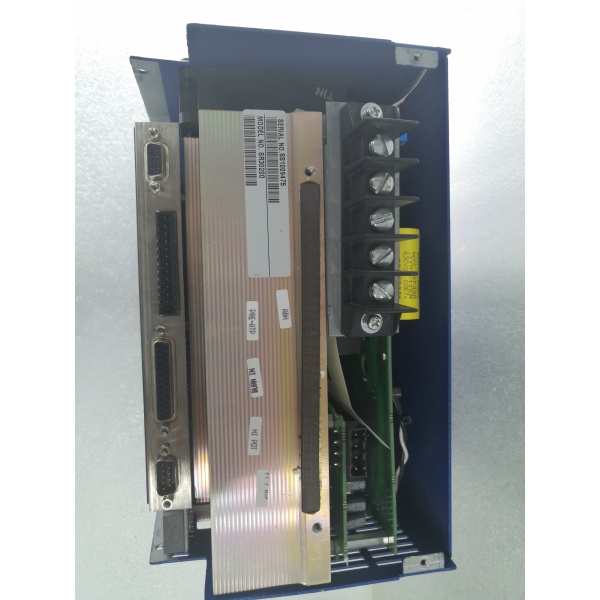
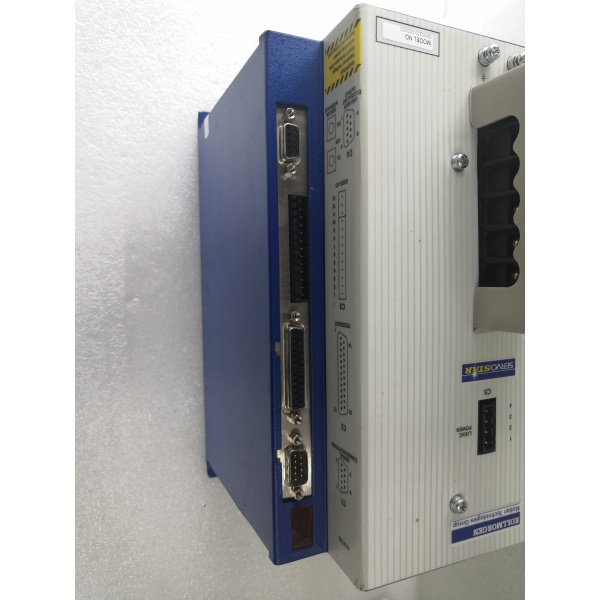
Description
Hard-Numbers: Technical Specifications
- Continuous Stall Torque: 8.5 Nm (75 in-lb)
- Peak Torque: 25.5 Nm (225 in-lb)
- Rated Speed: 3000 RPM
- Continuous Power: 2.7 kW (3.6 HP)
- Peak Power: 8.0 kW (10.7 HP)
- Voltage Constant: 75 V/kRPM
- Torque Constant: 1.2 Nm/A
- Resistance: 0.65 ohms (line-to-line)
- Inductance: 6.2 mH (line-to-line)
- Feedback: Resolver (standard on -000000 variant)
- Thermal Time Constant: 35 min
- Inertia: 6.5 kg·cm²
- Weight: 18 kg (40 lb)
- Mounting: IEC flange 100 mm with 14 mm shaft diameter
- Holding Brake: Optional (not included in base model)

KOLLMORGEN SR30200-000000
The Real-World Problem It Solves
You need a motor that delivers solid torque without demanding exotic cooling or oversized drives, and the environment is electrically noisy enough that optical encoders would be unreliable. The SR30200 gives you 8.5 Nm continuous torque in a compact 300mm frame, with resolver feedback that shrugs off oil mist, metal dust, and electrical interference.
Where you’ll typically find it:
- Feed drives on machining centers and CNC lathes
- Conveyor belt drives in material handling
- Turret and tool changer positioning on machine tools
The bottom line: It’s the mid-range workhorse that runs reliably in dirty environments where fancier motors would fail, delivering enough torque for most general automation tasks without breaking the budget.
Hardware Architecture & Under-the-Hood Logic
This is a standard 6-pole brushless servo motor using sinusoidal commutation. The rotor holds rare-earth permanent magnets, and the stator windings generate a rotating magnetic field. The resolver mounted on the non-drive end provides absolute position feedback through inductive coupling rather than optical sensing.
Signal flow breaks down like this:
- Drive outputs three-phase AC current to stator windings (U, V, W)
- Current vector aligns with rotor position via resolver feedback
- Magnetic interaction between stator field and rotor magnets produces torque
- Resolver excitation signal (typically 5-10 kHz) applied to rotor winding
- Resolver feedback signals (sine, cosine) return to drive for commutation
- Internal thermal switch opens at 150°C for overtemperature protection
- Front shaft seal (IP65) protects bearings from contaminants
KOLLMORGEN SR30200-000000
Field Service Pitfalls: What Rookies Get Wrong
Resolver Wiring ErrorsThe resolver has six wires: two excitation, two sine, two cosine. Techs cross them or connect shield improperly, causing position drift or commutation faults.
- Field Rule: Use the resolver cable diagram from the motor nameplate. Excitation pair usually has the highest resistance (25-35Ω). Verify with a multimeter before connecting—incorrect wiring causes erratic motion and can damage the resolver interface card.
Phase Sequence ConfusionUnlike induction motors, servo motors require specific phase sequence for proper direction. Swapping U, V, W causes immediate commutation fault.
- Quick Fix: Mark terminals clearly before removal. If you get direction wrong, swap two phases in the drive parameters, not the wiring. Never rely on trial-and-error phase swapping on a powered servo drive.
Thermal Margin NeglectThis motor can dump 2.7 kW of heat at rated load. Techs mount it in sealed cabinets or block airflow, then wonder why thermal faults appear during long cycles.
- Field Rule: Calculate RMS torque from your motion profile. If you’re above 75% of rated torque for extended periods, you need cooling. Measure cabinet temperature rise—if internal ambient hits 45°C+, add ventilation or derate the motor. A $50 fan saves a $2,000 motor.