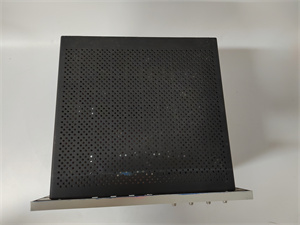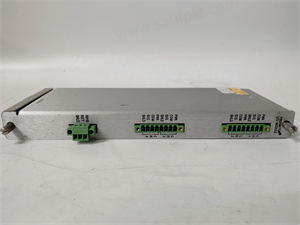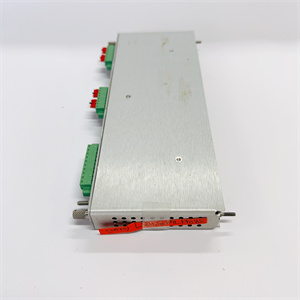
Description
Hard-Numbers: Technical Specifications
- Processor: BPPx processor board for real-time I/O scanning, debounce logic, and deterministic communication.
- Communication Protocol: Dual 10/100Base-TX Ethernet ports for redundant I/O network integration with the Mark VIe controller.
- Supply Voltage: 24 V DC Nominal (Supports 18-32 V DC industrial range).
- Power Consumption: ~12 W (Dependent on communication activity and connected terminal board).
- Discrete Inputs (DI): 16 or 24 independent channels (depending on specific firmware/terminal board pairing), optimized for dry contact sensing (voltage-free contacts) with integrated current limiting and noise filtering.
- Input Filter: Hardware-based 4 ms filter to eliminate contact bounce and high-frequency electrical noise.
- Voltage Suppression: 60 V RMS AC voltage suppression (at 50/60 Hz) to protect against inductive kickback and transient spikes.
- Input/Output Protection: Optical isolation and galvanic isolation (1500 VAC) between the field-side input circuits and the control-side logic/communication circuits.
- Operating Temperature: -30°C to +65°C (Standard industrial range; capable of brief exposure to -40°C to +85°C extremes).
- Humidity Tolerance: 5% to 95% non-condensing.
- Vibration Resistance: Compliant with IEC 60068-2-6 standards for industrial control panels and turbine packages.
- Protection: Industrial-grade conformal coating and IP20-rated enclosure for dust and moisture resistance. Certified for Class I Division 2 and ATEX Zone 2 hazardous locations.
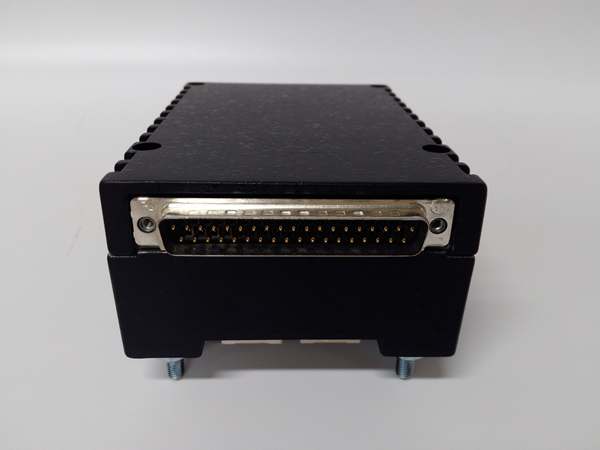
- Connectors: Dual RJ-45 Ethernet, one DC-37 pin connector for direct terminal board interface, and one 3-pin power connector.
- Compatible Terminal Boards: TBCI (H1, H2, H3), TICI, and STCI series.
- Incompatible Terminal Boards: DTCI series (DIN-rail mount).
- Dimensions (Approx.): 12.1 cm x 8.26 cm x 4.19 cm (4.78″ x 3.25″ x 1.65″).
- Weight (Approx.): 0.25 kg (0.55 lbs).
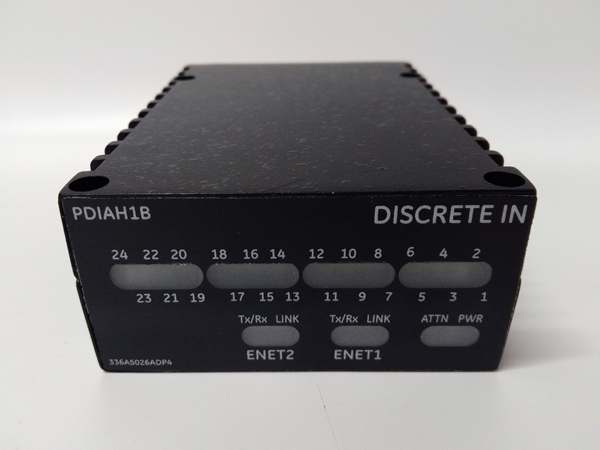
The Real-World Problem It Solves
In a running gas or steam turbine, safety and operational status are often monitored through simple binary contacts—is the lube oil pump running? Has the emergency stop been pressed? The solves the fundamental problem of reliably detecting the opening and closing of dry contacts in an electrically noisy industrial environment.
Mechanical switches and relays don’t just snap open or closed; they “bounce” microscopically, and long field wires act as antennas for electrical noise. The PDIAH1B eliminates this “ghost switching” by using optical isolation, a robust 4-millisecond hardware filter, and a precise wetting current. This ensures that a spurious voltage spike or mechanical chatter doesn’t accidentally trip a turbine or cause a nuisance alarm. Without this module, the control system would lack a dependable way to ascertain the true On/Off status of critical plant equipment.
Where you’ll typically find it:
- Mounted directly onto compatible discrete input terminal boards (such as the TBCI or TICI variants) within the turbine control cabinet using a DC-37 pin connector.
- Wired to field devices like emergency stop pushbuttons, lube oil pump status contacts, ventilation fan run signals, and turbine protection relays.
- Integrated into Triple Modular Redundant (TMR), Dual Modular Redundant (DMR), or Simplex architectures where its software-implemented fault tolerance (SIFT) ensures that a single point of field wiring failure won’t compromise the turbine’s safety.
Bottom line: It is the rugged, noise-immune gateway that ensures the Mark VIe brain accurately hears the “open/closed” status of the physical plant.
Hardware Architecture & Under-the-Hood Logic
The is engineered as a high-reliability, fault-tolerant digital input node. Its internal architecture is designed to filter out the chaos of the real world and present clean data to the controller. (Note: The internal architecture is largely consistent with the H1A variant, with component-level revisions for improved MTBF.)
- Input Signal Conditioning: The discrete inputs pass through precision current-limiting resistors and optical isolators. A small “wetting current” is sourced to keep contact surfaces clean and ensure a solid connection.
- Hardware Debouncing: A 4 ms hardware filter acts as the first line of defense against mechanical switch bounce and high-frequency noise, preventing false triggering before the signal even reaches the processor.
- Deterministic Communication: The onboard BPPx processor monitors the sanitized digital input states. It packages this data into Ethernet frames and transmits them to the Mark VIe controller at the configured frame rate (as fast as 10ms), ensuring minimal latency.
- Fault Management: The processor continuously monitors its own health and communication link status. If a critical fault is detected (e.g., loss of communication with the controller), it triggers hardware-level alarms to notify the Mark VIe system, allowing for a coordinated, safe shutdown of the turbine.
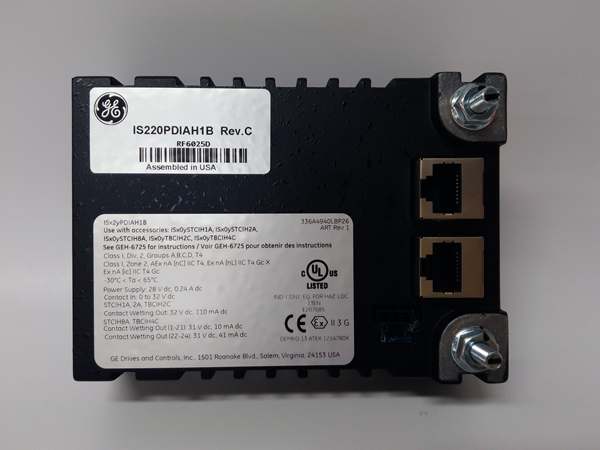
IS220PDIAH1B
Field Service Pitfalls: What Rookies Get Wrong
The “Phantom Closure” (Improper Wetting Current)
Rookies often treat dry contacts as simple open/closed switches, ignoring the physics of oxidation. Over time, inactive contacts develop a thin layer of oxidation that acts as an insulator.
- The Symptom: The Mark VIe system randomly alarms, claiming a limit switch has tripped or a pump has stopped, even when the physical device hasn’t moved. Wiggling the wires makes the alarm come and go.
- Field Rule: Dry contacts require a minimum “wetting current” (typically 5-10mA) to blast through oxidation and ensure a solid electrical connection. Verify that the ‘s internal wetting current is sufficient for the connected contact. If the field device uses long, small-gauge wires, the voltage drop might be too high. Measure the actual current flowing through the closed contact; if it’s near zero, you may need to add an external pull-up resistor to boost the wetting current.
Ignoring the 4ms Hardware Filter
The PDIAH1B has a non-negotiable 4-millisecond hardware filter on its inputs. Rookies often forget this when troubleshooting fast-acting signals.
- The Symptom: A high-speed digital pulse from a flow meter or a shaft encoder is completely ignored by the Mark VIe controller, even though a multimeter shows the contacts are cycling rapidly.
- Field Rule: The 4ms filter means the module physically cannot recognize an input pulse shorter than 4 milliseconds. This is intentional to prevent noise-induced false triggers. If your application requires capturing pulses faster than 4ms (higher than 125Hz), the PDIAH1B is the wrong module for the job. You will need to use a high-speed counter module or a different I/O pack designed for pulse train inputs.
The “Frankenstein” Upgrade (Mixing H1A and H1B without checking Firmware)
Sometimes, during a maintenance outage, a technician will swap an older IS220PDIAH1A with a newer without consulting the control engineer.
- The Symptom: The Mark VIe controller throws a “Hardware Mismatch” or “Firmware Incompatible” fault upon reboot, putting the turbine in a tripped or degraded mode.
- Field Rule: While H1A and H1B are generally form-fit-function compatible, the H1B may ship with a newer firmware version that the older Mark VIe controller (or its current ToolboxST project file) does not recognize. Always check the GE Mark VIe Product Compatibility Matrix before mixing hardware revisions in a running turbine control panel.
⚠️ Buyer Beware: The “Datasheet Scam”
If you are searching for this module online, you might encounter third-party reseller listings claiming the is an “Analog Input Module”, “Pulse Input Module”, or even a “16-Channel Thermocouple Card”.
- The Reality: In the GE Mark VIe ecosystem,
PDIAstrictly stands for Process Discrete Input Assembly. Third-party brokers often use “Black Hat” SEO tactics, copy-pasting random specifications from other modules into their listings to game search engine algorithms. - The Fix: Never order critical spares based solely on a reseller’s webpage. Always cross-reference the 100-character GE part number (found on the physical label) with the official GE Mark VIe I/O pack compatibility charts (GEH-6721 or similar volumes in the GE Online Store).
Commercial Availability & Pricing Note
Please note: The listed price is for reference only and is not binding. Final pricing and terms are subject to negotiation based on current market conditions and availability.