Description
Hard-Numbers: Technical Specifications
- Processor: BPPx processor board combined with dedicated analog acquisition hardware for real-time signal processing.
- Communication Protocol: Dual 10/100Base-TX Ethernet ports for deterministic communication with the Mark VIe controller.
- Supply Voltage: 24 V DC Nominal (Powered via a three-pin connector, supporting redundant power supplies).
- Power Consumption: ~10–20 W (Dependent on active channel count and communication load).
- Analog Inputs (AI): 10 total channels. Channels 1-8 are configurable for ±5 V, ±10 V, or 4-20 mA. Channels 9-10 are fixed as 1 mA or 4-20 mA current inputs.
- Analog Outputs (AO): 2 channels (0-20 mA standard, with hardware support on the first output for 0-200 mA).
- Signal Conditioning: Built-in filtering, open-circuit detection, and over-range detection for robust sensor data acquisition.
- Operating Temperature: 0°C to +60°C (Standard industrial range for control cabinet environments).
- Humidity Tolerance: 5% to 95% non-condensing.
- Vibration Resistance: Compliant with IEC 60068-2-6 standards for industrial control panels.
- Protection: Industrial-grade conformal coating for moisture and dust resistance.
- Isolation: Reinforced galvanic isolation (typically 1500V AC or higher) between field-side I/O and the control-side logic/communication circuits.
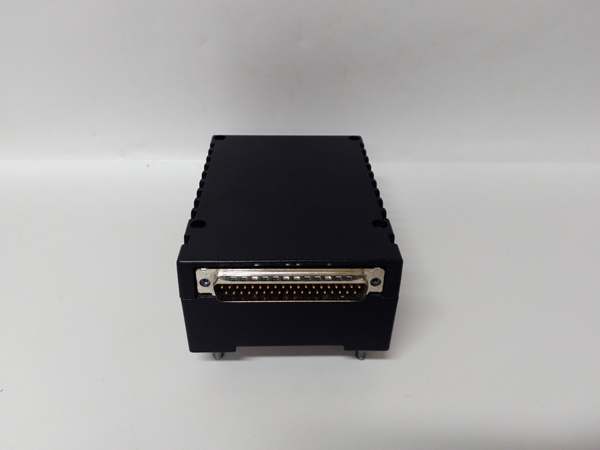
- Connectors: Dual RJ-45 Ethernet, one DC-37 pin connector for terminal board interface, and one 3-pin power connector.
- Dimensions (Approx.): Compact DIN-rail or panel-mountable enclosure.
- Weight (Approx.): 0.2–0.5 kg.
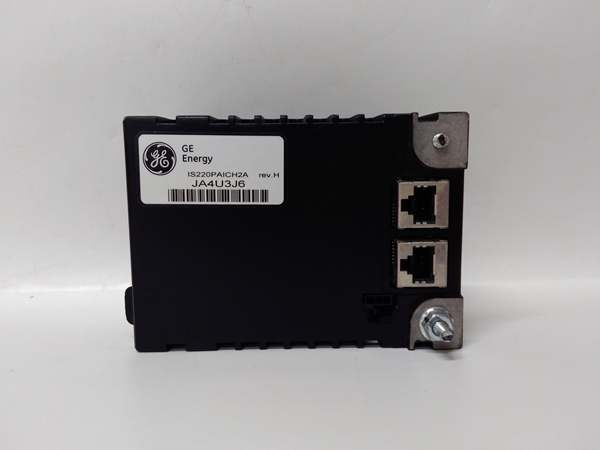
IS220PAICH2A
The Real-World Problem It Solves
In complex industrial turbine or power generation facilities, accurate monitoring of physical parameters like temperature, pressure, and flow is critical. The solves the fundamental problem of accurately digitizing a high density of analog signals and providing closed-loop control outputs while isolating them from the noisy electrical environment of the plant. It ensures that the Mark VIe controller receives clean, precise data to make split-second control decisions. Without this module, the control system would lose its ability to accurately regulate the continuous physical variables of the turbine, risking inefficiency or unsafe operating conditions.
Where you’ll typically find it:
- Mounted directly onto compatible terminal boards (such as the TDBS or TBCI) within the turbine control cabinet using a DC-37 pin connector.
- Interfacing with 4-20mA current loops from pressure transmitters, temperature sensors, or LVDTs.
- Sending analog control signals to hydraulic proportional valves or actuators to modulate turbine speed and load.
Bottom line: It is the crucial analog nerve ending that allows the Mark VIe digital brain to accurately perceive and smoothly control the physical dynamics of the turbine system.
Hardware Architecture & Under-the-Hood Logic
The is designed as a ruggedized, high-precision data acquisition and control node. Its internal architecture is optimized for deterministic signal processing and seamless integration into the Mark VIe Ethernet I/O network.
- Signal Acquisition & Conditioning: Incoming analog signals from the field pass through precision instrumentation amplifiers and anti-aliasing filters. The module performs necessary linearization and scaling before presenting the data to the onboard microcontroller.
- High-Resolution Conversion: The module utilizes high-resolution Analog-to-Digital Converters (ADCs) for inputs and Digital-to-Analog Converters (DACs) for outputs, ensuring minimal quantization error and high fidelity in signal representation.
- Microcontroller Processing: The onboard processor manages sampling rates, executes calibration routines, performs self-diagnostics, and packages digitized data into Ethernet frames for transmission to the main Mark VIe controller. It also receives digital setpoints from the controller and converts them into precise analog output currents.
- Fault Detection & Isolation: The module continuously monitors its own health, power supply quality, and communication link status. If a critical fault is detected (e.g., an open sensor loop, short circuit, or loss of communication), it triggers hardware-level alarms to protect the turbine and connected equipment.
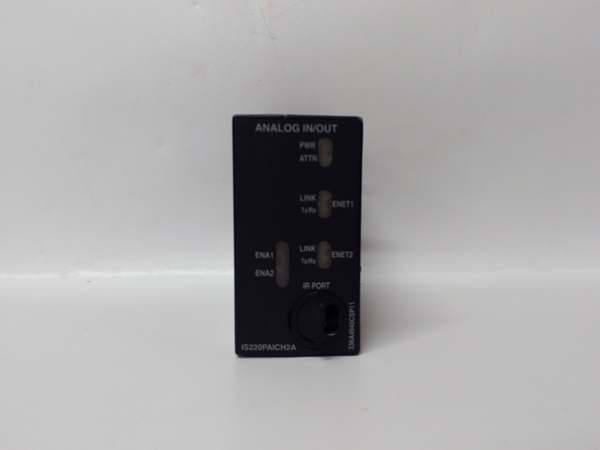
IS220PAICH2A
Field Service Pitfalls: What Rookies Get Wrong
The “Ghost Reading” Caused by Improper Grounding/Shielding
Rookies often focus solely on the module itself when troubleshooting erratic analog readings, overlooking the fundamental importance of proper grounding and shielding in the field wiring. They might swap the , only to find the mysterious fluctuations persist.
- The Symptom: Analog input values jitter or drift randomly, especially when nearby heavy machinery turns on or off. The readings may show sudden spikes or drops that don’t correspond to actual physical changes in the process.
- Field Rule: Before replacing the I/O pack, meticulously check the shielding and grounding of the field cables. Ensure that the shield is properly terminated and that there are no ground loops. Use a multimeter to verify that the analog common (return) has a solid, low-impedance connection to the system ground. Clean, stable power and signal grounds are paramount for accurate analog measurements.
Mismatched Terminal Board Compatibility
The is designed to mate with specific GE terminal boards (like the TDBS or TBCI) via a DC-37 connector. Rookies might try to install it on an incompatible or improperly configured terminal board.
- The Symptom: The module powers up, but specific channels read zero, max out, or throw continuous “Open Circuit” faults even when sensors are connected.
- Field Rule: Always verify that the physical terminal board part number is compatible with the PAICH2A. Check the terminal board’s manual to ensure the DC-37 pinout aligns with the I/O pack’s expectations. If the terminal board has onboard jumpers or DIP switches for channel configuration, ensure they match the I/O pack’s software setup.
Ignoring the Soft-Start Feature During Power Cycling
While the has an inherent soft-start feature to control inrush current, rookies often assume they must power down the entire cabinet to replace or troubleshoot the module.
- The Symptom: Unnecessary extended downtime for the turbine control system during what could have been a simple online replacement or diagnostic check.
- Field Rule: Because of the soft-start circuitry, the I/O pack can often be safely inserted or removed without disconnecting the main 24V DC power source. However, always follow strict Lockout/Tagout (LOTO) procedures and consult the site’s safety protocols. Utilize the dual RJ-45 ports for redundant Ethernet connections to avoid communication loss during maintenance.
Commercial Availability & Pricing Note
Please note: The listed price is for reference only and is not binding. Final pricing and terms are subject to negotiation based on current market conditions and availability.