Description
Hard-Numbers: Technical Specifications
- Output Channels: Multiple Independent Relay Drivers (Supports both fused and dedicated output configurations depending on host terminal board)
- Operating Voltage (Logic): 24VDC (Supplied from the host terminal board)
- Compatible Host Boards: TDBS, SRLY, and TDBT Terminal Boards
- Redundancy Support: Simplex, Dual-Redundant, or Triple Modular Redundant (TMR)
- Communication Interface: Modbus RTU (Via host TDBS board)
- Physical Dimensions: Approx. 10.16 cm W x 33.02 cm H (Standard Mark VIe daughterboard form factor)
- Operating Temperature: -30°C to +65°C (Suitable for extreme turbine environments)
- Protection: Conformal Coated PCB (Moisture, dust, and chemical resistance)
- Agency Approvals: UL Listed, CE, CSA
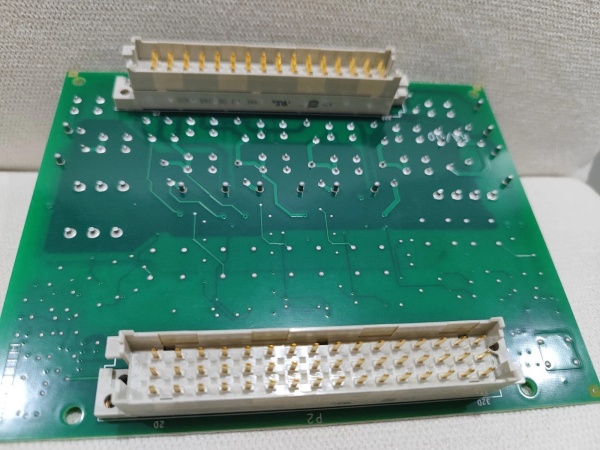
IS200WROBH1A
The Real-World Problem It Solves
You are setting up the auxiliary control panel for a heavy-duty gas turbine or a critical compressor station. The Mark VIe controller needs to send commands to start standby pumps, open vent valves, and trigger local audible alarms. Directly switching these inductive, high-current field devices would expose the sensitive 24VDC I/O rack to dangerous voltage spikes and potential short circuits. You need a rugged, isolated interface that can handle the grunt work of switching field loads while keeping the main PDIO processor safe.
Where you’ll typically find it:
- Mated to TDBS or SRLY Terminal Boards: Mounted as a daughterboard inside Mark VIe I/O racks to provide heavy-duty, protected relay driving capabilities for auxiliary systems .
- TMR Turbine Protection Racks: Installed on TDBT terminal boards in Triple Modular Redundant systems to execute voting logic for non-critical auxiliary shutdowns or status annunciators .
- Balance of Plant (BOP) & Auxiliaries: Driving high-inertia contactors, solenoid banks, and alarm beacons where reliable, isolated switching is mandatory .
It acts as the robust switching interface for your Mark VIe outputs, ensuring that inductive kickback from a field device doesn’t propagate back into the sensitive control logic.
Hardware Architecture & Under-the-Hood Logic
The “H1A” suffix denotes a specific hardware revision of the WROG (Wire Relay Output) board. It is designed strictly as an option board—it cannot function as a standalone component. Instead, it plugs into the expansion header of a host terminal board (like the TDBS or TDBT) to offload and protect high-current discrete outputs .
- Galvanic Isolation: The board utilizes optocouplers and robust relay contacts to create a strong physical and electrical隔离 between the Mark VIe’s 5VDC/24VDC logic levels and the noisy, high-inductance field wiring. This prevents voltage transients from propagating back into the I/O rack .
- Load Switching & Protection: The WROG is engineered to handle the arcing and wear associated with switching real-world mechanical devices like motor starter coils and solenoid valves. When paired with appropriate host terminal boards, it supports both fused outputs (for general purpose use) and dedicated outputs (for critical alarms) .
- TMR Voting Capability: When deployed in a Triple Modular Redundant (TMR) configuration, three WROG boards work in parallel on a TDBT terminal board. The system employs “2-out-of-3” voting for the relay outputs, meaning auxiliary devices will only activate if at least two of the three WROG modules agree that the command is valid, effectively eliminating false triggers caused by a single-point hardware failure .
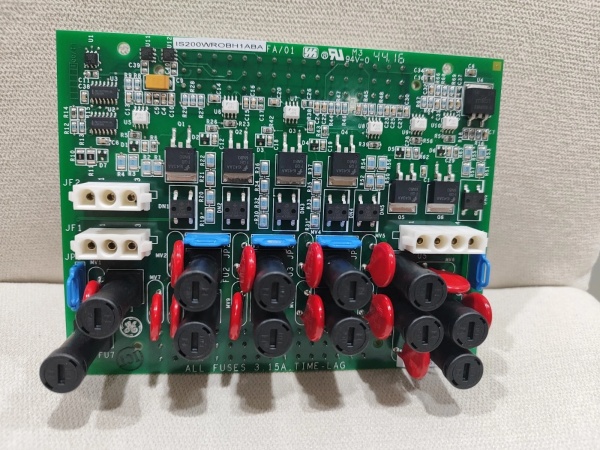
IS200WROBH1A
Field Service Pitfalls: What Rookies Get Wrong
Ignoring the Host Board’s Fusing Strategy
A technician is replacing a failed WROG board. He swaps the hardware, but within hours, the new board stops responding to commands. He assumed the WROG had internal fuses, but the actual protection was located on the host TDBS terminal board. The repeated short circuits in the field wiring eventually damaged the WROG’s driver transistors.
- Field Rule: The WROG relies heavily on the host terminal board (TDBS/SRLY) for circuit protection. Always check and verify the health of the fuses on the host terminal board before replacing a faulty WROG. Never bypass or up-fuse the host board’s protection devices.
Forgetting to Power-Down the 24VDC Supply Before Swapping
An electrician needs to replace a WROG board in a live rack. Thinking it’s a hot-swappable component like a redundant power supply, he pulls the board while the 24VDC auxiliary power is still applied to the terminal block. The resulting arc damages the backplane connector pins.
- Quick Fix: Unlike some modern hot-swappable I/O, option boards like the WROG must be installed or removed with the 24VDC power supply to the terminal board turned off. Always follow lock-out/tag-out procedures for the specific I/O rack segment before performing hardware replacements.
Forcing the WROG into an Incompatible Terminal Board Revision
An engineer is upgrading an older Mark VIe system. He orders an IS200WROGH1A to pair with an existing SRLY terminal board he found in the warehouse. He forces the connection, but the system won’t recognize the module. The HMI reports “PDIO Option Board Not Detected.”
- Quick Fix: Not all terminal board revisions support all option boards. The host boards (TDBS, SRLY, TDBT) have multiple hardware revisions. Before ordering or installing a WROG, check the silkscreen on the host terminal board to ensure it has the correct option board expansion header populated. If the header is missing or the board revision is too old, the WROG simply won’t communicate with the controller .
Commercial Availability & Pricing Note
Please note: The listed price is for reference only and is not binding. Final pricing and terms are subject to negotiation based on current market conditions and availability.