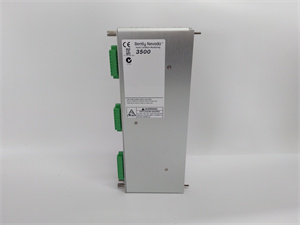
Description
Hard-Numbers: Technical Specifications
- Input Voltage: 125 VDC (sourced from EPDM power module)
- Output Voltage: Up to 500V DC (drives SCRs)
- Peak Output Current: ±2000A DC
- Transformers: 8 (for signal amplification)
- Transistors: 10+ (high-power switching)
- Connectors: 14 total (8 double, 4 quadruple, 2 sextuple)
- Female Board Connectors: 3 (for optional daughterboards)
- Configurable Jumpers: 5 onboard (J1-J5)
- Diagnostic LEDs: 22 total (1 Red Fault, 5 Green Power/Command, 16 Amber Temp/Current)
- Operating Temperature: -20°C to +60°C
- Storage Temperature: -40°C to +85°C
- Humidity Range: 5%–95% non-condensing
- Isolation Rating: 2500 Vrms (power to control circuits)
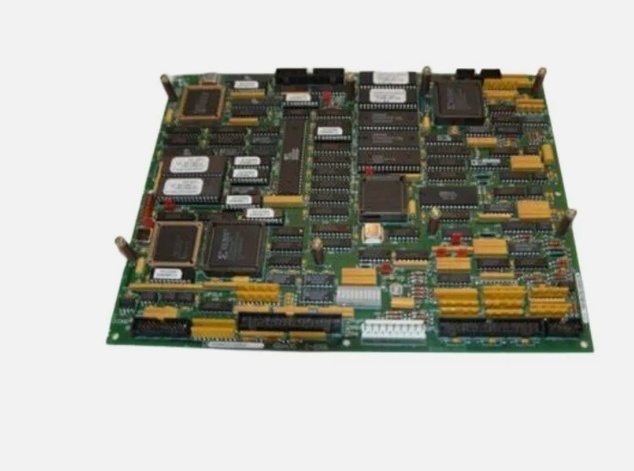
IS200EHPAG1A
The Real-World Problem It Solves
You’re standing in a 9FA gas turbine exciter cabinet where the standard EGPA boards are barely pushing enough gate current to fire the massive 2000A thyristor bridge. The generator keeps tripping on “Field Overcurrent” because the pulses are too weak to fully saturate the SCR gates, causing partial conduction and localized heating. You need a board that can deliver hammer-blow gate pulses at ±2000A peak. This EHPA board solves that nightmare. It crams eight transformers and ten-plus high-power transistors into a single slot, pushing up to 500V DC into the gate-cathode circuit and ensuring crisp, simultaneous SCR turn-on across all six phases.
Where you’ll typically find it:
- Large 9FA/9HA Gas Turbine Exciter Cabinets: Driving high-current thyristor bridges in 500MW+ combined-cycle units.
- Heavy-Duty Steam Turbine Generators: Managing gate firing sequences for massive brushless exciters with 2000A+ field currents.
- Retrofit Projects: Replacing undersized gate drive boards in legacy power plants running high-impedance thyristor modules.
It turns a borderline, heat-prone SCR firing system into a deterministic, high-current gate drive loop.
Hardware Architecture & Under-the-Hood Logic
This isn’t a wimpy signal repeater; it’s a high-voltage pulse generator built to survive the brutal electrical environment right next to a multi-megawatt thyristor bridge. It lives on the EX2100 backplane, acting as the final muscle between the ESEL board’s logic and the violent world of the power bridge.
- Low-Level Pulse Reception: Firing commands arrive from the ESEL board via 14 plug connectors on the upper-right corner. The EHPA buffers and shapes these millisecond-precision logic signals before amplification.
- High-Voltage DC/DC Conversion: Eight onboard transformers and more than ten high-power transistors form the core amplification stage. This beast takes the 125VDC input and generates up to 500V DC gate drive voltage, with ±2000A peak current capability—enough to punch through even the most stubborn SCR gate capacitance.
- Multi-Stage Output Routing: The amplified pulses exit through 14 ruggedized plug connectors (8 double, 4 quadruple, 2 sextuple) plus three female board connectors for optional daughterboards. This gives you flexible cabling options to reach every SCR in the bridge, no matter how the cabinet is laid out.
- Real-Time Diagnostics & Protection: Twenty-two LEDs provide instant visual feedback—one red for faults, five green for power and command status, and sixteen amber for bridge temperature, output firing, line filter status, and cooling fan rotation. If anything drifts out of spec, the board latches a hardware fault and kills the gate outputs before the bridge melts down.
Field Service Pitfalls: What Rookies Get Wrong
Mismatching the 14 Plug Connectors to the Bridge Layout
A rookie is wiring the EHPA’s 14 plug connectors to the SCR bridge. He hooks up the 8 double-plug connectors to single-gate SCRs and the 2 sextuple connectors to triple-gate modules. The pinouts don’t match, and he forces the connectors in, bending the pins. Two weeks later, one SCR fails to fire, causing asymmetric heating and a catastrophic bridge explosion.
- Field Rule: Study the connector pinout diagram in the GEI-100461 manual before landing a single wire. The 8 double-plug, 4 quadruple, and 2 sextuple connectors are mapped to specific SCR gate configurations. Never force a connector—if it doesn’t slide in smoothly, you’ve got the wrong pinout.
Ignoring the 5 Onboard Jumpers (J1-J5) on Replacement
A junior engineer swaps a dead EHPA and ignores the jumpers, assuming the factory defaults work everywhere. The turbine powers up, but the gate pulses are out of phase with the AC sine wave. Severe harmonic distortion appears in the generator terminal voltage, and the rotor winding starts overheating within hours.
- Quick Fix: Photograph the J1 through J5 jumper settings on the old board before removal. These jumpers control pulse width, polarity, and voltage levels. Replicate them exactly. If you’re upgrading from a previous revision, consult the site-specific manual to verify the jumper map matches your SCR module specifications.
Undersizing the 125VDC Input Lugs
To snake through a cramped cable tray, a tech reuses #16 AWG wire for the 125VDC input from the EPDM module. The EHPA draws serious current during pulse amplification. The undersized wire heats up to 100°C, melts the insulation, and shorts the input stage—blowing the plant’s entire 125VDC distribution breaker and blacking out the control system.
- Field Rule: Use minimum #12 AWG (4mm²) stranded copper wire for the 125VDC input. Crimp compression lugs and torque them to 15 lb-in. Apply anti-oxidizing paste to prevent corrosion creep. This board pulls real power—don’t starve it with skinny wire.
Commercial Availability & Pricing Note
Please note: The listed price is for reference only and is not binding. Final pricing and terms are subject to negotiation based on current market conditions and availability.