Description
System Architecture & Operational Principle
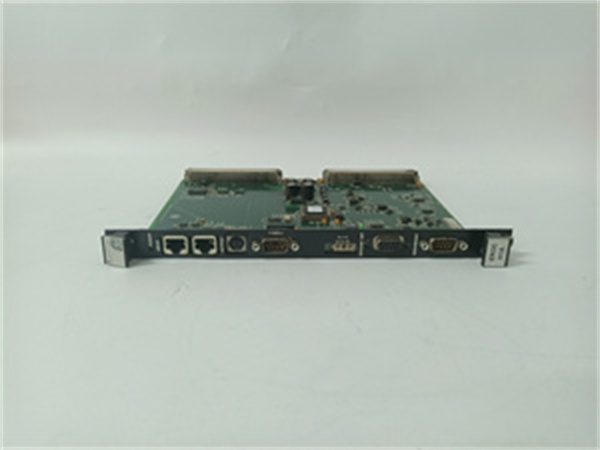
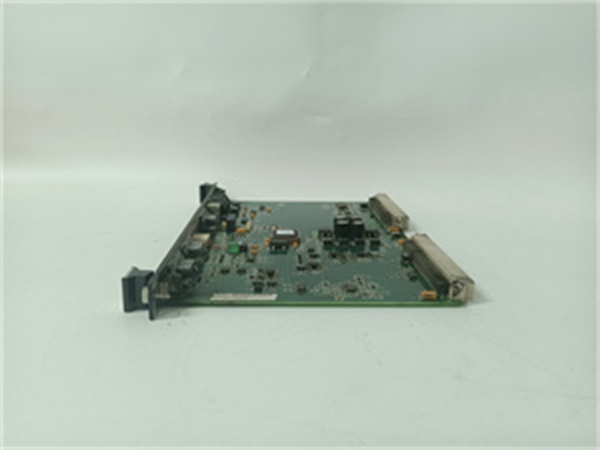
The is not an active processor; it is the structural and electrical backbone (BAPA – Backplane Assembly) of the Mark VI turbine control cabinet (e.g., <R1>, <S1>, <T1> cores). It is a large, multilayer PCB mounted vertically at the rear of the cabinet chassis.
Its primary job is passive: it provides the 96-pin DIN 41612 connectors (P1/P2) into which you plug the VME cards (UCVE, DSPX, SIOB, TRLY, etc.). Electrically, it receives the 28 V DC cabinet supply (via terminal blocks on the board or feed-through) and distributes regulated/protected power rails across the backplane pins to every slot. It handles the VMEbus arbitration, address decoding, and data path wiring. In a TMR (Triple Modular Redundant) setup, three separate BAPA boards exist (one per core R, S, T), ensuring physical isolation—if a backplane shorts out in Rack R, Racks S and T remain live. This board is Level 2 (Control) hardware, providing the deterministic interconnect required for <20ms turbine protection loops.
GE IS200BAPAH1A
Core Technical Specifications
- Board Type: Passive Backplane Assembly (BAPA)
- System: GE Mark VI Speedtronic
- Input Voltage: 28 V DC (Nominal, from EPSM/PDM)
- Connector Standard: DIN 41612, 96-pin (Type C, Rows A/B/C)
- Slot Configuration: Typically 10-12 Slots (VME64 Standard spacing)
- Layer Count: 6+ Layers (Power planes, Ground planes, Signal traces)
- Key Features: Integrated Fuse/Protection on power planes, Test Points for voltage verification
- Coating: Conformal Coated (Implied by “H1A” revision for humidity resistance)
- Mounting: Chassis Mount (Rear of Cabinet)
- Dimensions: Approx. 233mm (H) x 160mm+ (W) [Standard 6U VME footprint length]
- Environmental: 0°C to +60°C (Cabinet Ambient)
Customer Value & Operational Benefits
Deterministic Signal Integrity
The etched trace geometry on the BAPA is calculated for impedance control. Unlike point-to-point wiring where cable capacitance varies, the backplane ensures the VMEbus signals (Address/Data strobes) arrive with predictable skew. This is why a Mark VI can execute a trip vote in <10ms without data collisions, directly impacting turbine safety availability.
Centralized Power Integrity
Instead of daisy-chaining power wires to every card (voltage drop nightmare), the BAPA uses solid copper planes. This ensures the DSPX or UCVE sees a stiff 5V rail even during inrush when relays (TRLY) click shut. It reduces nuisance “Under Voltage” faults on the logic bus during transient loads.
Modular MTTR Reduction
Because the I/O cards plug into thisboard, you never touch field wires to swap a CPU. The field termination is on separate terminal boards (STCA, TBAI) cabled to the pack. This backplane design allows a <5 minute processor swap (hot or cold) without disturbing the 100+ field wires on the terminal blocks.
Field Engineer’s Notes (From the Trenches)
The BAPA is the “spinal cord” of the rack. If you have intermittent communication errors (VME Bus Error, Processor Not Responding) that move when you reseat cards, suspect the backplane pins before blaming the CPU.
Specifically, look at Slot 1 (Far Left) and Slot 2 (Controller). These get the most insertion cycles. Use a jeweler’s loupe to check for splayed/twisted pins in the 96-pin DIN connectors. A pin sitting 0.2mm out of alignment will cause the card to “half-seat”—power works, comms drop.
Also, clean the board. In steam plants, mineral dust settles on the bare fiberglass between connectors. If humidity spikes, you can get surface leakage between the +5V plane and Ground, popping the 5V regulator on the EPSM. Hit it with 90% Isopropyl Alcohol and a stiff brush annually. And for God’s sake, don’t use “No-Clean” flux near the edge connectors; the residue is slightly conductive and will cause ghost interrupts on the VME IRQ lines six months later.
Real-World Applications
- Gas Turbine Control Core (<R1> Rack): The BAPA hosts the UCVE (Controller), DSPX (Processing), VVIB (Vibration), and SIOB (I/O) cards that manage the 7FA gas turbine sequencing and protection.
- Steam Turbine Trip Rack: Used in the <T> (Trip) core, hosting TRLY and TREG boards. The BAPA ensures the E-Stop command from the TREG votes across the backplane to the TRLY outputs driving the fuel trip solenoids with zero latency.
GE IS200BAPAH1A
High-Frequency Troubleshooting FAQ
Q: My Mark VI rack loses communication with Slot 3 (SIOB) but power LEDs are on. Is the BAPA bad?
A: Possibly, but check mechanical seating first. The 96-pin DIN connector requires significant force. If the ejector lever isn’t fully latched, the P2 (secondary) rows (A/C) often misalign while P1 (Row B – Power) makes contact. You get lights (Power), but no data (Bus). Re-seat with firm, even pressure. If that fails, check the BAPA’s test points for 5V at that slot. No voltage = cracked trace on backplane (rare, but happens with rack impacts).
A: Generally yes, provided the slot count and form factor match your cabinet (e.g., 10-slot vs 12-slot). The “H1A” is the functional rev; “B” or “GD” are artwork updates (trace routing, coating improvements). They are backward compatible. However, do not mix Mark VI BAPA with Mark VIe backplanes (IS215 series)—the VME pinouts for I/O packs changed in VIe. Forcing a VIe pack into a VI BAPA can backfeed 24V into 5V logic.
Q: The 28V DC input to the BAPA is good, but Slot 2 CPU won’t boot (No “OK” LED).
A: Check the 3.3V/5V Sense lines at the backplane test points. The BAPA distributes power, but the EPSM (Power Supply) regulates it. If the BAPA has a cold solder joint on the Sense Return pin at the input terminal, the EPSM thinks the remote voltage is low and shuts down the 5V rail to protect the CPU. Wiggle the input power lugs on the BAPA; if the CPU flickers, you’ve found a loose crimp or cracked solder joint on the backplane itself.
Please note: The listed price is not the actual final price. It is for reference only and is subject to appropriate negotiation based on current market conditions, quantity, and availability.