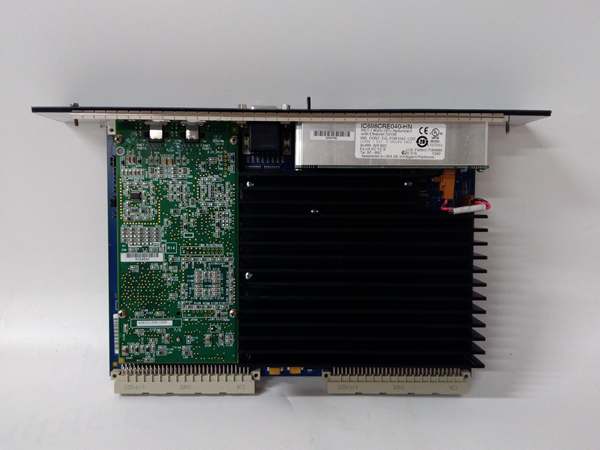
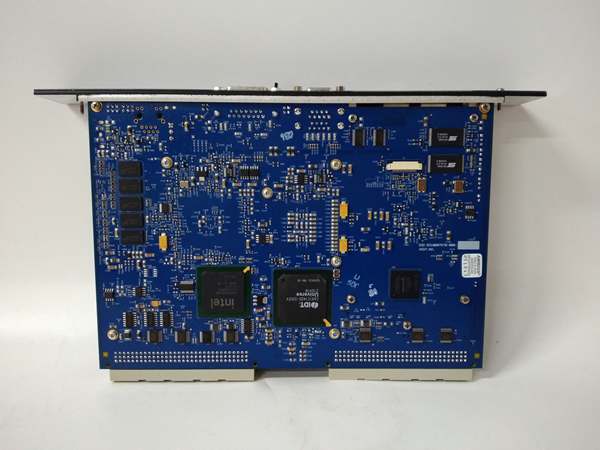
Description
Hard-Numbers: Technical Specifications
-
Processor: Intel Pentium M 1.8 GHz (1800 MHz)
-
CPU Memory: 64 MB battery-backed RAM
-
User Flash Memory: 64 MB non-volatile (for program, configuration, register data)
-
Scan Speed: 0.024 ms per 1000 boolean contacts/coils
-
Floating Point: Hardware-accelerated Yes
-
I/O Capacity: 32,768 discrete inputs / 32,768 discrete outputs; 32,768 analog inputs / 32,768 analog outputs
-
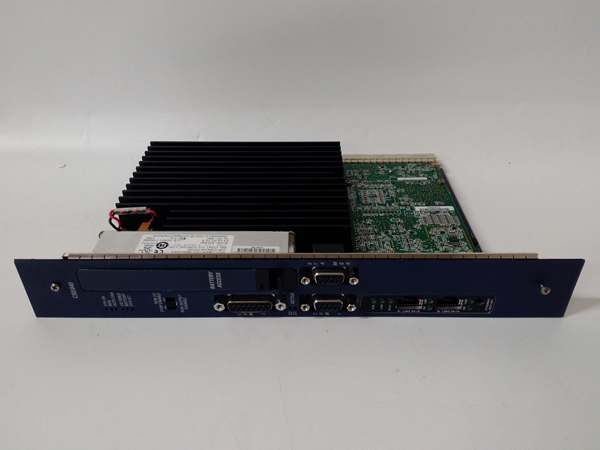
Ethernet Ports: 2× 10/100 Mbps RJ-45 (auto-negotiating, auto-crossover detection)
-
Serial Ports: 3× total — RS-485 (COM1), RS-232 (COM2), RS-232 Station Manager port
-
Serial Protocols: Modbus RTU Slave, SNP, Serial I/O
-
VMEbus: VME64 compliant, supports Series 90-70 I/O and third-party VME modules
-
Power Requirements: +5 VDC @ 6.8 A (nominal); +12 VDC @ 0.003 A; -12 VDC @ 0.003 A
-
Operating Temperature: 0°C to 60°C (with fan tray); up to 70°C with enhanced cooling
-
Storage Temperature: -40°C to +85°C
-
Humidity: 5% to 95% non-condensing
-
Dimensions: 6U VME — approximately 340 mm × 32 mm × 220 mm (H × W × D)
-
Weight: 0.8 kg (1.5 lbs)
-
Redundancy: Hot Standby (HSB) — requires paired CPU with IC698RMX016 Redundant Memory Xchange module
-
Web/FTP Connections: Up to 16 combined connections
-
Program Blocks: Up to 512 blocks, max 128 KB per block
-
Clock Accuracy: Time-of-day ±2 seconds/day; Elapsed time ±0.01%
-
Reference Manual: GFK-2223 (Installation), GFK-2224 (Programming)

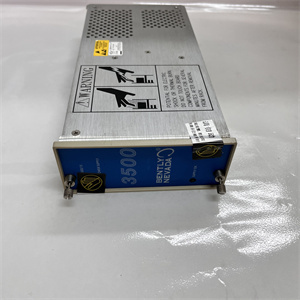
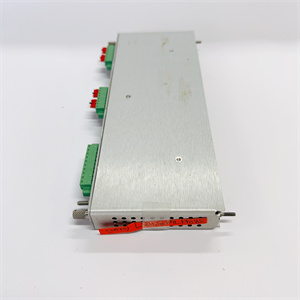
GE IC698CRE040-HN
The Real-World Problem It Solves
Critical processes—gas turbines, reactor cooling, pharmaceutical batching—cannot tolerate the minutes or hours of downtime required to reload a failed PLC program. The IC698CRE040-HN pairs with a second identical CPU and an RMX016 memory exchange module to create a bumpless Hot Standby Redundancy setup. When the primary fails, the backup assumes control within milliseconds, preserving all I/O states and control variables.
Where you’ll typically find it:
-
GE Frame 6/7/9 gas turbine Mark VI/VIe control cabinets in combined-cycle power plants
-
Safety instrumented systems (SIS) for offshore platform process shutdown
-
Pharmaceutical continuous manufacturing lines where batch loss costs millions
This board eliminates the “single point of failure” in high-performance VME-based control, bridging legacy 90-70 I/O with modern 1.8 GHz processing speed and Ethernet connectivity.
Hardware Architecture & Under-the-Hood Logic
The IC698CRE040-HN functions as the redundant master in a dual-controller architecture. Unlike simple backup schemes, both CPUs execute the same logic simultaneously, with the RMX016 module synchronizing data between primary and backup in real-time.
Signal flow and processing logic:
-
CPU Core: The 1.8 GHz Pentium M executes the control application from battery-backed RAM. The 64 MB flash stores the compiled program and configuration; on boot, this loads into RAM for execution.
-
Redundancy Link: The IC698RMX016 module connects the two CPUs via high-speed fiber or copper, exchanging state data every scan. The primary controls I/O; the backup mirrors internal registers and outputs but stays off the bus.
-
Memory Architecture: 64 MB RAM is split between system overhead and user application. The %W reference table (bulk memory) is configurable up to the maximum available RAM. Battery backup preserves RAM contents during power loss—critical for retaining runtime data.
-
VMEbus Master: The CPU acts as VME64 master, polling Series 90-70 I/O modules (discrete, analog, specialty) across the backplane. Supports both GE native modules and third-party VME hardware.
-
Network Stack: Dual Ethernet ports run EGD (Ethernet Global Data), SRTP (Service Request Transport Protocol), Modbus TCP Server/Client, and embedded web/FTP server. Port 1 typically handles programming/HMI; Port 2 handles I/O or peer-to-peer.
-
Synchronized Switchover: When the primary detects a fault (watchdog timeout, power loss, diagnostic failure), the backup CPU takes over VMEbus mastership within one scan cycle. Outputs hold state; the process sees no disruption.
GE IC698CRE040-HN
Field Service Pitfalls: What Rookies Get Wrong
Ignoring the Battery-Backed RAM
The 64 MB user RAM relies on a lithium battery (IC698ACC701) to maintain data during power outages. When the battery dies, the CPU loses all program and runtime data on next boot, forcing a full download from flash or programming software.
-
Field Rule: Check battery status via the %S system registers quarterly. Replace every 3-5 years during scheduled outages—never wait for the “Battery Low” fault. Always verify RAM contents match flash after replacement; a cold boot reloads from flash but may not have the latest online edits.
Mixing Firmware Versions in Redundant Pairs
HSB redundancy requires absolute synchronization between primary and backup CPUs. If one runs firmware 6.75 and the other 6.20, the redundancy link fails to initialize, leaving you with two independent CPUs fighting for VMEbus control.
-
Quick Fix: Before installing a spare, verify the firmware revision on both CPUs using the Station Manager port or PME software. Upgrade the older unit via WinLoader through the RS-232 port. Match not just the major version (6.x) but the specific release number. Document the firmware version on the rack door.
Insufficient Cooling in High-Temp Installations
The 1.8 GHz Pentium M runs hot—6.8A at 5V generates significant heat. In 60°C ambient environments (turbine compartments, Middle East installations), the standard heatsink is inadequate. Thermal throttling or random CPU faults follow.
-
Field Rule: Always install the RX7i fan tray (IC698ACC735 or equivalent) when ambient exceeds 45°C. Verify airflow with a smoke pencil—blocked vents or missing baffles cause hot spots. Monitor the CPU temperature via PME diagnostics; sustained operation above 60°C reduces MTBF by 50%. If the rack is in a NEMA 4X enclosure, add external forced ventilation or air conditioning.