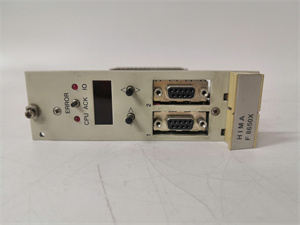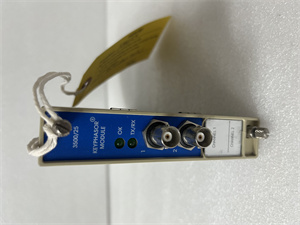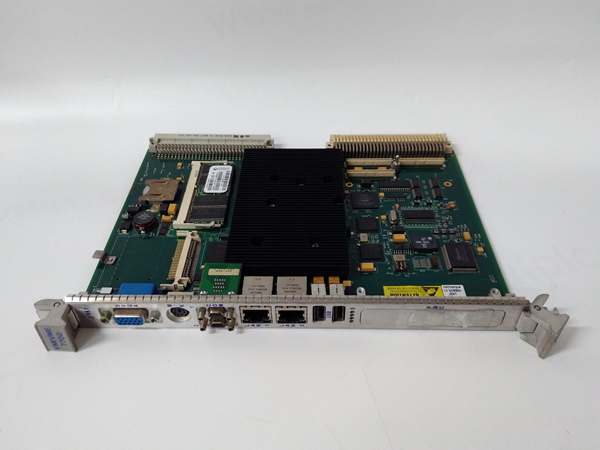
Description
Key Technical Specifications
-
Model Number: IC697VRM015
-
Manufacturer: GE Fanuc (now Emerson)
-
Memory: 256 kByte dual-port reflective RAM; 512-word FIFO per node
-
Data Rate: 170 Mbaud serial, 155 Mbps optical (typ.)
-
Fiber Ports: 2 × multimode ST, 850 nm, up to 2 km, 256 nodes per ring
-
Interrupts: 8 vectored lines, propagated across ring in < 3 µs
-
Power Supply: 25.8 VDC ±5 %, 0.804 A, 2.48 W typical
-
Isolation: 1500 VDC node-to-node; 500 V field-to-logic
-
Latency: < 5 µs per hop, deterministic < 50 µs full ring
-
Environmental: –40 °C to +85 °C storage, 0 °C to +60 °C operational; 5-95 % RH non-condensing; conformal-coated
-
Dimensions / Weight: 170 × 125 × 167 mm, 1.5 kg
-
Protection: IP30 aluminium heatsink case, 4 kV lightning surge, 600 W surge suppression, reverse-polarity guard

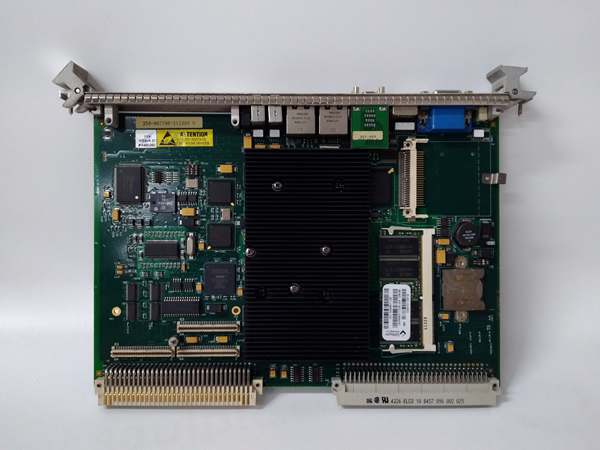
GE VMIVME-7700RC
Field Application & Problem Solved
A Series 90-70 turbine controller needs to share 100 kB of real-time data with a remote VME rack 500 m away—copper won’t do it without repeaters and noise. Slide the IC697VRM015 into each rack, run two multimode fibers, and every write to local RAM is mirrored across the ring in < 50 µs. When the card fails the ring breaks and both CPUs flag “VRM FAULT”; swap the module, snap the ST fibers back in, and the mirror resumes—no re-cal, no firmware flash. Found in every Series 90-70 remote pair: gas-turbine Mark V upgrades, steel-mill drives, and wind-turbine test stands. Value is determinism: 170 Mbaud keeps the data clock jitter-free, so the servo loop never sees a late sample.
A Series 90-70 turbine controller needs to share 100 kB of real-time data with a remote VME rack 500 m away—copper won’t do it without repeaters and noise. Slide the IC697VRM015 into each rack, run two multimode fibers, and every write to local RAM is mirrored across the ring in < 50 µs. When the card fails the ring breaks and both CPUs flag “VRM FAULT”; swap the module, snap the ST fibers back in, and the mirror resumes—no re-cal, no firmware flash. Found in every Series 90-70 remote pair: gas-turbine Mark V upgrades, steel-mill drives, and wind-turbine test stands. Value is determinism: 170 Mbaud keeps the data clock jitter-free, so the servo loop never sees a late sample.
Installation & Maintenance Pitfalls (Expert Tips)
Fiber bend radius—break a strand and ring dies
Multimode ST needs 1.5 in minimum bend. Techs zip-tie it tight and fracture the core; you see “VRM TIMEOUT” and chase ghosts. Use stick-on radius clips and leave a 3 in service loop—problem gone for life
Multimode ST needs 1.5 in minimum bend. Techs zip-tie it tight and fracture the core; you see “VRM TIMEOUT” and chase ghosts. Use stick-on radius clips and leave a 3 in service loop—problem gone for life
.
Battery dead—interrupt table blanks, CPU hunts
The 3 V lithium cell backs the interrupt vector table. When it drops below 2.2 V the CPU can’t service VRM interrupts and you get spurious “MEM PARITY.” Cell is solder-tab; cut it out, add a CR2032 holder on the faceplate, and reload the table via Logicmaster—five-minute fix, no crane needed.
The 3 V lithium cell backs the interrupt vector table. When it drops below 2.2 V the CPU can’t service VRM interrupts and you get spurious “MEM PARITY.” Cell is solder-tab; cut it out, add a CR2032 holder on the faceplate, and reload the table via Logicmaster—five-minute fix, no crane needed.
Node address clash—same ID on ring, data collision
Each card has a 6-bit DIP; duplicate IDs and both nodes write to the same RAM address, corrupting data. Always power one rack at a time and verify unique IDs with the VRM diagnostic screen before you close the cabinet.
Each card has a 6-bit DIP; duplicate IDs and both nodes write to the same RAM address, corrupting data. Always power one rack at a time and verify unique IDs with the VRM diagnostic screen before you close the cabinet.
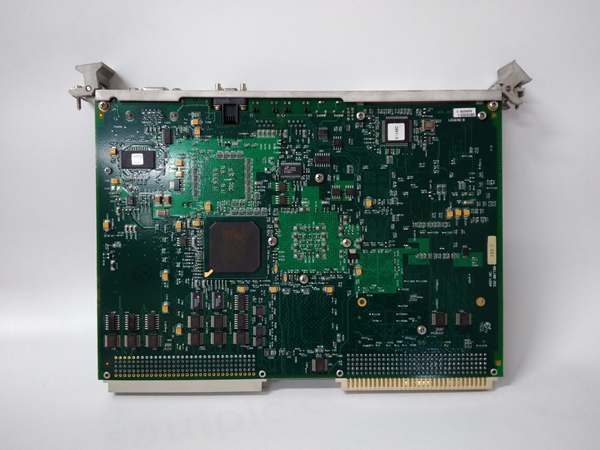
GE VMIVME-7700RC
Missing shoulder washers—card arcs to rack
The four corner holes are through-plated. Forget the fiber washers and the card edge sits 0.5 mm proud; 25.8 V finds the rack paint, arcs, and blows a hole in the ground plane. Use the original GE shoulder washers—torque to 8 in-lb, no more .
The four corner holes are through-plated. Forget the fiber washers and the card edge sits 0.5 mm proud; 25.8 V finds the rack paint, arcs, and blows a hole in the ground plane. Use the original GE shoulder washers—torque to 8 in-lb, no more .
Technical Deep Dive & Overview
IC697VRM015 is a deterministic shared-memory node frozen in 1995 silicon. A 170 Mbaud serializer writes every local RAM change to the fiber ring; a 512-word FIFO buffers bursts; an 8-line interrupt propagates across the ring in < 3 µs. Because the memory is dual-ported you can swap the card hot—just kill the 25.8 V supply first or you’ll arc-weld the ST ferrules. Treat the fiber like instrumentation cable and the module will keep the VME racks mirrored for another thirty years .
IC697VRM015 is a deterministic shared-memory node frozen in 1995 silicon. A 170 Mbaud serializer writes every local RAM change to the fiber ring; a 512-word FIFO buffers bursts; an 8-line interrupt propagates across the ring in < 3 µs. Because the memory is dual-ported you can swap the card hot—just kill the 25.8 V supply first or you’ll arc-weld the ST ferrules. Treat the fiber like instrumentation cable and the module will keep the VME racks mirrored for another thirty years .