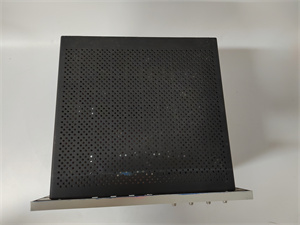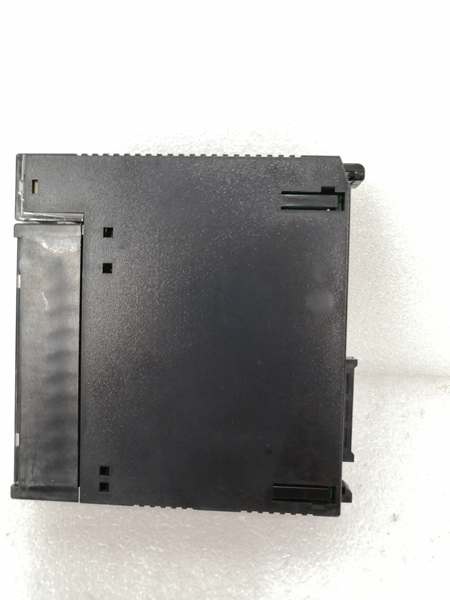
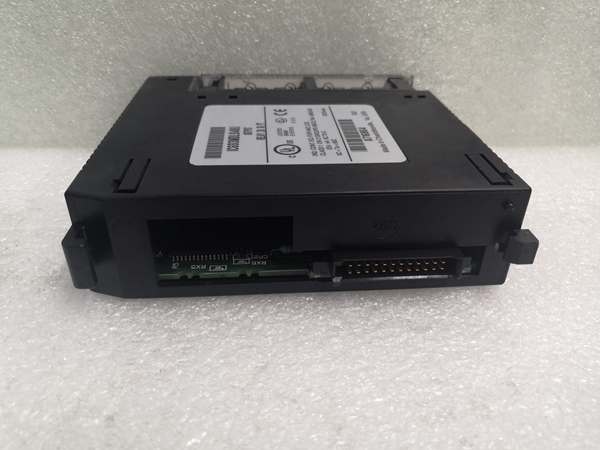
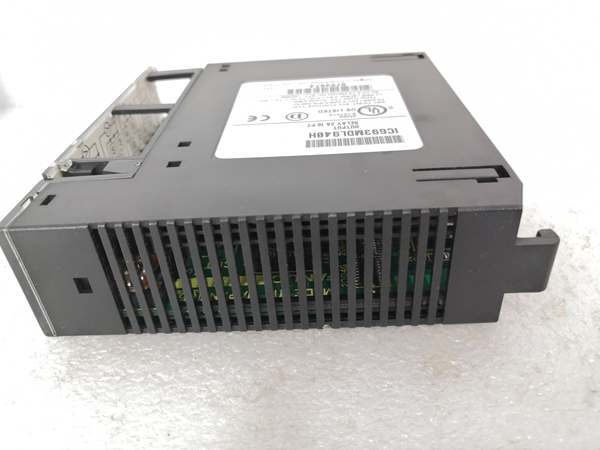
Description
System Architecture & Operational Principle
The IC693MDL940 occupies a single slot on the GE 90-30 universal backplane, functioning as a discrete AC input interface at Level 1 of the Purdue Model (Basic Control). It receives 120V AC signals from field devices (dry contacts, limit switches, pushbuttons) and converts these signals into logic levels readable by the CPU. Upstream, the CPU reads the input state via %I memory mapping during each scan; downstream, the module provides optical isolation and zero-crossing detection to prevent false triggering from contact bounce or voltage transients.
Unlike the IC693MDL930 with its 8-point isolation groups, the IC693MDL940 features a single common reference for all 32 inputs. All inputs share the same neutral connection and ground reference, which simplifies wiring for applications where all field devices are powered from the same 120V AC source. This design reduces terminal block complexity and wiring time—technicians only need to connect one neutral for the entire module rather than four separate neutrals for 8-point groups. The zero-crossing detection circuitry ensures input state changes are only recognized when the AC waveform crosses zero volts, reducing susceptibility to noise spikes and contact bounce.
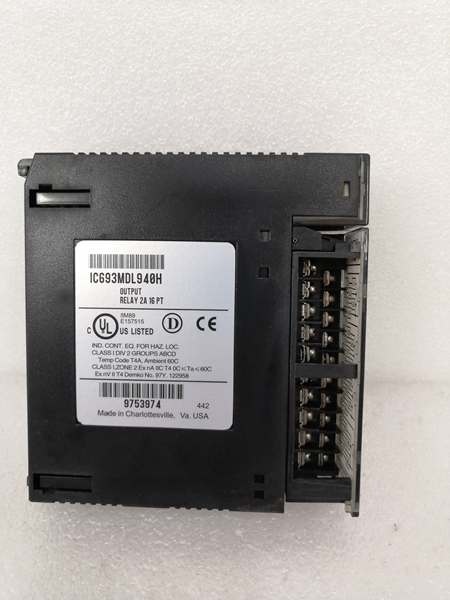
GE IC693MDL940
Core Technical Specifications
- Physical Interface: 40-pin terminal block (2 connectors, 16 points each) or front-facing removable terminal block option
- Input Type: 32-point discrete input, 120V AC, non-isolated (single common reference)
- Input Voltage Range: 90-132V AC at 47-63 Hz (nominal 120V AC)
- Input Current: 12mA per point at 120V AC
- Isolation: 1500V RMS optical isolation between field side and backplane; inputs share common reference (no group isolation)
- Backplane Current Draw: Approximately 480mA @ 5V DC
- Response Time: 20-40ms typical (zero-crossing detection adds inherent delay)
- LED Indicators: Individual LEDs per input point (ON when input energized) plus module status LEDs
- Environmental: Operating temperature 0°C to 60°C (32°F to 140°F), humidity 5-95% non-condensing
- Terminal Block: 40-pin plug-in terminal block, supports wire gauges 22-14 AWG
- Field Wiring: Single common neutral for all 32 inputs; inputs accept dry contacts or sourcing 120V AC signals
- Diagnostic Capabilities: No onboard diagnostics beyond LED indication (discrete module, not intelligent)
- Zero-Crossing Detection: Input state changes recognized only at AC zero-crossing points (every 8.3ms at 60Hz)
Customer Value & Operational Benefits
Simplified Wiring with Single Common Reference
The IC693MDL940’s non-isolated design with a single common neutral significantly reduces wiring complexity compared to isolated input modules. Technicians only need to connect one neutral for the entire module, reducing terminal block wiring time and minimizing the potential for wiring errors during installation. For applications where all field devices are powered from the same 120V AC source and share the same ground reference, this design provides optimal simplicity—no need to track which inputs belong to which isolation group or connect multiple neutrals. This reduction in wiring complexity directly translates to lower installation costs, faster commissioning, and reduced potential for wiring errors that could cause downtime.
Zero-Crossing Detection Provides Noise Immunity
The zero-crossing detection circuitry ensures that input state changes are only recognized when the AC waveform crosses zero volts, providing inherent immunity to voltage spikes and contact bounce. In noisy electrical environments (near large motors, transformers, or welding equipment), DC inputs or non-zero-crossing AC inputs may false-trigger from transient noise. The 940’s zero-crossing requirement means that momentary voltage spikes occurring during the AC waveform’s peak are ignored—the input only recognizes sustained signals that span multiple zero-crossings. This reduces nuisance faults and eliminates the need for external filters or signal conditioners in many applications, lowering hardware cost and improving reliability.
32-Point Density Maximizes Cabinet Space Efficiency
With 32 input points in a single slot, the IC693MDL940 reduces the number of I/O modules required for applications with high discrete point counts. Each 32-point module replaces two 16-point modules, freeing backplane slots for other module types or reducing the physical rack size. In space-constrained installations (marine control panels, skid-mounted equipment), this density is critical—it allows more I/O capacity per cabinet footprint without sacrificing individual point indication. The per-point LED status indicators provide fast visual troubleshooting without the need for a laptop or multimeter.
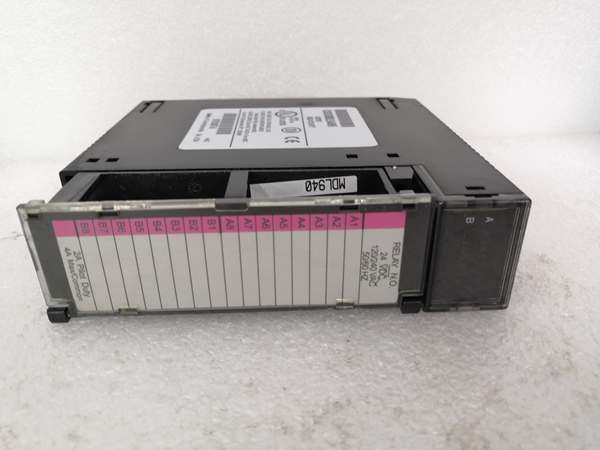
GE IC693MDL940
Field Engineer’s Notes (From the Trenches)
Here’s the critical distinction that trips up techs: the IC693MDL940 has NO input-to-input isolation—all 32 inputs share a common reference. I’ve seen techs assume it works like the isolated 930 and wire inputs from different 120V AC sources with different ground references, which causes ground loops, erratic behavior, and potential damage to field devices. The 940 is designed for applications where every input shares the same 120V AC source and ground. If you have mixed power sources or different ground references, use the isolated IC693MDL930 instead. Also, the neutral connection is a single terminal for all 32 inputs—don’t try to wire multiple neutrals or create artificial isolation groups. The terminal block is designed for one common neutral only. Finally, the 940’s response time of 20-40ms with zero-crossing detection is significantly slower than DC inputs. I’ve seen applications where techs specified a 940 for a high-speed counter input on a conveyor system, then wondered why counts were being missed. The 940 is not suitable for high-speed applications requiring sub-20ms response. Use DC input modules (like the IC693MDL753 series) for photoeyes or encoder inputs where response time matters.
Real-World Applications
Assembly Line Control Panel with Unified Power Source
In automotive assembly lines where all control devices share a single 120V AC control transformer, the IC693MDL940 monitors 32 limit switches, pushbuttons, and selector switches for workstation interlocks and sequencing. The single common neutral simplifies wiring in the crowded control cabinet—technicians connect one neutral for all 32 inputs, reducing wiring time and minimizing the potential for errors. The zero-crossing detection provides noise immunity in the electrically noisy assembly environment near resistance welding robots and large motors. Input states map to interlock logic—if any critical limit switch or emergency 终止 is activated, the PLC immediately halts the associated workstation, preventing operator injury or equipment damage.
Packaging Machine with Centralized Control System
In packaging machinery where all field devices are powered from a central 120V AC distribution panel, the monitors 32 inputs from photoelectric sensors, limit switches, and operator controls. The non-isolated design matches the centralized power architecture—all inputs share the same source and ground reference, eliminating the need for isolation groups. The zero-crossing detection eliminates false triggers from contact bounce on mechanical limit switches and from electrical noise generated by VFD-driven packaging belts. The per-point LED indicators enable rapid troubleshooting—technicians can visually identify which sensor or control triggered a machine 终止 without connecting to the PLC, reducing downtime in high-speed packaging operations.
High-Frequency Troubleshooting FAQ
The primary difference is isolation: has a single common reference for all 32 inputs (non-isolated), while IC693MDL930 provides 8-point isolation groups (250V RMS between groups). The 940 is designed for applications where all inputs share the same 120V AC source and ground reference, offering simplified wiring with a single neutral. The 930 is suitable for applications where inputs are sourced from different 120V AC circuits or different ground references, as each group operates independently. Functionally, both modules are identical in terms of input voltage range, response time, and current draw. Choose the 940 for unified power source installations where isolation is not required; choose the 930 for mixed-source installations or environments prone to ground loop issues.
No, the is designed for a single common reference—all 32 inputs must share the same 120V AC source and ground reference. Wiring inputs from different 120V AC sources with different ground references will create ground loops, causing erratic behavior, input flickering, or potential damage to field devices. If your application requires inputs from different power sources, use the isolated IC693MDL930 with its 8-point isolation groups. The 930 allows mixing inputs from different electrical systems because each group operates independently with its own reference. Never attempt to create artificial isolation on the 940 by using external relays or transformers—the module’s design assumes a common reference, and bypassing this assumption can cause unpredictable behavior.
Why do my inputs flicker even with zero-crossing detection?
Input flickering on the , despite zero-crossing detection, typically indicates marginal input voltage, poor contact resistance, or ground loop issues. Since the 940 lacks group isolation, any ground potential difference between field devices can cause input instability. Measure the input voltage at the terminal block—if it’s below 90V AC or above 132V AC, the input is outside the guaranteed operating range. Common causes include long cable runs with excessive voltage drop, corroded terminal connections, or failing field device contacts. If voltage is within range, suspect ground loop issues—verify that all field devices share the same ground reference. The 940 is particularly sensitive to ground potential differences because all inputs share a common reference. If you have mixed ground references, you must use the isolated IC693MDL930 instead.
The features a single common neutral terminal for all 32 inputs. Connect the neutral conductor from your 120V AC source to this single neutral terminal—do not attempt to wire multiple neutrals or create isolation groups. All inputs share this common reference, so ensure all field devices are powered from the same 120V AC source and share the same ground. When wiring, refer to the terminal block diagram in the module documentation to identify the common neutral terminal. Unlike the 930 with separate neutrals for each 8-point group, the 940’s simplified design requires only one neutral connection, reducing wiring complexity but imposing stricter requirements on unified power source architecture.
Commercial Availability & Pricing
Please note: The listed price is not the actual final price. It is for reference only and is subject to appropriate negotiation based on current market conditions, quantity, and availability.