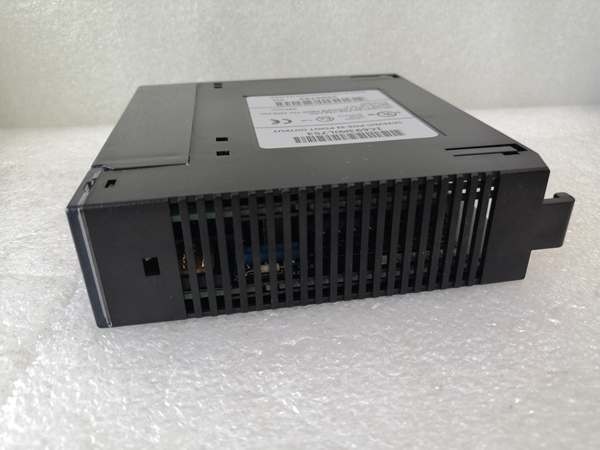
Description
System Architecture & Operational Principle
The IC693MDL753K occupies a single slot on the GE 90-30 universal backplane, functioning as a discrete input interface at Level 1 of the Purdue Model (Basic Control). It receives 24V DC signals from field devices (PNP proximity sensors, sourcing limit switches, or PLC output modules) and converts these signals into logic levels readable by the CPU. Upstream, the CPU reads the input state via %I memory mapping during each scan; downstream, the module provides electrical isolation and filtering to prevent false triggering from signal noise or contact bounce.
The -K suffix indicates this is the final production revision of the IC693MDL753 platform, representing the culmination of all incremental improvements from earlier revisions (A through J). This revision incorporates the enhanced ESD protection and improved EMC filtering introduced in the -G revision, plus additional optimizations for manufacturing consistency and component availability. The module retains full backward compatibility with existing 90-30 systems—no programming changes are required when upgrading from any earlier revision.
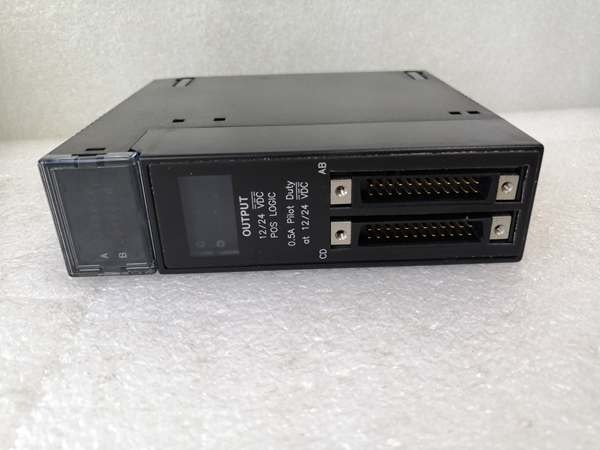
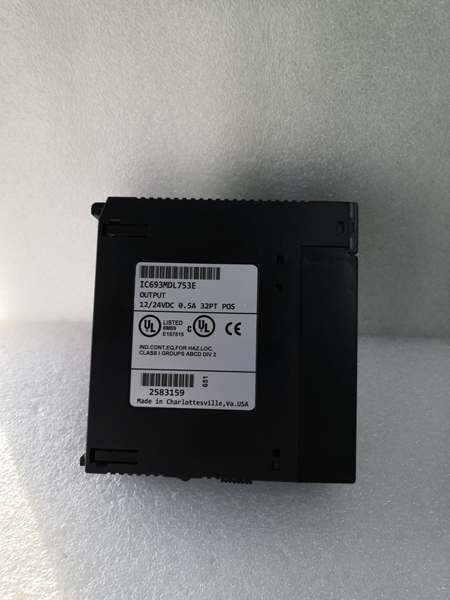
GE IC693MDL753
Core Technical Specifications
- Physical Interface: 40-pin terminal block (2 connectors, 16 points each) or front-facing removable terminal block option
- Input Type: 32-point discrete input, 24V DC, negative logic (sourcing outputs)
- Input Voltage Range: 15-30V DC (nominal 24V DC)
- Input Current: 7mA per point at 24V DC
- Input Filter Config: Selectable 1ms, 5ms, or 10ms per point group (configurable via software)
- Isolation: 1500V RMS optical isolation between field side and backplane
- Backplane Current Draw: Approximately 420mA @ 5V DC
- Response Time: 1-10ms (depending on filter setting; typical 1ms with filter disabled)
- LED Indicators: Individual LEDs per input point (ON when input energized) plus module status LEDs
- Environmental: Operating temperature 0°C to 60°C (32°F to 140°F), humidity 5-95% non-condensing
- Terminal Block: 40-pin plug-in terminal block, supports wire gauges 22-14 AWG
- Field Wiring: Negative logic—field device sourcing to input terminal, common terminal to +24V
- Diagnostic Capabilities: No onboard diagnostics beyond LED indication (discrete module, not intelligent)
- Revision Status: Final production revision incorporating all enhancements from earlier revisions (G, H, I, J)
Customer Value & Operational Benefits
Ultimate Reliability from Cumulative Engineering Improvements
The IC693MDL753K represents the final evolution of the IC693MDL753 platform, incorporating all engineering improvements from 10 prior revision cycles. This final production revision delivers the highest reliability and longest service life of any 753 variant. Facilities installing -K modules benefit from years of field feedback and component stress testing—known failure modes from earlier revisions have been eliminated through design refinements. For new installations or complete rack replacements, the -K revision provides optimal lifecycle value, reducing long-term maintenance costs and minimizing the risk of premature module failure.
Enhanced ESD and EMC Protection for Harsh Environments
The -K revision inherits the enhanced electrostatic discharge (ESD) protection and electromagnetic compatibility (EMC) filtering introduced in the -G revision, making it ideal for electrically noisy environments. Facilities with extensive VFD usage, welding operations, or high-static processes (plastic extrusion, textile manufacturing) benefit from the -K’s superior noise immunity without sacrificing input response speed. The module reliably filters EMI transients that caused false triggers on early revisions, reducing nuisance faults and unplanned downtime. This enhanced protection eliminates the need for external line filters or signal conditioners in many applications, lowering hardware cost and cabinet space requirements.
Seamless Migration Path and Future Spare Parts Availability
As the final production revision, the IC693MDL753K is positioned as the standard spare part for all 753 variants moving forward. GE typically consolidates manufacturing around the final revision, ensuring long-term component availability and consistent quality. Facilities with mixed revision inventories (A through J) can standardize on the -K revision during scheduled outages, simplifying spare parts management. The -K maintains full backward compatibility with earlier revisions—no programming changes, wiring modifications, or configuration updates are required when upgrading. This standardization reduces inventory complexity and ensures that future spare part purchases will be compatible with existing installations.
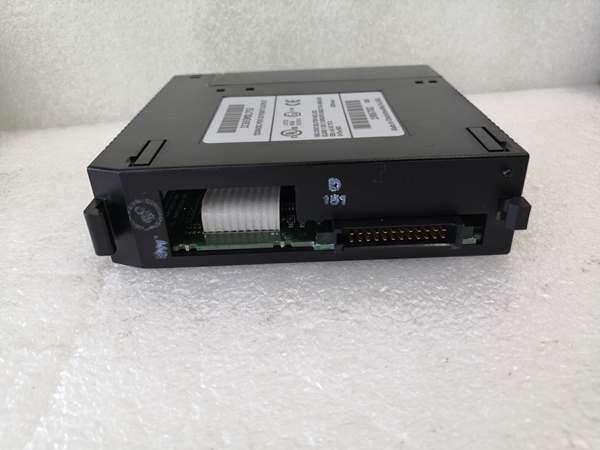
GE IC693MDL753
Field Engineer’s Notes (From the Trenches)
Here’s the reality check on the -K revision: it’s essentially the best-of-all-worlds culmination of the 753 platform, but it doesn’t fundamentally change the game from a -G revision. If you’re running a facility with -G or -H modules already in service, there’s no urgent business case to proactively swap them out for -K units unless you’re doing a full rack refresh. The -K’s real value is for new installations, complete system retrofits, or facilities plagued with mixed revision nightmares. I’ve walked into plants where a single rack contained A, C, E, and G revisions, making spare parts inventory a guessing game. Standardizing on -K eliminates that headache. One critical note: the -K revision may use updated terminal block plastic formulations that address some of the brittleness issues seen on very early 753 revisions from the 1990s. If you’re replacing 20-year-old modules where the terminal block plastic has become brittle and prone to cracking during wire removal, the -K will solve that problem. Also, the -K revision’s enhanced protection can mask marginal wiring just like the -G does—don’t let superior immunity become an excuse for poor installation practices. Shield your cables, ground at one point, and maintain separation from VFD outputs. Finally, for facilities planning long-term operation of 90-30 systems (which GE has officially transitioned to legacy support status), the -K is the revision to stockpile as critical spare parts. It represents the final production standard with the longest expected component lifecycle.
Real-World Applications
Food Processing Plant with Mixed Legacy Installations
In food processing facilities undergoing phased modernization, the IC693MDL753K serves as the standard replacement module for aging discrete input installations. The plant may contain racks with mixed 753 revisions from various installation phases over 20 years. Standardizing on the -K revision during scheduled maintenance outages simplifies spare parts inventory and ensures consistent performance across all input modules. The enhanced ESD protection handles static generated by product handling and operator interaction with washdown-rated control panels. The improved EMC filtering eliminates false triggers from VFDs driving conveyor motors and pumps. Input states map to HMI alarms and interlock logic—if any critical sensor triggers (e.g., temperature switch, flow switch, safety gate), the PLC immediately initiates the appropriate safety response.
Pharmaceutical Manufacturing Facility with High Regulatory Compliance Requirements
In pharmaceutical manufacturing plants, the IC693MDL753K provides the highest reliability revision for discrete input monitoring on critical process equipment (reactors, centrifuges, sterilization tunnels). The -K revision’s cumulative engineering improvements and final production status ensure compliance with FDA 21 CFR Part 11 requirements for validated equipment. Facilities can document the use of the final production revision in validation protocols, demonstrating commitment to equipment consistency and reliability. The enhanced protection features reduce the likelihood of input-related deviations that could trigger regulatory investigations or batch rejections. The configurable input filters allow mixed-signal environments—1ms filters for high-speed photoeyes on packaging lines, and 10ms filters for mechanical limit switches on slow-moving process equipment.
High-Frequency Troubleshooting FAQ
What is the difference between IC693MDL753K and earlier IC693MDL753 revisions?
The is the final production revision of the 753 platform, incorporating all engineering improvements from earlier revisions (A through J). It includes the enhanced ESD protection and improved EMC filtering introduced in the -G revision, plus additional manufacturing optimizations for component consistency. Functionally, all 753 revisions are identical—32 input points, negative logic, configurable filters, identical response times and current draw. The -K represents the mature, battle-tested evolution of the platform with the highest reliability and longest expected service life. No programming changes or wiring modifications are required when upgrading from any earlier revision.
Should I proactively replace working -G or -H modules with -K units?
Generally, no. If your facility is operating reliably with -G or -H revisions, there’s no urgent business case to proactively swap them out for -K modules unless you’re doing a full rack refresh or experiencing module failures. The -K’s primary value is for new installations, complete system retrofits, or facilities with mixed revision inventories that want to standardize on a single revision. However, for critical safety-related inputs or facilities with long-term operational plans (10+ years), upgrading to -K during scheduled outages may provide incremental reliability benefits. The decision should be based on your facility’s specific risk tolerance, spare parts strategy, and maintenance schedule.
Yes, the is fully compatible with all earlier 753 revisions and can be mixed in the same rack without issues. The modules will operate identically from the CPU’s perspective—input mapping, filter configuration, and memory addressing are consistent across all revisions. However, from a maintenance and inventory perspective, mixing revisions creates complexity. If a module fails, technicians must verify the specific revision installed to ensure the correct spare is available. Standardizing on the -K revision simplifies spare parts management and reduces the risk of installing an incorrect revision during emergency repairs. For new installations or rack replacements, use -K modules exclusively to maintain revision consistency.
How do I identify the revision of my IC693MDL753 module?
The revision letter (K, J, H, G, etc.) is printed on the module label, typically located on the front faceplate or the side of the module. The label will show the full part number including the revision suffix (e.g., “”). Additionally, the revision may be indicated on a sticker or engraved on the module casing. If the label is damaged or missing, you can sometimes identify the revision by the manufacturing date code or by removing the module and checking the internal PCB markings. However, the most reliable method is to read the part number from the module label. Keep accurate records of installed revisions in your asset management system to simplify spare parts ordering and maintenance planning.
Commercial Availability & Pricing
Please note: The listed price is not the actual final price. It is for reference only and is subject to appropriate negotiation based on current market conditions, quantity, and availability.