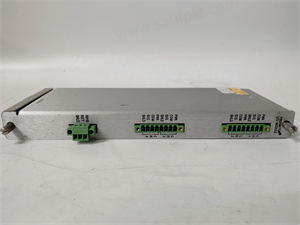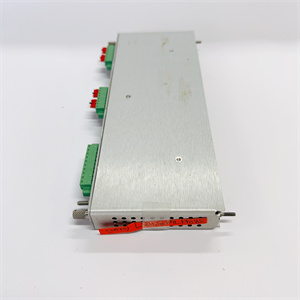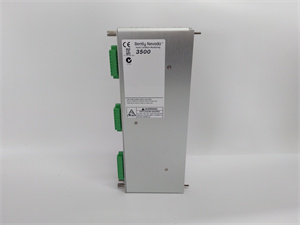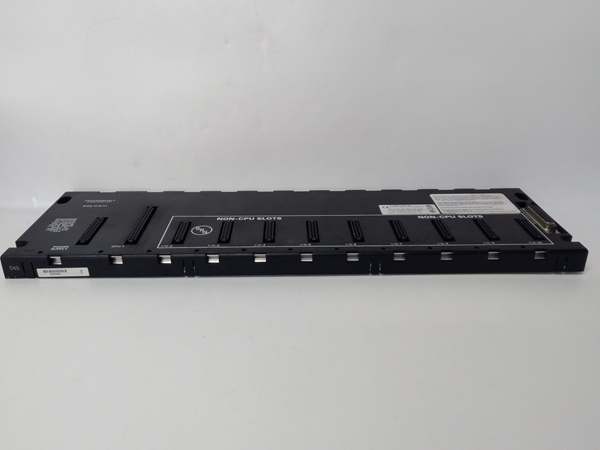
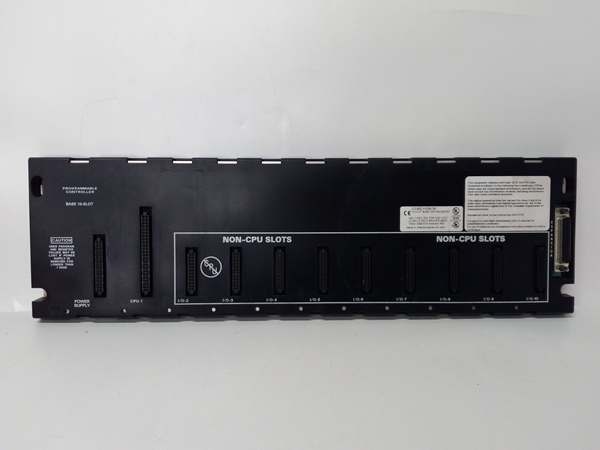
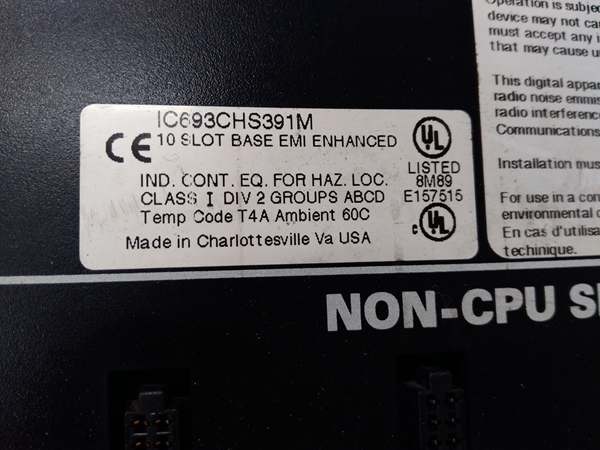
Description
Hard-Numbers: Technical Specifications
- Processor: Intel 80188 embedded, 10 MHz clock
- User Memory: 12 KB maximum (Rev T and later firmware)
- Register Memory: 2 KB (1024 words, %R addressing)
- Discrete I/O: 320 points max combined (%I + %Q)
- Analog Input: 64 words (%AI)
- Analog Output: 32 words (%AQ)
- Timers/Counters: 340 combined
- Scan Rate: 0.6 ms per 1K Boolean logic (typical)
- Serial Port: 1 (via power supply connector)
- Serial Protocols: SNP Slave, SNP-X Slave only (no master mode)
- Power Draw: 430 mA @ +5 VDC from backplane
- Operating Temp: 0°C to 60°C (32°F to 140°F)
- Storage Temp: -40°C to 85°C (-40°F to 185°F)
- Slots: 10 total (9 I/O + 1 power supply)
- Expansion: None (no expansion port, no remote rack)
- Floating Point: Not supported
- Interrupts: Not supported
- Battery-Backed Clock: Not supported

GE IC693CHS391
The Real-World Problem It Solves
You need a PLC that fits in a tiny enclosure with zero room for a separate CPU module. Every slot counts. This baseplate sandwiches the processor onto the backplane, freeing up that slot number 1 for actual I/O. You get 320 points of control in a single rack without paying extra for a modular CPU you don’t need.
Where you’ll typically find it:
- Small packaging lines: Labelers, carton sealers, shrink wrappers—100-200 I/O points, fast cycle times, cabinet space at a premium
- Batch mixing systems: Small recipe-driven mixers with analog temp/pressure loops and discrete valve control
- Standalone machine centers: Single CNC loaders, hydraulic presses, test stands where the PLC is the brain of one machine and nothing else
Bottom line: It’s an economy workhorse for tight spaces and moderate I/O counts—cheap, compact, but permanently limited to one rack. When you outgrow 320 points or need expansion, you’re replacing the whole baseplate.
Hardware Architecture & Under-the-Hood Logic
The Rev T baseplate has the CPU and memory chips soldered straight to the PCB. No socket, no swap-out capability. The 80188 talks to all backplane modules through the shared bus, pulling I/O images during every scan cycle. Battery-backed RAM lives on the board, but the battery itself sits in the power supply module—unplug that PSU and you’ve got about an hour before your program evaporates.
-
Power-up sequence triggers internal POST on the 80188. The processor checks RAM integrity, reads configuration data, and initializes all bus drivers. System status bits (%S, %SA, %SB, %SC) load into internal registers.
-
Input scan sweeps all discrete input modules in slots 1-10. Data from each module’s backplane connector maps into the %I image table. Analog modules (%AI) update simultaneously through their backplane registers.
-
Program scan executes ladder logic from rung 1 through the last rung. The 80188 processes each instruction using current %I values, internal coils (%M), timers, counters, and registers (%R). No floating-point math—everything’s 16-bit integer.
-
Output scan writes the calculated %Q image table to all output modules via the backplane bus. Analog outputs (%AQ) update simultaneously. All physical outputs change state based on this single pass.
-
Serial port handler checks the power supply connector for incoming SNP/X slave requests. The CPU only responds—it never initiates. A master device (HMI, programming software) pulls data from memory or pushes writes on command.
-
Watchdog timer resets every successful scan completion. If the scan hangs longer than the watchdog timeout (typically 200-500 ms), the CPU faults and shuts down all outputs safely.
-
Optional communication modules (Ethernet, Profibus) installed in I/O slots exchange data with the CPU through %R memory mapping. The 80188 doesn’t run network stacks—that’s offloaded to the option module coprocessor.
-
Memory retention runs from battery-backed RAM. The backup battery lives in the power supply, not on the CPU board. If you pull that PSU, the on-board super capacitor buys you roughly one hour of retention. After that, your program’s gone.
GE IC693CHS391
Field Service Pitfalls: What Rookies Get Wrong
Treating Rev T as interchangeable with Rev R/S
You swap a dead Rev T with a Rev R from inventory. The program loads, but timers run slow and communication drops randomly. Rev R shipped with older firmware that doesn’t handle SNP-X properly, and your plant standardized on Rev T for a reason.
- Field Rule: Match revisions exactly when replacing embedded CPUs. Rev T carries firmware v7.00+ with full 12KB support and updated SNP/X timing. Earlier revisions have different memory limits and timing quirks. If you must use a different revision, test it offline for at least 24 hours before trusting it in production.
Assuming expansion is possible
You hit the 320-point I/O limit and try to slap on an expansion baseplate. There’s no expansion connector on the backplate. You’re staring at a dead-end architecture with zero growth path.
- Field Rule: IC693CPU323T does NOT expand. Period. No remote racks, no expansion baseplates, no daisy-chaining. You get 10 slots total—use them wisely. If you’re approaching 300 points, start planning a migration to a modular CPU (IC693CPU350+) before you’re forced into an emergency retrofit during a shutdown.
Losing program during power supply swap
You yank the power supply to swap it out, get distracted for lunch, and come back to a blank PLC. The battery was in that PSU you just unplugged, and the board’s super capacitor only holds memory for about an hour.
- Field Rule: Have your replacement PSU prepped and ready before touching the installed one. Complete the swap within 15 minutes if you want to preserve program retention. If you’re taking longer, back up the program via serial port or PCM card first. Never trust that one-hour retention window—it’s a best-case number.
Expecting floating-point math from the 80188
You write a PID loop with floating-point scaling and get bizarre results. The 80188 doesn’t do floats—you’re asking it to process something it fundamentally can’t handle.
- Field Rule: Scale everything to integers. Multiply by 100 or 1000 to preserve decimal precision, do your integer math, then scale back down. Watch for overflow—16-bit signed integers roll over at 32767. If your application needs floating-point, upgrade to a CPU that supports it. Stop trying to hack integer arithmetic for complex control loops.
Ignoring backplane current limits
You load up eight 16-point relay output modules plus analog cards. The PLC resets randomly. The CPU draws 430mA, your outputs are pulling another 800mA, and that old power supply was already borderline.
- Field Rule: Do the math before you populate the rack. Add up the current draw for every module plus the CPU’s 430mA at +5VDC. Verify your power supply (likely IC693PWR321 or PWR330) can handle the total. High-current output modules like IC693MDL740/741 will sink significant current—plan for it. Brownouts kill embedded CPUs, and there’s no swapping the processor.
Running communication wires alongside power cables
You route the serial SNP cable right through the conduit with 480V motor feeds. Your HMI keeps dropping connections intermittently. You’re swimming in noise, and the unshielded serial line has no defense.
- Field Rule: Keep signal cables away from power. Minimum 6 inches separation, preferably in separate conduit. Use shielded serial cable and ground the shield at one end—usually the PLC side. If you must cross power, do it at 90 degrees. Noise is the silent killer of serial communication on these old platforms.
Forgetting the default rack number
You install this as a second rack in a system and can’t figure out why addressing is scrambled. Embedded baseplates default to Rack Zero, always. You can’t change it without the right tools.
- Field Rule: IC693CPU323T defaults to Rack 0. If you’re integrating it into a multi-rack system, either use it as the primary rack or reconfigure the entire system’s addressing scheme to accommodate. Don’t assume you can just set it to Rack 2 like a modular CPU—it doesn’t work that way. Verify addressing before you start wiring I/O.
Trusting the “supercapacitor” retention myth
You pull the battery for testing, expecting the board’s supercapacitor to hold the program for days. It doesn’t. The spec says one hour, and that’s in ideal conditions at room temperature. In a hot enclosure, you’ve got maybe 30 minutes.
- Field Rule: Treat that supercapacitor as emergency protection, not a storage solution. If you need the program, back it up. Never rely on passive retention for anything beyond a quick power supply swap. Hot cabinets shorten retention time dramatically. When in doubt, download the program to a laptop.
Commercial Availability & Pricing Note
Please note: The listed price is for reference only and is not binding. Final pricing and terms are subject to negotiation based on current market conditions and availability.