Description
Key Technical Specifications
-
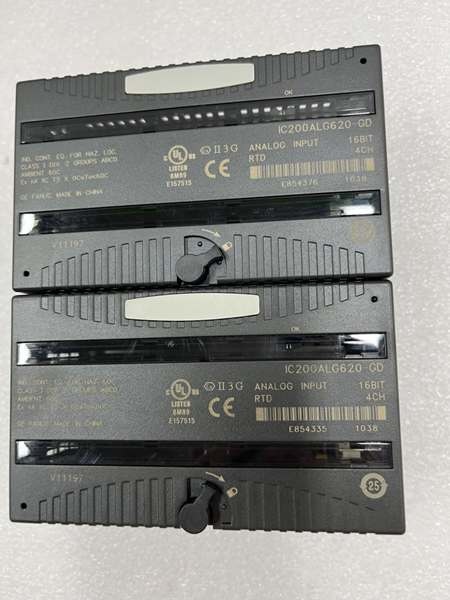
Model Number: IC200ALG620
-
Manufacturer: Emerson Automation (ex GE Fanuc)
-
Channels: 4, individually configurable for 3-wire or 4-wire RTD
-
Sensor Types: Pt 25/100/1000 Ω, Cu 10/50/100 Ω, Ni 100/120 Ω, Ni/Fe 604 Ω; direct resistance 0-500 Ω / 0-3000 Ω
-
Resolution: 16 bits (15 bits + sign)
-
Accuracy: ±0.15 % of reading @ 25 °C; ±0.004 %/°C drift
-
Update Rate: 210 ms per channel @ 60 Hz; 230 ms @ 50 Hz
-
Isolation: 1500 V AC input-to-frame, 250 V AC input-to-logic
-
Max Lead Resistance: 5 Ω per leg
-
Power: 125 mA from 5 V back-plane; no external supply required
-
Diagnostics: Open RTD, short, over/under-range, high/low alarm, wiring fault
-
LEDs: Green “OK” = back-plane power; amber = module fault
-
Temp Range: 0 – 60 °C operating; auto-cal at power-up & periodically
-
Certifications: CE, UL listed

IC200ALG620
Field Application & Problem Solved
You need four reactor skin temperatures into a VersaMax rack and you don’t want to buy three separate transmitters. Snap this module onto the rail, land the 4-wire Pt-100 sensors, and you get 0.1 °C resolution straight into the PLC. No loop power required—the module excites the RTDs itself. If a sensor wire breaks, the “OK” LED turns amber and the PLC receives an open-wire bit; you can swap the sensor hot without dropping the process. Steel mills love it because the 1500 V isolation keeps VFD noise from walking into the measurement.
You need four reactor skin temperatures into a VersaMax rack and you don’t want to buy three separate transmitters. Snap this module onto the rail, land the 4-wire Pt-100 sensors, and you get 0.1 °C resolution straight into the PLC. No loop power required—the module excites the RTDs itself. If a sensor wire breaks, the “OK” LED turns amber and the PLC receives an open-wire bit; you can swap the sensor hot without dropping the process. Steel mills love it because the 1500 V isolation keeps VFD noise from walking into the measurement.
Installation & Maintenance Pitfalls (Expert Tips)
Lead resistance bites on long runs
5 Ω per leg is the hard limit. If your field run is 500 ft of 16 AWG you’re already at 4 Ω—add a corroded joint and the module reads 3 °C high. Use 14 AWG or move the rack closer.
Lead resistance bites on long runs
5 Ω per leg is the hard limit. If your field run is 500 ft of 16 AWG you’re already at 4 Ω—add a corroded joint and the module reads 3 °C high. Use 14 AWG or move the rack closer.
3-wire vs 4-wire matters
Factory default is 3-wire. If you land a 4-wire Pt-100 and forget the jumper, you still carry the extra copper resistance and the reading drifts with ambient temperature. Move the jumper on the carrier and land the sense pair.
Factory default is 3-wire. If you land a 4-wire Pt-100 and forget the jumper, you still carry the extra copper resistance and the reading drifts with ambient temperature. Move the jumper on the carrier and land the sense pair.
Auto-cal is not magic
The module calibrates itself at power-up and every few minutes. If you hot-swap a sensor while the PLC is running you’ll see a 2-second glitch. Disable the channel in logic first, then swap, then re-enable.
The module calibrates itself at power-up and every few minutes. If you hot-swap a sensor while the PLC is running you’ll see a 2-second glitch. Disable the channel in logic first, then swap, then re-enable.
Amber LED lies on half-shorts
A high resistance short (say 200 Ω) won’t trip the open-wire bit but will throw the reading off by 10 °C. If the value looks suspicious, meter the sensor at the terminal block before you blame the module.
A high resistance short (say 200 Ω) won’t trip the open-wire bit but will throw the reading off by 10 °C. If the value looks suspicious, meter the sensor at the terminal block before you blame the module.
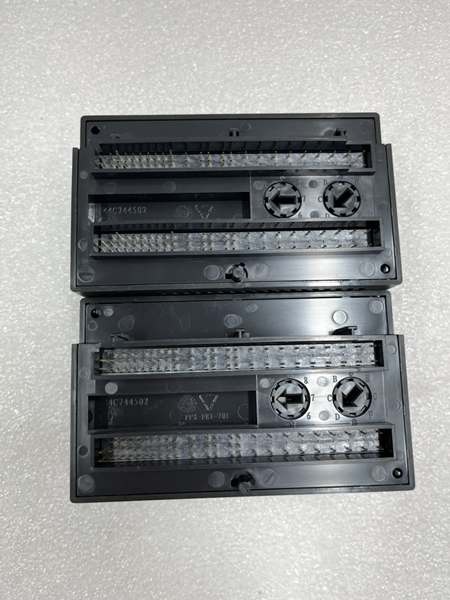
IC200ALG620
Technical Deep Dive & Overview
Internally each channel owns its own sigma-delta ADC and constant-current source. The current source excites the RTD, the ADC measures the resulting drop, and the FPGA averages 16-bit samples over one power-line cycle to kill 50/60 Hz noise. Because calibration is stored in non-volatile memory, you can swap the carrier and the module still knows its offset—no re-calibration required. No processor on the power path means you can hot-swap with the PLC running; the rack loses the channel for 300 ms while the ADC re-initializes, then resumes normal scanning .
Internally each channel owns its own sigma-delta ADC and constant-current source. The current source excites the RTD, the ADC measures the resulting drop, and the FPGA averages 16-bit samples over one power-line cycle to kill 50/60 Hz noise. Because calibration is stored in non-volatile memory, you can swap the carrier and the module still knows its offset—no re-calibration required. No processor on the power path means you can hot-swap with the PLC running; the rack loses the channel for 300 ms while the ADC re-initializes, then resumes normal scanning .