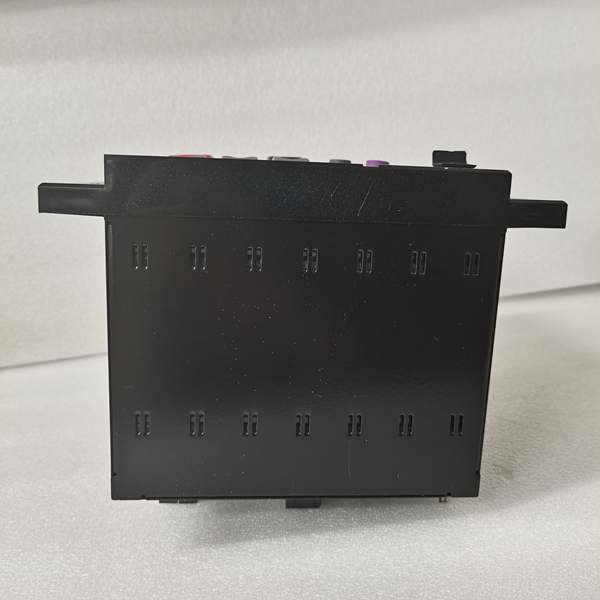
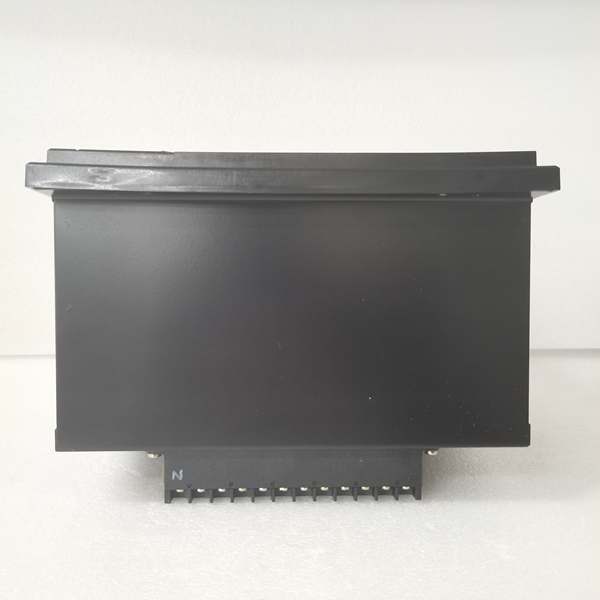
Description
Hard-Numbers: Technical Specifications
- Protection Elements: 50/51 (phase overcurrent), 50N/51N (neutral), 50G/51G (ground), 67 (directional), 21 (distance), 79 (4-shot autorecloser), 50BF (breaker failure), 27/59 (undervoltage/overvoltage), 81U/O (under/over frequency), 81R (ROCOF), 49 (thermal)
- Analog Inputs: 3-phase CT (1A/5A configurable, range 0.1-6000A), 3-phase VT (up to 208V L-N)
- Digital Inputs: Up to 80 inputs (8 standard in Slot F, expandable via CIO modules)
- Digital Outputs: Up to 56 outputs (8 standard in Slot F, Form-A/Form-C/Form-SSR available)
- Communication Protocols: IEC 61850 Ed.2 (MMS, GOOSE, SV), IEC 60870-5-103/104, DNP3.0 (serial/TCP), Modbus RTU/TCP, IEEE 1588 PTP, IRIG-B, SNTP
- Ethernet Ports: 1× 10/100BaseTX (rear board B), optional 100 Base FX fiber module available in other variants
- Serial Ports: 2× RS485 (rear board A, redundant), 1× RS232 front panel
- Operating Temperature: -40°C to +70°C
- Isolation Rating: 2000V AC RMS I/O-to-chassis, 1500V RMS channel-to-channel
- Power Input: 110-250V DC (88-300V DC range) or 120-230V AC (96-250V AC range)
- Power Draw: 30W typical
- Oscillography: Up to 512 records, programmable sampling (64 samples/cycle max), up to 5 seconds capture
- Event Recorder: 479-512 events, 1ms time-tag resolution
- Trip Time: ≤20ms typical for instantaneous overcurrent
- Language Support: English-only (no Chinese language option)

The Real-World Problem It Solves
Legacy feeder protection requires stacking multiple single-function relays—overcurrent here, distance there, separate autorecloser box. The F650BABF2G0HI consolidates protection, control, metering, and breaker monitoring into one chassis, eliminating inter-relay wiring nightmares and reducing panel footprint in space-constrained HV switchgear cubicles. When a breaker fails to open (stuck mechanism), the 50BF element detects the fault current persisting and trips adjacent breakers within 100ms—preventing cascading busbar collapse. The English-only interface simplifies operation for English-speaking crews but limits deployment in multi-lingual environments compared to C-suffix variants.
Where you’ll typically find it:
- 11kV-145kV distribution substations protecting outgoing feeders and transformer bays in English-speaking regions
- Industrial power plants requiring breaker failure protection and four-shot reclosing for overhead lines
- Utilities upgrading from electromechanical to numerical protection with IEC 61850 process bus integration
- Greenfield projects where English-only operation is acceptable and cost optimization is prioritized
Bottom line: One relay replaces racks of old-school relays, provides high-speed breaker failure backup, and integrates directly into digital substations without copper wiring for inter-tripping. English-only HMI keeps it simple but restricts cross-cultural deployment.
Hardware Architecture & Under-the-Hood Logic
This is a modular microprocessor-based relay where the CPU module handles all protection algorithms, programmable logic, and communications. The backplane uses a high-speed CAN bus to connect CT/VT acquisition modules, digital I/O modules, and optional remote I/O expanders (CIO modules). No dedicated FPGA—all signal processing runs on the 32-bit CPU with deterministic scan cycles. The “2” code in Slot F means 8 digital inputs + 8 outputs + 2 trip/close circuit supervision circuits—lower I/O density than the “1” code (16+8). The “HI” suffix indicates high-voltage power supply (110-250V DC or 120-230V AC).
- CT/VT modules isolate and digitize analog inputs (current/voltage from field transformers)
- Digitized samples stream to CPU via internal CAN bus at up to 64 samples/cycle
- CPU executes protection element algorithms (overcurrent, distance, directional) in real-time
- Programmable logic engine processes inputs from protection elements, digital contacts, and remote GOOSE messages
- Trip/control decisions routed to output relay modules with <2ms contact response time
- Oscillography engine captures pre-fault (up to 5 cycles) and post-fault data to non-volatile memory
- Communication modules push GOOSE/IEC 61850 messages to upstream SCADA via Ethernet ports
- Breaker failure element monitors fault current after trip initiation—if current persists beyond setpoint, triggers backup trip output
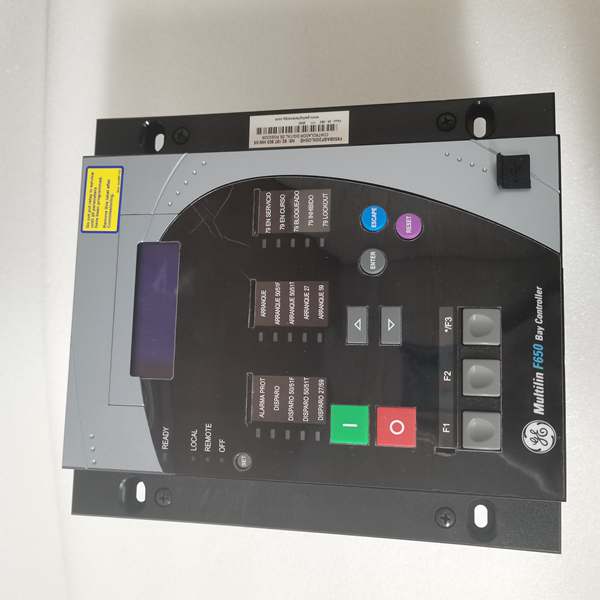
- Basic LCD display renders English-only screens for local monitoring and parameter configuration
Field Service Pitfalls: What Rookies Get Wrong
Lower I/O Density on “F2” Slot ConfigurationThe “F2” code in Slot F provides only 8 digital inputs + 8 outputs + 2 trip/close supervision circuits. Rookies misconfigure the relay expecting 16 inputs (F1) and end up short on control signals—can’t wire all breaker auxiliaries, position switches, and interlocks. They’re forced to add external interposing relays or reconfigure the protection scheme, costing days of rework.
- Field Rule: Always verify the Slot F I/O configuration before ordering or commissioning. F2 = 8DI/8DO/2TCS, F1 = 16DI/8DO. If your breaker has 10+ status contacts (52a, 52b, spring-charged, motor-operated, SF6 low-pressure, etc.), you need F1 or add a CIO remote I/O module for extra inputs. Confirm via EnerVista 650 Setup > System Info > Hardware Configuration.
Missed Trip/Close Circuit Supervision WiringThe F2 board includes 2 dedicated trip/close circuit supervision (TCS) inputs—but only if you wire them correctly. Rookies connect TCS to digital input terminals instead of the supervision voltage sense points. The relay never detects an open trip coil, and when a breaker fails to trip during a fault, the operator has no warning until equipment damage occurs.
- Quick Fix: Wire TCS supervision across the trip coil (52a contact in series with the supervision circuit). Configure TCS inputs in EnerVista 650 Setup > Inputs/Outputs > Trip Circuit Supervision. Test by disconnecting the trip coil wire at the breaker—relay should alarm “Trip Circuit Failure” within 50ms. Verify the alarm activates on the HMI.
RS485 Redundancy Configured as Single NetworkThe rear board A has redundant RS485 ports (Port 1 and Port 2). Rookies wire both ports to the same RS485 bus thinking it doubles the bandwidth—this creates signal reflections and causes intermittent communication failures. The redundancy is for hot-standby, not parallel operation.
- Field Rule: Use Port 1 as primary and Port 2 as backup to a separate RS485 network or redundant master. If single network is used, terminate Port 1 properly (120Ω at both ends) and leave Port 2 disconnected. Test redundancy by pulling the primary RS485 cable—Port 2 should take over without communication loss alarm.
IEC 61850 GOOSE Time Sync Skew Without IEEE 1588The board “B” is basic 10/100BaseTX Ethernet without IEEE 1588 PTP time synchronization. Rookies rely on NTP/SNTP for GOOSE timestamps, resulting in ±100ms skew between IEDs. When a fault occurs, event sequence analysis shows inconsistent timing—fault origin is misidentified, root cause analysis fails.
- Field Rule: For applications requiring precise GOOSE time alignment (breaker failure protection, differential schemes), order the F650 with board “G” or higher that includes IEEE 1588 support. If stuck with board “B”, configure all IEDs to use SNTP from the same NTP server and accept ±100ms time sync accuracy, or add external GPS clock via IRIG-B if available.
Firmware Upgrade Without SCL File Re-importUpgrading F650 firmware changes GOOSE control block addresses and IEC 61850 SCL file structure. The downstream IEDs (distance relays, busbar protection) still subscribe to the old APPIDs. After a fault, critical GOOSE messages never arrive—backup schemes fail to operate because the subscription mapping is broken.
- Field Rule: After any firmware upgrade, export the new SCL file from the upgraded F650 and re-import it into all subscribed IEDs. Verify GOOSE subscriptions using the IEC 61850 configuration tool. Never assume backward compatibility—always revalidate the complete GOOSE message mapping before returning the bay to service.
Overcurrent Curve Selection Mismatch Between CT RatingThe F650 supports IEC and ANSI inverse time curves. Rookies select the “Extremely Inverse” curve but configure it for a 5A CT secondary while the actual CT is 1A—settings are off by factor of 5. During a fault, the relay times out incorrectly, tripping too fast or too slow, causing coordination failure with upstream protection.
- Quick Fix: Always verify CT secondary rating (1A or 5A) during commissioning. Configure overcurrent element settings with the correct CT ratio and curve parameters. Test with secondary injection to verify the trip time matches the curve at 2×, 5×, and 10× pickup current. If trip time is off by ~5×, re-check the CT ratio configuration.
Commercial Availability & Pricing Note
Please note: The listed price is for reference only and is not binding. Final pricing and terms are subject to negotiation based on current market conditions and availability.