Description
DS3800HXRC1E1C: Product Overview
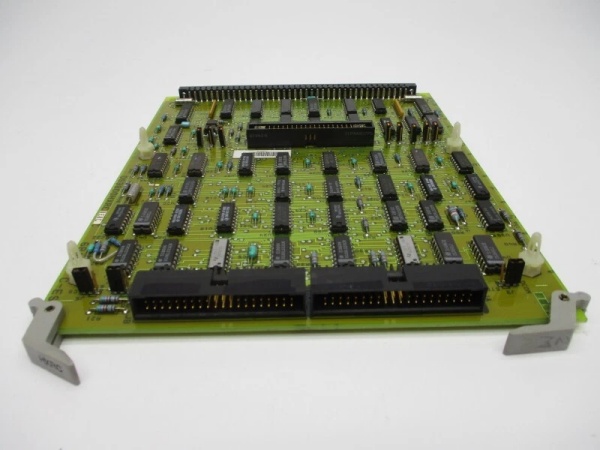
This board occupies a 6BA Euro-card slot in GE Mark IV turbine and EX2000 exciter control racks, serving as the receiving end of a high-speed data link between the central processor and remote I/O pods. It accepts parallel address/data from DS3800HXTA transmitter cards (or equivalent), buffers the signals with controlled-impedance traces, and presents clean 5 V CMOS levels to the CPU over the NDIA bus. The receiver also provides 1500 Vdc isolation to protect the processor from ground loops and switching transients originating in the field wiring.
This board occupies a 6BA Euro-card slot in GE Mark IV turbine and EX2000 exciter control racks, serving as the receiving end of a high-speed data link between the central processor and remote I/O pods. It accepts parallel address/data from DS3800HXTA transmitter cards (or equivalent), buffers the signals with controlled-impedance traces, and presents clean 5 V CMOS levels to the CPU over the NDIA bus. The receiver also provides 1500 Vdc isolation to protect the processor from ground loops and switching transients originating in the field wiring.
The epoxy-sealed construction makes this a line-replaceable module—internal faults require complete card swap rather than field repair. The module hot-swaps when the rack is powered down, and its low profile allows adjacent-slot population without additional cooling. As part of the DS3800 family, it benefits from the Mark IV platform’s deterministic 2 ms control interval and extensive installed base in power generation applications. The E1C revision includes timing refinements for improved skew tolerance in long-cable installations.
DS3800HXRC1E1C: Technical Specifications
-
Model Number: DS3800HXRC1E1C
-
Manufacturer: General Electric (GE Fanuc)
-
Product Type: High-Speed Receiver / Data Link Board
-
Series: DS3800, Mark IV Speedtronic
-
Form Factor: 6BA Euro-card (≈ 233 × 160 mm)
-
Back-Plane Connector: Dual 40-pin header (J1/J2)
-
Logic Levels: 5 V CMOS/TTL (CPU side); differential line receiver (field side)
-
Data Rate: Up to 10 MHz parallel (synchronous with CPU clock)
-
Skew Tolerance: <2 ns channel-to-channel (E1C revision improvement)
-
Isolation: 1500 Vdc field-to-logic; opto-coupled control lines
-
Cable Length: Up to 10 m shielded twisted-pair to HXTA transmitter
-
Power Demand: +5 V @ 1.0 A, +15 V @ 0.2 A from rack 2PL bus
-
Operating Temperature: 0 – 60 °C
-
Weight: ≈ 0.22 kg
-
Construction: Epoxy-sealed copper traces—non-repairable

DS3800HXRC1E1C
Core Features & Customer Value
Controlled-Impedance Signal Integrity: The 6-layer board uses stripline routing with 50 Ω termination to maintain <2 ns skew across the 40-pin interface. For systems engineers, this enables reliable operation with 10-meter cable runs between the CPU rack and remote I/O pods, reducing panel space requirements by distributing electronics rather than centralizing all cards.
E1C Revision Timing Improvements: The E1C includes refined clock recovery and wider skew margins compared to earlier revisions. For maintenance teams, this means fewer “DATA LINK FAIL” alarms in installations with aged cables or marginal terminations—common in plants with 20-plus year infrastructure.
Epoxy-Sealed Construction: All internal copper is encapsulated in high-temperature epoxy. In coastal or industrial environments with conductive dust and high humidity, this prevents trace-to-trace shorting that would cause random “RECEIVER FAIL” alarms after ten-plus years. The trade-off is non-repairability—internal faults require whole-card exchange—but this is offset by reduced troubleshooting time and single-spare stocking rather than maintaining a repair bench.
Typical Applications
In combined-cycle power plants, this board installs in the Mark IV turbine control core where it receives high-speed data from HXTA transmitter cards in the exhaust temperature monitoring pod. The differential receivers reject common-mode noise from the 30-meter cable run across the turbine deck, while the buffered 5 V output drives the CPU A/D converters without additional conditioning.
On utility-scale EX2000 static exciters, the same card receives firing-angle data from the bridge-interface transmitter located in the high-voltage cubicle. The 1500 V isolation prevents SCR switching transients from corrupting the CPU data bus during load rejection events.
Mechanical-drive gas compressors frequently use this part number in split-rack configurations where the CPU resides in the control room and I/O pods mount on the compressor skid. The 10-meter cable capability eliminates the need for fiber-optic converters in many applications, reducing cost and complexity.