Description
Key Technical Specifications
-
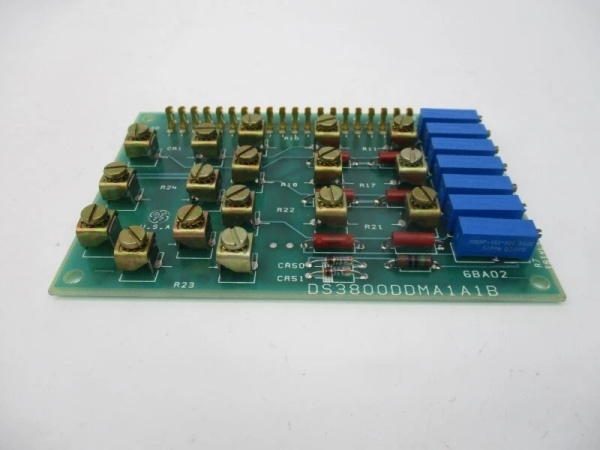
Model Number: DS3800DDMA1A1B
-
Manufacturer: General Electric
-
Function: Multi-channel signal distribution & trimming interface
-
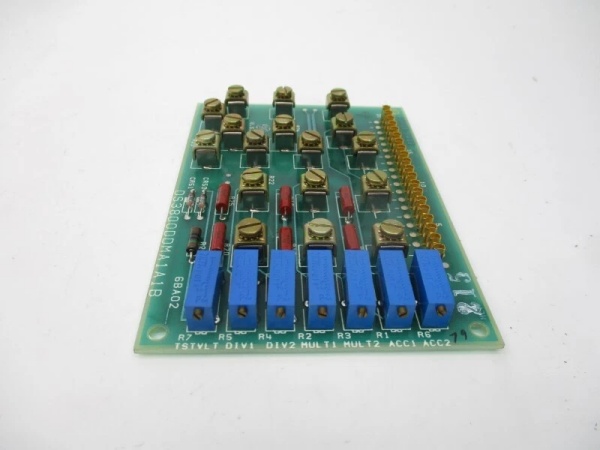
Field Connectors: 20 single-pin headers for sensor / actuator wiring
-
Trimmers: 7 potentiometers for on-site gain/offset or filter corner adjustment
-
Logic Interface: 5 V CMOS/TTL levels via 40-pin back-plane (J1/J2)
-
Isolation: 500 V channel-to-ground; opto-coupled digital lines
-
Power Demand: +5 V @ 0.8 A, +15 V @ 0.2 A from rack 2PL bus
-
Operating Temperature: 0 – 60 °C board rating
-
Board Size: 6BA Euro-card ≈ 233 × 160 mm; weight 0.35 kg
- Construction: Epoxy-sealed copper traces—non-repairable

GE DS3800DDMA1A1B
Field Application & Problem Solved
In a Mark IV C-core you often have mixed signals—thermocouples, 4-20 mA loops, and dry contacts—all needing different gains or offsets. This card is the Swiss-army knife. It lands the raw wires on the 20-pin headers, lets you dial in the exact span with the seven trim-pots, and buffers the result to the CPU. When a lightning hit blows a trace, the epoxy seal keeps the fault from spreading—you swap the whole card in three minutes and the turbine is back online—no download, no re-cal. Every peaker site keeps a spare taped inside the door because without DDMA you can’t scale the field signals; no scaling, no closed-loop control.
In a Mark IV C-core you often have mixed signals—thermocouples, 4-20 mA loops, and dry contacts—all needing different gains or offsets. This card is the Swiss-army knife. It lands the raw wires on the 20-pin headers, lets you dial in the exact span with the seven trim-pots, and buffers the result to the CPU. When a lightning hit blows a trace, the epoxy seal keeps the fault from spreading—you swap the whole card in three minutes and the turbine is back online—no download, no re-cal. Every peaker site keeps a spare taped inside the door because without DDMA you can’t scale the field signals; no scaling, no closed-loop control.
Installation & Maintenance Pitfalls (Expert Tips)
Trimmer pots walk with vibration
After six months of turbine shakes the 7 trim-pots can drift 2 %. After every major, hit each pot with a drop of fingernail polish or you’ll chase mysterious offset errors that clear when you bump the card.
Trimmer pots walk with vibration
After six months of turbine shakes the 7 trim-pots can drift 2 %. After every major, hit each pot with a drop of fingernail polish or you’ll chase mysterious offset errors that clear when you bump the card.
Epoxy seal means no trace repair
If a via lifts or a copper plane burns, you cannot solder it—epoxy won’t take heat. Order a new board; attempting repair voids the UL listing and you’ll fight the same fault next month
If a via lifts or a copper plane burns, you cannot solder it—epoxy won’t take heat. Order a new board; attempting repair voids the UL listing and you’ll fight the same fault next month
.
Single-pin headers are fragile
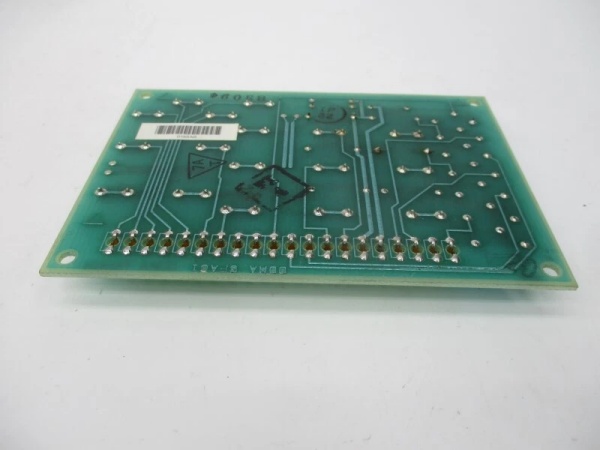
The 20 field pins are 0.025″ square posts—bend one and you lose a channel. Use a proper extraction tool; never rock the plug side-to-side.
The 20 field pins are 0.025″ square posts—bend one and you lose a channel. Use a proper extraction tool; never rock the plug side-to-side.
Power-up sequence matters
The DDMA bus must be live before the CPU boots. If you rack this card after the CPU, the processor throws “DDMA TIMEOUT” and hangs. Always install in slot order: power, I/O, then CPU.
The DDMA bus must be live before the CPU boots. If you rack this card after the CPU, the processor throws “DDMA TIMEOUT” and hangs. Always install in slot order: power, I/O, then CPU.
Technical Deep Dive & Overview
Internally the board is a passive signal conditioner—no CPU, no firmware. Each channel hits a buffer amp, a trim-pot divider, and exits through the 40-pin back-plane to the CPU A/D. Because everything is hardware, you can hot-swap with the rack powered: pull the old card, slam in the new, seat the 40-pin connector, and the CPU re-acquires the scaled signal inside 100 ms
Internally the board is a passive signal conditioner—no CPU, no firmware. Each channel hits a buffer amp, a trim-pot divider, and exits through the 40-pin back-plane to the CPU A/D. Because everything is hardware, you can hot-swap with the rack powered: pull the old card, slam in the new, seat the 40-pin connector, and the CPU re-acquires the scaled signal inside 100 ms
.