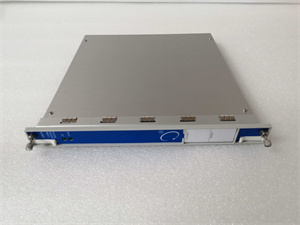
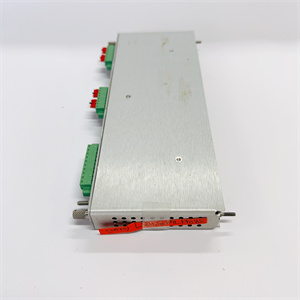
Description
Key Technical Specifications
-
Model Number: DS200FHVAG1ABA
-
Manufacturer: General Electric (GE)
-
Function: HV gate interface & cell monitor for 6-pulse SCR/GTO bridges
-
Isolation: 2 kV basic board-to-logic; transformer-coupled gate drive
-
Fiber Port: 1 × F-type coax-fiber hybrid; transmits gate OK / fault status to remote electronics
-
Voltage Class: Up to 690 VAC system (bridge potential)
-
Gate Drive Output: ±15 V pulse, 6 A peak (typical GTO/GCT values)
-
Cell Monitor: On-board desat & temperature feedback to fiber link
-
Dimensions: 16 × 16 × 12 cm, 0.8 kg
-
Operating Temperature: –40 °C…+70 °C (ambient inside card-file)
-
Mounting: Mark V card-file; 96-pin DIN 41612 to back-plane
-
Status: Factory discontinued – new & tested spares available
Field Application & Problem Solved
In an LCI drive the biggest headache is getting gate-status feedback from a 690 V SCR bridge without running copper cables that pick up noise or create ground loops. Drop the DS200FHVAG1ABA into the rack: it sits at bridge potential, fires the gates through pulse transformers, and shoots device OK / fault data over a single fiber back to the Mark V DSP. You’ll typically find one card per six-pulse bridge on Frame-7/9 peakers—swap time is five minutes with the unit on turning gear. Core value: it collapses six individual gate monitors, a high-voltage isolator, and a fiber transmitter into one plug-in card you can swap without rewiring the cabinet
In an LCI drive the biggest headache is getting gate-status feedback from a 690 V SCR bridge without running copper cables that pick up noise or create ground loops. Drop the DS200FHVAG1ABA into the rack: it sits at bridge potential, fires the gates through pulse transformers, and shoots device OK / fault data over a single fiber back to the Mark V DSP. You’ll typically find one card per six-pulse bridge on Frame-7/9 peakers—swap time is five minutes with the unit on turning gear. Core value: it collapses six individual gate monitors, a high-voltage isolator, and a fiber transmitter into one plug-in card you can swap without rewiring the cabinet
.
Installation & Maintenance Pitfalls (Expert Tips)
Fiber Connector Left Open = Dust Fault
The F-type hybrid port will collect dust if left uncapped; signal drops 6 dB and you’ll chase “gate comm-loss” that isn’t there. Cap the connector whenever the cable is removed for more than an hour
The F-type hybrid port will collect dust if left uncapped; signal drops 6 dB and you’ll chase “gate comm-loss” that isn’t there. Cap the connector whenever the cable is removed for more than an hour
.
Board Lives at Bridge Potential – Short the Bus First
The whole card floats at 690 V. If you pull it before the DC link bleeds you’ll arc-weld the 96-pin connector. Wait for bus < 50 V or use the external discharge resistor.
The whole card floats at 690 V. If you pull it before the DC link bleeds you’ll arc-weld the 96-pin connector. Wait for bus < 50 V or use the external discharge resistor.
Gate Leads Must Be Twisted Pair – No Exceptions
The 15 V gate pulse rides on 18 AWG shielded pair; run it untwisted and dv/dt couples into the 5 V logic, giving random “gate fault” trips every time the bridge fires. Ground the shield at the card end only.
The 15 V gate pulse rides on 18 AWG shielded pair; run it untwisted and dv/dt couples into the 5 V logic, giving random “gate fault” trips every time the bridge fires. Ground the shield at the card end only.
Spare Lead-Time Is 6-8 Weeks – Keep One on the Shelf
Factory stock is gone; new & tested spares are available but not overnight. If you crack a fiber bulkhead or burn a layer you’ll be down until the part arrives—keep one in stores or you’ll discover the weakness during the next forced outage
Factory stock is gone; new & tested spares are available but not overnight. If you crack a fiber bulkhead or burn a layer you’ll be down until the part arrives—keep one in stores or you’ll discover the weakness during the next forced outage
.
Technical Deep Dive & Overview
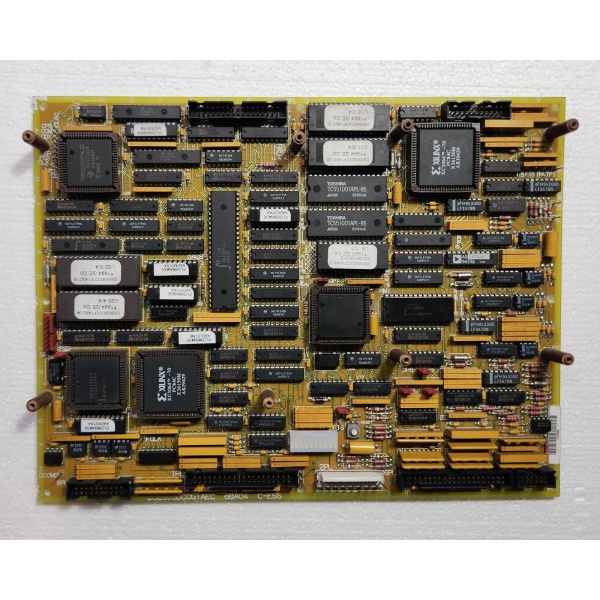
Internally the card is a pulse-transformer array bolted to a 2 kV isolation barrier. Each SCR/GTO gets its own gate winding; the on-board desat comparator watches V<sub> and kills the pulse if the device fails to commutate. An opto-coupler drives the fiber LED—lose the opto and the Mark V throws “Gate FLT” even if the device is fine. No firmware—pure hardware—so you can swap it without reloading parameters; just remember to cap the fiber or the LAN will fault on the first packet
Internally the card is a pulse-transformer array bolted to a 2 kV isolation barrier. Each SCR/GTO gets its own gate winding; the on-board desat comparator watches V<sub> and kills the pulse if the device fails to commutate. An opto-coupler drives the fiber LED—lose the opto and the Mark V throws “Gate FLT” even if the device is fine. No firmware—pure hardware—so you can swap it without reloading parameters; just remember to cap the fiber or the LAN will fault on the first packet
.